An approved finish sample is useful only if everyone can identify it and explain what was approved. Give the physical sample a stable reference, record the product and finish it represents, and connect that record to the current order. Preserve it for the delivery comparison. A photograph labeled “our color” cannot reliably carry all of those decisions by itself.
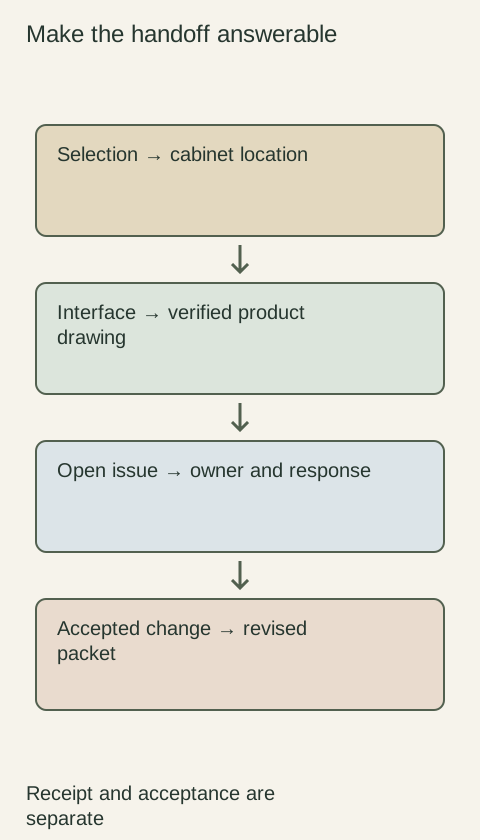
Diagram Apply the same traceable handoff to finish samples: a received sample and an accepted finish are different states.
State the purpose of the sample
A color chip may demonstrate color while leaving door profile, edge treatment and grain variation unresolved. A full door may show those details but still fail to represent the full range of a stained finish. Write what the sample is being used to approve and what needs another reference. Approval should not expand merely because the same object appears in several project photographs.
Identify whether the sample is a candidate, an accepted reference or a superseded option. A showroom sample borrowed for discussion should not become an order authorization without an explicit decision. If the seller uses its own sample number, preserve that number alongside the project reference rather than replacing it with an informal nickname that nobody else can trace.
Build an identity that stays with the object
Record supplier, product family, finish name or code, substrate or wood when relevant, sheen and door style. Include the sample’s received condition and the date of the approval decision. Connect it to the room or component group it covers. A project with different finishes needs a clear mapping between each reference and the pieces to which it applies.
Keep labels on protective packaging or a separate tag unless a finish-safe method has been confirmed. Photograph the face, reverse and identifying label together in a small set of images so the object can be recognized later. Avoid writing on the show face or placing unapproved adhesive on a finish simply to make the documentation look permanent.
Keep photographs as records, not substitute color standards
Benjamin Moore cautions that screen and printed representations can differ from actual paint colors. For cabinet approval, use photographs to record the sample identity, placement and decision context, while retaining the physical reference for appearance comparison. A screenshot is not an exact color target for another supplier.
Store the sample according to its supplier’s handling instructions, protected from jobsite dirt, scratching, moisture and unnecessary exposure. Keep it accessible to the person checking delivery. If a borrowed sample must be returned, agree on another traceable reference before returning it. Do not silently let the only physical comparison disappear and assume a phone album provides the same evidence.
A worked handoff after a finish change
Imagine approving a warm gray sample, then later accepting a cooler gray for the same doors. The installer still has a photograph of the first sample, and the purchasing contact has the newer finish code. Without a clear status record, both may believe they hold the approved selection when the delivery arrives.
Mark the earlier reference as superseded, connect the new sample to the accepted order revision and share the same identity record with the receiving person. Retain the old decision as history without leaving it in the active approval set. The key is not collecting more pictures; it is making the current choice unmistakable across the people handling the order.
Use the reference before installation changes the evidence
At receipt, verify the product labels and compare representative pieces with the accepted sample under relevant, comparable light. Check the characteristics that sample actually approved. A good color match does not answer an unresolved edge detail or a different door profile. Record concerns while packaging labels and part locations can still be connected to the visible items.
Keep the reference through the agreed review period and retain its identity for future service questions. If it becomes scratched or otherwise changes, document that condition instead of continuing to call it an untouched standard. A useful sample record tells a later reader which object was approved, for which parts, in what condition and under which version of the purchase decision.
Pure White
Cream White
Light Warm Gray
Gray
Navy
Black
Oak Tone
Dark Walnut Tone
Design study These finish studies are design references, not a list of currently orderable colors. Screens and lighting change the appearance; compare a physical sample before choosing.See all finish options →
A color name does not identify a finish system. Compare the decorative surface, the core, the edge and the repair method before choosing a cabinet front.
The sample shows the door frame, a separate center panel, the face frame and the cabinet box. Each component has its own place in this Shaker construction.
Shaker construction: door frame, center panel, face frame and cabinet box. The cutaway helps locate these parts; confirm each material in the specifications for the selected cabinet.
01 / Door frame
The Shaker door has rails and stiles around a separate center panel. The frame and center panel are different components; confirm their materials in the specifications for the selected cabinet.
02 / Face frame
The face frame surrounds the opening at the front of the cabinet box and sits behind the doors. The face frame, door frame and cabinet box are separate parts.
03 / Cabinet box
The sample exposes the cabinet sides, interior surfaces and layered edges. The image does not establish the wood species or material specification of a selected cabinet.