What are kitchen cabinets made of? Check the parts behind the finish
A painted door, a wood-grain side and a plywood cabinet box can belong to the same cabinet. Here is how to read those parts, what the sample photos actually show, and which details to put on a quote.
Start with the cabinet box, then the face frame, doors and drawers. A cabinet can use different materials in each of those places. “Solid wood door” does not tell you what the shelves are made of, and a wood-grain surface does not identify the core beneath it. To compare cabinets, ask what each part is made from and how that part is built.
That distinction matters when the room looks finished. The door gives you the color and profile you see every day. The box holds the shelves and hardware. The opening decides whether a wide platter will pass through. A useful specification connects those jobs to named components, rather than giving the whole cabinet a single material label.
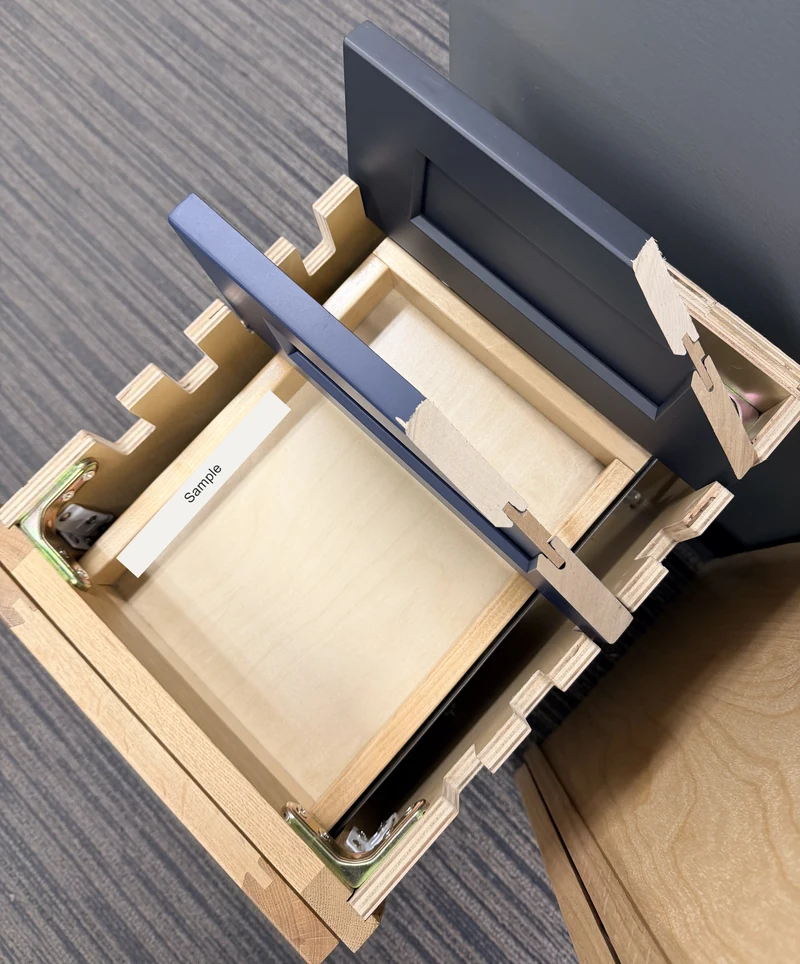
Physical sample The physical sample exposes several separate parts. The painted face, cut core and surrounding box edge should be examined individually; this photograph does not establish their species, material grades or thicknesses.
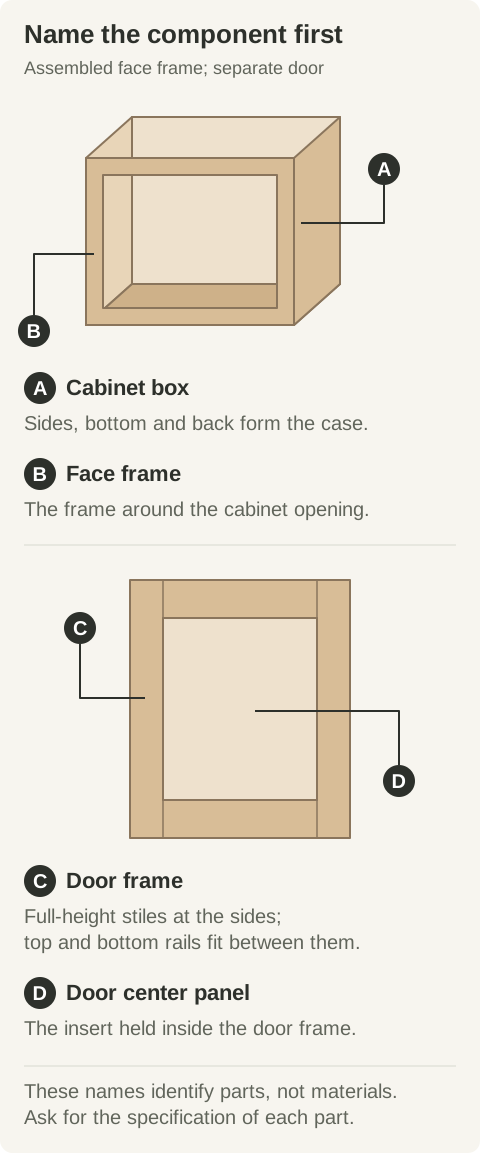
The cabinet box, face frame and door frame are different parts
The cabinet box is the case: its sides, bottom and back, along with the rails or panels used to hold it together. Shelves fit inside it. An exposed end may also have a decorative panel, so the surface visible at the end of a kitchen run is not necessarily the structural side behind it.
On a framed cabinet, the face frame surrounds the front opening of the box. It stays in place when the door opens. The door frame belongs to the moving door: its vertical pieces are called stiles and its horizontal pieces are rails. In a frame-and-panel door, those pieces surround a separate center panel. Some doors use a routed single-piece construction instead, so a Shaker-style outline alone does not tell you how the door was assembled.
Diagram A component map for reading specifications. The geometry is illustrative and does not assign materials or dimensions to the photographed sample.
The same distinction applies to a drawer. The drawer front is the finished piece you pull. The drawer box is the container behind it, including its sides and bottom. A handsome drawer front tells you little about the bottom panel, the corner joints or the runners. Read those lines separately in the construction description.
What solid wood, plywood, particleboard and MDF mean
Solid wood retains the structure and grain of the original timber. It exchanges moisture with the surrounding air, which can change its dimensions. Door construction needs to accommodate that movement, including where the frame and center panel meet.
Plywood is made from thin wood veneers bonded in layers, with grain directions crossing between layers. An exposed edge can reveal that layered construction. The plywood label still leaves questions about panel thickness, core construction, surface veneer and the job the panel is intended to do. A decorative wood veneer is a surface layer; it does not mean the entire panel is solid timber.
MDF, or medium density fiberboard, uses wood fibers bonded into a panel. Its fine, uniform surface can be machined and painted without the grain pattern of solid lumber. It is used for door panels and other shaped components. “Engineered wood” is an umbrella term that includes several kinds of manufactured wood panel, so it should not automatically be read as MDF.
Particleboard uses wood particles bonded with resin under heat and pressure. It is used in cabinet boxes and shelving, often with a decorative surface. Its particles differ from the finer fibers used in MDF. Plywood and particleboard are both established options for the flat panels of a cabinet box; the specification should name which one is used.
A listing may call that decorative surface “melamine” or TFL, short for thermally fused laminate. TFL bonds resin-treated decorative paper directly to a panel, commonly particleboard or MDF. It provides the visible color or pattern; the core beneath it remains a separate specification. Look at the edge treatment as well as the face.
Paint coatings and formed film coverings are other ways to finish a cabinet component. The Composite Panel Association explains each in the links below. These surface terms describe how a component is covered, while plywood, particleboard and MDF describe its underlying construction.
For cabinet boxes and shelves, weight and stiffness are useful starting points. Columbia Forest Products describes its veneer-core panels as lighter and better at spanning a gap than its particleboard and MDF cores. Its particleboard core offers a smooth, uniform surface, but is heavier and more prone to expansion from moisture than the other cores in that guide. Those comparisons concern the listed panel cores, not finished cabinets of every design. For a wide shelf carrying dishes, check its thickness, unsupported span and stated load capacity; for a sink base, examine the protection at edges and plumbing cutouts.
For painted doors, MDF offers a smooth surface and dimensional consistency without a visible wood-grain pattern. A solid-wood frame with an MDF center panel combines a framed-door construction with a stable paintable panel. It still has joints: American Woodmark notes that joint lines can become visible as wood moves in its mixed-material painted doors. If visible natural grain is the priority, solid wood or a wood-veneered panel serves a different purpose. Choose the surface you want, then check whether the door is assembled from separate pieces or routed from a single panel.
For drawer boxes, look at the connection between the front and sides. Dovetails use interlocking pins and tails, giving a wood drawer a mechanical connection at its corners. Conestoga also specifies hardware preparation for its drawer boxes, because the notches and clips must suit the runners. Metal drawer systems take another approach, using formed sides and their own connecting hardware. A wood species or the word “dovetail” does not settle the whole choice: check how the bottom is supported, the usable inside dimensions and the load rating of the complete drawer system.
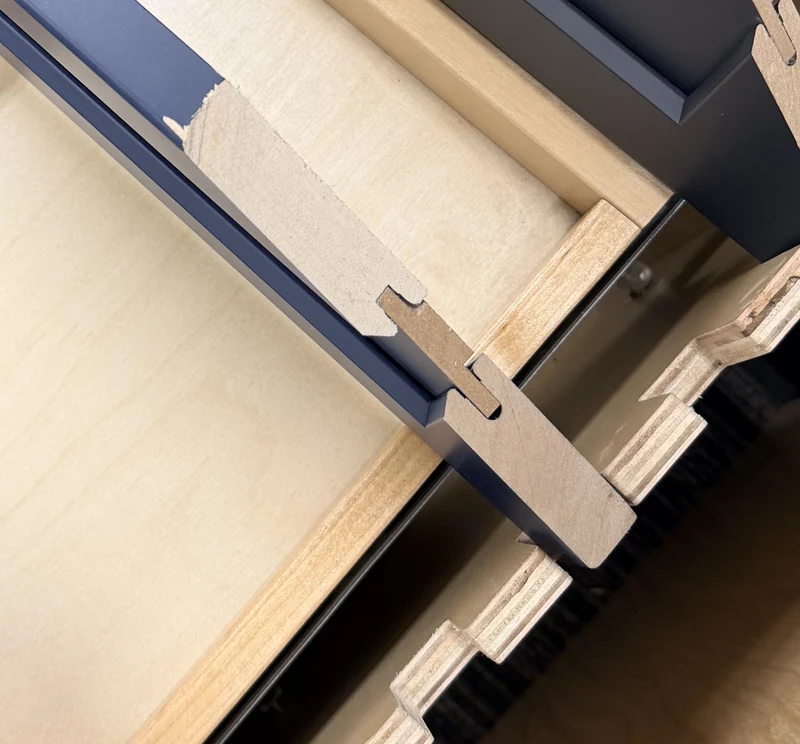
Physical sample The cut exposes the painted component, its joint and the layered edge of the surrounding sample box. The markers locate visible details.
A
The exposed interior of the painted component.
B
A narrow insert engages the neighboring piece at a shaped joint. The cut reveals how separate parts meet.
C
Visible layers on the stepped edge of the surrounding sample box.
The difference between these locations is why a material name belongs to a specific component, not to the whole cabinet.
For a cabinet you intend to order, match the sample to the exact door style and construction sheet. Keep its identification with that sheet so the color choice and material description refer to the same selection. A labeled sample and a component list make it much easier to resolve a vague quote.
Thickness matters, but outside width is not storage width
American Woodmark's construction page shows why standard construction and upgrades should be read together. It lists 1/2-inch engineered-wood sides in its standard construction, followed by a 1/2-inch plywood side option and a 3/4-inch plywood furniture-end option. The page does not identify the standard side panel more specifically in that entry, so “engineered wood” should stay as written. This is a published manufacturer's example, not a usaKT.com product specification. Check which construction option is actually included in the quote.
Frameless construction removes the face frame at the cabinet opening, so comparable frameless cabinets generally offer a less restricted opening and can accommodate wider drawers. That answers the basic storage question. The exact gain still depends on the side thickness, hinge arrangement and drawer system; there is no single extra-width figure that fits every comparison.
For a large serving tray or a towel basket, check the narrowest opening it must pass through, then the space inside. For a drawer organizer, use the inside drawer dimensions and the clearance above it when the drawer closes. An organizer can be narrower than the cabinet's listed width and still fail to fit the actual drawer.
Choose the finish with a sample; choose the construction with a specification
The dark blue painted sample makes the distinction easy to miss: the finish runs across the face while the cuts expose different structures below. A blue finish name is a color description, not a material specification. The same is true of an oak-colored image. Color, grain appearance and construction belong on separate lines in your comparison.
Use a physical sample in the room where the cabinets will go. Compare it with the floor and countertop in the light you actually use. A screen image can help you narrow a direction, but it cannot settle an exact color match. If you are comparing painted and wood-grain fronts, look at the face and edge together rather than judging them from a distant room picture.
Put the component details next to the price
Before comparing quotes, make a short construction list for each selection. Include the box sides, bottom, shelves and back; the face frame if there is one; the door frame and center panel; and the drawer sides, bottom and runners. Write down material and thickness where specified. If the description only says “wood,” leave that line open for a more precise answer.
Then compare like with like. A plywood side panel does not establish a plywood shelf. A solid wood door frame does not establish a solid wood center panel. A full-extension runner does not identify the drawer-box material. Those are separate purchase details, and getting them onto the same quote is how you see what a price difference actually buys.
Compare the actual countertop products, heat-source routine and fabrication proposal. A fired porcelain slab and resin-bound quartz are different materials, but neither label replaces a complete kitchen specification.
Compare a complete tile-and-grout installation with a specified slab surface. The choice changes the wall’s repeated joints, material transitions, care and finished edges.
Granite is a broad commercial name; quartz surfacing is a manufactured product. Choose with the selected slabs, care requirements and complete fabrication in view.
Design references for comparing tones. Screen colors do not replace physical samples; confirm finish availability for the selected cabinet.
Beyond the finish / The construction
Cabinet construction. Made visible.
The sample shows the door frame, a separate center panel, the face frame and the cabinet box. Each component has its own place in this Shaker construction.
Shaker construction: door frame, center panel, face frame and cabinet box. The cutaway helps locate these parts; confirm each material in the specifications for the selected cabinet.
01 / Door frame
The Shaker door has rails and stiles around a separate center panel. The frame and center panel are different components; confirm their materials in the specifications for the selected cabinet.
02 / Face frame
The face frame surrounds the opening at the front of the cabinet box and sits behind the doors. The face frame, door frame and cabinet box are separate parts.
03 / Cabinet box
The sample exposes the cabinet sides, interior surfaces and layered edges. The image does not establish the wood species or material specification of a selected cabinet.