Before choosing a dark cabinet finish, check how the complete door will look between cleanings and how easily you can restore the appearance you want. Concentrate on exposed ledges, grasping edges and the areas around pulls. Dark color is not a cleaning specification: the surface material, texture, profile and care instructions determine what you can safely do with it.
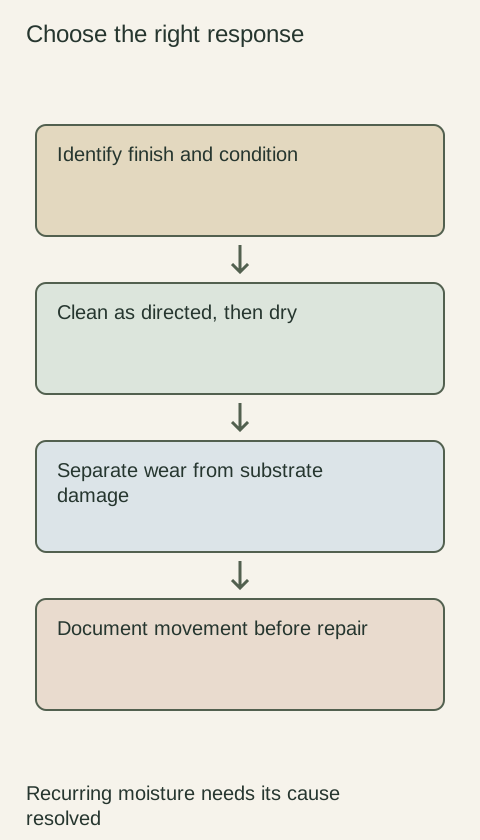
Diagram The diagram separates routine cleaning from conditions needing assessment. It does not assign a cleaning frequency or chemical to dark colors.
Separate visible dust from a difficult-to-clean surface
Ask yourself what you are noticing on the sample. A light particle that stands out against the color is different from a greasy contact mark, a dried splash or a scratch. Greater visibility does not automatically mean the surface attracts more dirt. Equally, a mark that is hard to see at first may still require prompt attention under the product’s care instructions.
Inspect a representative finished door, including the lower inside edge of its frame, rather than a freshly polished flat chip alone. Look under the light that will normally reach the cabinetry. Do not scatter flour or abrasive dust on a showroom sample to create a test. Ordinary existing dust and normal handling, with the owner’s permission, provide useful observations without contaminating the finish.
Map the places your routine will need to reach
Imagine the path of a cleaning cloth around the actual pull, through the inside profile and along the exposed bottom edge. A broad flat face and a narrow ledge are different cleaning tasks. Check whether a finger can guide the approved soft cloth into the detail without catching on hardware or pressing hard against a sharp transition.
Consider who will clean these areas and what appearance they expect between cleanings. Someone content with occasional visible dust may enjoy the finish that another person would wipe repeatedly. There is no honest universal cleaning interval for a color. Review the household’s actual use and the specific surface, rather than accepting a promise that every dark cabinet needs daily care.
Try the prescribed cleanup, not a stronger shortcut
KraftMaid’s care guidance emphasizes gentle cleaning, prompt attention to spills and thorough drying for its cabinetry. The broader buying lesson is to obtain the instructions for the exact finish you are considering. Do not transfer another manufacturer’s cleaner recommendation simply because both products are dark.
On a suitable sample and with permission, observe an approved cleaning demonstration. Check it after drying: is the original appearance restored, do streaks remain, and can you reach the corners comfortably? If a mark persists, ask for an assessment. Increasing pressure, adding polish or trying a stronger household chemical may alter the surface rather than solve an ordinary maintenance task.
A worked choice between color and profile
Imagine liking a charcoal finish on both a flat door and a framed door. The framed version has the character you prefer, but pale dust is noticeable on its inner ledge. The flat version has less ledge detail, yet hand marks remain visible around the opening area. Neither sample is completely free of maintenance.
Compare the approved cleaning effort and decide which type of upkeep bothers you less. You might keep the framed door because you value its appearance, choose the simpler profile, or reconsider the color after seeing the full sample. Do not choose from a photograph in which every surface has just been prepared for display and assume that is the permanent everyday condition.
Define the expectation before accepting the order
Save the exact finish, profile, care instructions and approved sample identity. If a seller describes the surface as fingerprint resistant or easy to clean, ask which product feature and care conditions that statement covers. Resistance is not permission to ignore spills or use any cleaner, and it does not describe every dark finish in the same catalog.
At receipt, inspect clean, dry surfaces and document any existing marks before routine use. Later, distinguish removable residue from changes that remain after the prescribed care. Photograph persistent concerns without trying repeated repairs. A dark finish is a sound choice when its actual appearance and manageable care fit your preferences, not because it has been assigned a blanket label of either impractical or maintenance-free.
Pure White
Cream White
Light Warm Gray
Gray
Navy
Black
Oak Tone
Dark Walnut Tone
Design study These finish studies are design references, not a list of currently orderable colors. Screens and lighting change the appearance; compare a physical sample before choosing.See all finish options →
A color name does not identify a finish system. Compare the decorative surface, the core, the edge and the repair method before choosing a cabinet front.
The sample shows the door frame, a separate center panel, the face frame and the cabinet box. Each component has its own place in this Shaker construction.
Shaker construction: door frame, center panel, face frame and cabinet box. The cutaway helps locate these parts; confirm each material in the specifications for the selected cabinet.
01 / Door frame
The Shaker door has rails and stiles around a separate center panel. The frame and center panel are different components; confirm their materials in the specifications for the selected cabinet.
02 / Face frame
The face frame surrounds the opening at the front of the cabinet box and sits behind the doors. The face frame, door frame and cabinet box are separate parts.
03 / Cabinet box
The sample exposes the cabinet sides, interior surfaces and layered edges. The image does not establish the wood species or material specification of a selected cabinet.