Test the closed end of a galley with the objects you need to turn
Being able to walk to the end does not prove you can retrieve a tray, turn and return. Check the carried object, the person and the open fronts together.
At the closed end of a galley, test the complete journey in, the task performed there and the return to the entrance. The person cannot simply continue out through the far end. A cabinet may be reachable while the object taken from it is difficult to turn or carry back. Treat the end as a working and turning position, not as leftover floor area that automatically becomes useful storage.
Identify what brings someone to the closed end
List the items stored there and the equipment operated there. A shallow utensil drawer creates a different task from retrieving a wide tray or opening a deep appliance door. Identify the representative object and how it is held during normal use. The clearance relevant to that object may be above the counter, beside a handle or below an upper cabinet, rather than at the floor line shown on the plan.
Record whether the person carries something on the way in, on the way out or both. Also note where it can be set down while a cabinet is opened. A return that works only after placing the object on the floor or moving an unrelated appliance may not match the intended routine. Include any other person who regularly uses the same end at that time.
Draw the obstacles at the height of the carried item
Measure between the relevant finished projections, including handles and open fronts where they intersect the task. The clear width between cabinet boxes does not describe every higher or lower level. Use the selected appliance’s actual door movement and the cabinet’s actual opening. Keep the closed-end wall in the sketch so that turning cannot accidentally borrow space beyond it.
ABCD
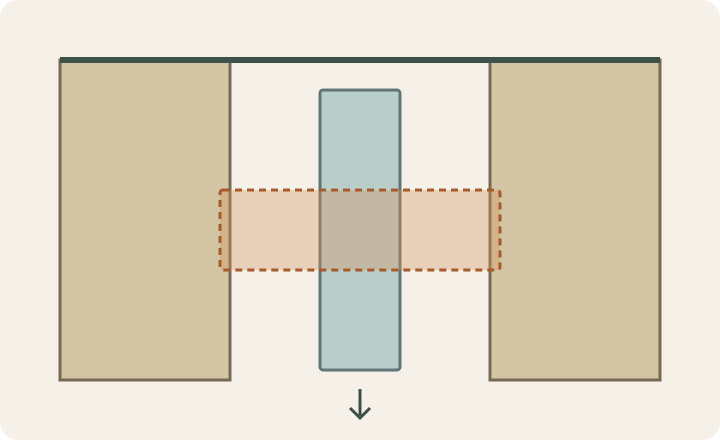
Diagram The outlines compare orientations of a hypothetical rigid tray at the checked height. They do not include a person or prescribe an aisle size. The arrow shows the return toward the only open end.
A
Closed end of the galley.
B
Tray aligned along the passage.
C
Crosswise tray outline passes into a side obstruction.
D
Return direction toward the open end.
A narrow approach can still fail at the turn
In a hypothetical check, the obstruction-to-obstruction width at the tray’s height is 26 inches. A rigid tray is 28 inches long and 8 inches wide. It fits lengthwise with 8 inches across the passage, but a level crosswise position needs 28 inches and exceeds the available width by 2 inches. This comparison alone does not model the person, hands or intermediate rotation. It is not an aisle standard; it explains why successful entry does not prove a successful turn.
If a different orientation is proposed, test the whole movement with an appropriate empty representative object. Do not assume that lifting, tilting or turning diagonally will be practical with the intended contents. The available width may change with height, but the person also needs a usable grip and a destination. A shape that can mathematically be maneuvered through a gap is not automatically a comfortable daily task.
Combine the end task with the fronts that must be open
Open the relevant drawer or door and occupy the actual standing position. Check how the item leaves storage and how the front is closed again. A deep drawer may fill the very area intended for turning. If an appliance door opens into the route, include its operating state rather than testing only a parked position. Identify whether another person would be trapped beyond the open front during ordinary use.
An item stored upright may need to rise out of a divider before it can turn. Check that extraction separately from the movement in the passage: the object can meet an overhanging counter or the cabinet opening before it ever reaches the turning position. Record both stages instead of assuming that a fully opened drawer guarantees access to everything inside.
Choose end storage according to the completed movement
If a bulky item cannot be retrieved and turned conveniently, compare a more accessible home for that item before adding mechanisms or assuming a wider cabinet will help. The end may suit smaller frequently used objects, or it may need to remain available for the task beside it. Evaluate the actual storage access of any alternative; shifting the problem to a different blind corner is not a solution.
Keep a sketch of the end wall, relevant projections, open fronts, standing position and carried object orientations. Mark the usable setting-down point and the return route. Test the arrangement with the intended user before accepting the cabinet assignment. The decision should demonstrate a complete trip out of the galley, not just a photograph of someone reaching the final cabinet.
Pure White
Cream White
Light Warm Gray
Gray
Navy
Black
Oak Tone
Dark Walnut Tone
Design study These finish studies are design references, not a list of currently orderable colors. Screens and lighting change the appearance; compare a physical sample before choosing.See all finish options →
A taller cabinet can add storage while removing the only continuous work area. Check the meal-preparation task before allocating the remaining wall length.
Identify who passes through and why, then test the route while the kitchen is operating. Closed cabinet fronts conceal the most useful traffic questions.
The sample shows the door frame, a separate center panel, the face frame and the cabinet box. Each component has its own place in this Shaker construction.
Shaker construction: door frame, center panel, face frame and cabinet box. The cutaway helps locate these parts; confirm each material in the specifications for the selected cabinet.
01 / Door frame
The Shaker door has rails and stiles around a separate center panel. The frame and center panel are different components; confirm their materials in the specifications for the selected cabinet.
02 / Face frame
The face frame surrounds the opening at the front of the cabinet box and sits behind the doors. The face frame, door frame and cabinet box are separate parts.
03 / Cabinet box
The sample exposes the cabinet sides, interior surfaces and layered edges. The image does not establish the wood species or material specification of a selected cabinet.