Custom hood cabinet or finished hood: compare the shell, insert and liner separately
A decorative hood shell is not a working ventilation appliance. Separate the furniture, powered insert and liner so a low insert price does not become an incomplete kitchen budget.
A hood-shaped cabinet is only one part of the purchase
A custom wood surround can match the cabinets, but the decorative shell does not itself move air. It needs the selected ventilation equipment and compatible enclosure details. A finished under-cabinet hood instead supplies its own visible appliance housing. Compare these complete arrangements, not a bare insert price against a complete hood price.
Zephyr describes Twister as an insert concealed beneath a custom enclosure and offers a separate optional adjustable-depth liner. The insert and liner are therefore different items. A liner finishes and protects the surrounding underside; it is not another name for the powered ventilation unit.
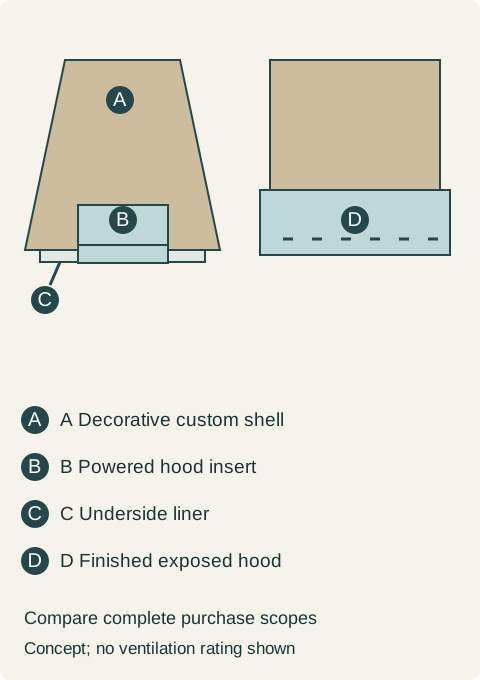
In the custom arrangement, the opening exposes the insert's underside while a liner can finish the surrounding area. The outer shell controls the furniture appearance. Its apron, depth and internal shape must accommodate the selected equipment and its documented access; adding a wider wood surround does not automatically enlarge the insert's capture area.
Zephyr's cited under-cabinet manual describes a hood mounted beneath a kitchen cabinet. This is a finished appliance arrangement with its own housing, not a request to construct a decorative enclosure around an insert. The applicable cabinet attachment and duct openings still need coordination.
Teaching example Conceptual assembly comparison: the left custom shell surrounds a powered insert and an underside liner; the right finished hood has its own exposed housing below a cabinet. These are purchasing components, not a mounting or airflow design.
Put missing components back into the comparison
Consider hypothetical comparison allowances, not market prices: an insert at $450, a liner at $100, a decorative shell at $600 and additional shell-related fitting at $150 total $1300. A finished hood option at $700 with its corresponding fitting included is $600 lower on this limited comparison. Shared duct and electrical work are excluded equally; any actual differences in those services must be added before calling either figure a final installed price.
The household in that example does not need a cabinet-matching surround and selects the finished option, preserving the allowance for useful storage elsewhere. Another household may value the custom exterior enough to accept the added scope. Neither conclusion establishes which appliance has adequate ventilation performance for the cooking equipment.
Do not add a liner automatically just because one exists in the catalog. Some products combine functions or use different enclosure details. Identify exactly what the selected insert includes, what the maker specifies and what the cabinet quote supplies. An optional accessory is neither universally required nor universally dispensable.
Keep the furniture decision separate from ventilation selection
Compare the proposed arrangements only after the ventilation design is appropriate for the actual cooking appliance and installation. The decorative shell, duct route, power, maintenance access and final trim must then be included in the respective scope. Keep the exact equipment references attached to the cabinet drawing.
The useful buying distinction is whether you want a finished appliance face or a separately built furniture surround. Once that is clear, the quote can show all the components needed to create it, instead of concealing a second purchase behind the word hood.
Pure White
Cream White
Light Warm Gray
Gray
Navy
Black
Oak Tone
Dark Walnut Tone
Design study These finish studies are design references, not a list of currently orderable colors. Screens and lighting change the appearance; compare a physical sample before choosing.See all finish options →
Design around the actual insert and the tasks that remain after installation. A component can fit inside the enclosure yet lack the movement needed for cleaning or service.
A duct centerline does not describe the space occupied by connectors, bends and installation access. Draw the complete verified route, then decide what storage remains usable.
Looking for kitchen cabinet prices? Prepare your cabinet types, sizes, quantities and finish preferences, then contact usaKT.com for a project quote. Freight is separate.
The sample shows the door frame, a separate center panel, the face frame and the cabinet box. Each component has its own place in this Shaker construction.
Shaker construction: door frame, center panel, face frame and cabinet box. The cutaway helps locate these parts; confirm each material in the specifications for the selected cabinet.
01 / Door frame
The Shaker door has rails and stiles around a separate center panel. The frame and center panel are different components; confirm their materials in the specifications for the selected cabinet.
02 / Face frame
The face frame surrounds the opening at the front of the cabinet box and sits behind the doors. The face frame, door frame and cabinet box are separate parts.
03 / Cabinet box
The sample exposes the cabinet sides, interior surfaces and layered edges. The image does not establish the wood species or material specification of a selected cabinet.