Receiving cabinets is a project task with a beginning and an end. Prepare before the truck arrives, compare the shipment with the accepted order and record what you actually inspect. A signed delivery document and a complete cabinet inspection are not necessarily the same event. Use the seller’s and carrier’s actual procedures, including their stated reporting requirements, without assuming a universal deadline.
Have the right record at the receiving point
Keep the accepted cabinet schedule, packing list when provided, delivery instructions and contact route available to the receiver. Mark partial shipments so the team knows which items are expected now. KraftMaid’s inspection guide recommends reviewing the delivered cabinets promptly; the useful principle is to arrange inspection rather than assuming someone else will do it. Assign enough competent help and a protected inspection area. Do not organize heavy-carton handling around a receiver who has no suitable assistance or equipment.
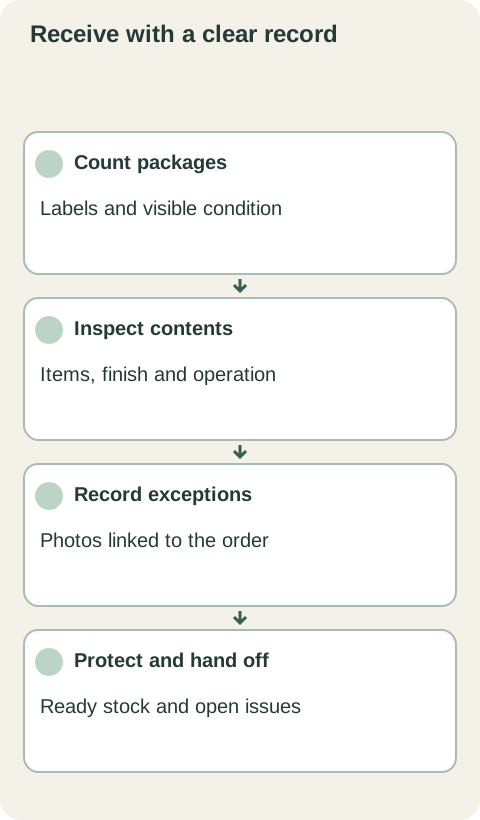
Compare the packages and labels with the shipping paperwork. Record missing packages, crushed corners, wet cartons or other visible exceptions accurately. Take an overall photo and closer images that show the label and condition together. Follow the actual receiving instructions for annotations or immediate contact when something is wrong. Storage preparation also matters: KraftMaid describes a dry, covered, secure environment for its products. Prepare the applicable conditions for your selected cabinets rather than leaving the shipment outside while you investigate.
Diagram Preserve product identity through inspection and any later response.
Inspect contents without losing identity
Open cartons carefully so tools and handling do not create damage. Keep each product linked to its carton label and cabinet position. Check the supplied items, finish identification and visible condition, and operate accessible doors and drawers safely. Include small hardware packages, shelves, panels and trim in the reconciliation. KraftMaid’s FAQ illustrates how order information assists identification of its products; maintain the same kind of traceable link for your chosen supplier. Do not mix unlabeled parts from several cartons into one pile.
Separate missing, damaged, wrong and not-yet-shipped items. For a damage report, provide the order identifier, SKU or cabinet position, label photo, overall view and useful detail. Describe what you observed rather than guessing the cause. Ask which next action is authorized and preserve the answer. Avoid installing, altering, discarding or repairing an affected item before understanding the applicable process. A receiving report is a request for resolution, not proof that a replacement or reimbursement has been approved.
Protect inspected cabinets until installation
Follow the selected manufacturer’s storage instructions. Keep cabinets dry, secure and protected from ongoing wet work and handling damage. Preserve packaging for protection and for the applicable issue process, while keeping labels readable. Arrange access so the installer can find the required items without repeatedly moving everything. Do not improvise stacks that could damage cabinets or become unstable. Track a damaged piece separately from ready-to-install stock and keep any replacement request tied to the original item.
Close the receiving list and hand it over
Mark inspected items as usable, pending review or missing, and list the remaining shipment balance. Share the current record with the installer before scheduling work that depends on it. Keep photos, documents and response history together. If a replacement is approved, record what will arrive and reconcile it when received; do not close the item merely because a request was sent. The completed receiving file should explain what arrived, what condition was checked and which issues still require action.
Make the photographs usable for a response
Keep the order label readable and connect a close-up to a wider view of the same piece. Include the cabinet position in your notes so the seller can relate the report to the schedule. If no product damage is visible, describe the carton condition without converting it into a product-damage claim. Avoid editing photos in a way that removes the location or condition context. Send the requested files through the agreed channel and keep copies with the response. This allows later handling and inspection to be distinguished from the condition first recorded at receipt.
Before you release the order
Have the current order and expected shipment list ready.
Connect photos and exceptions to package labels.
Separate damage, shortages, wrong items and later releases.
Protect inspected stock and hand open issues to the installer.
Finish references
Pure White
Cream White
Light Warm Gray
Gray
Navy
Black
Oak Tone
Dark Walnut Tone
Design study These finish studies are design references, not a list of currently orderable colors. Screens and lighting change the appearance; compare a physical sample before choosing.See all finish options →
The sample shows the door frame, a separate center panel, the face frame and the cabinet box. Each component has its own place in this Shaker construction.
Shaker construction: door frame, center panel, face frame and cabinet box. The cutaway helps locate these parts; confirm each material in the specifications for the selected cabinet.
01 / Door frame
The Shaker door has rails and stiles around a separate center panel. The frame and center panel are different components; confirm their materials in the specifications for the selected cabinet.
02 / Face frame
The face frame surrounds the opening at the front of the cabinet box and sits behind the doors. The face frame, door frame and cabinet box are separate parts.
03 / Cabinet box
The sample exposes the cabinet sides, interior surfaces and layered edges. The image does not establish the wood species or material specification of a selected cabinet.