usaKT.com offers nationwide delivery. For a particular order, the destination and handling still need to be defined. Shipping to a city does not describe where the driver will stop, who unloads or how cabinets reach the room. Give the seller a site-access brief before accepting freight terms. It should describe the actual property and the services the receiving team needs.
Start with destination and receiving identity
Supply the full destination address, ZIP code, location type and receiving contact. Note whether the order goes directly to a home, a job site, a warehouse or another agreed receiving point. Ask which carrier and service are being quoted when that information is available. FedEx Freight publishes distinct service levels, showing why delivery scope must be named rather than inferred from the word freight. This is a carrier example, not a statement that it carries usaKT.com orders.
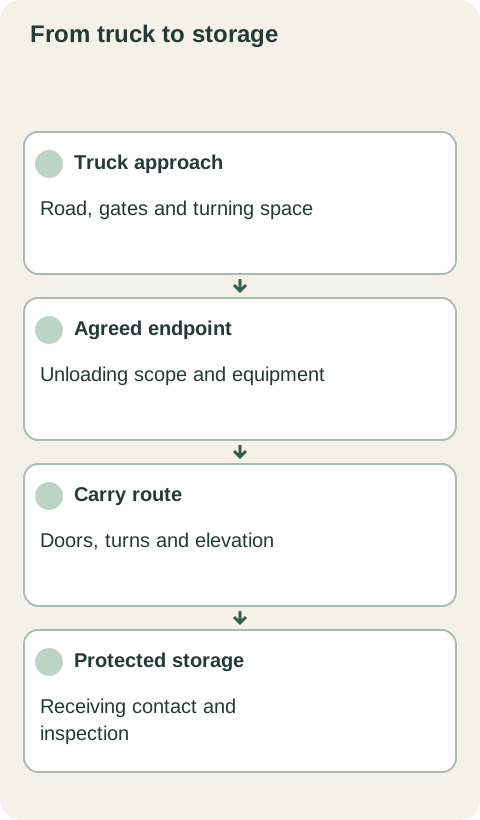
Record gates, road surface, steep approaches, low branches, parking constraints and places a truck cannot turn. Photograph the route where words may be ambiguous. A narrow driveway that a car uses may not describe a usable truck approach. Discuss possible receiving points with the seller or carrier rather than asking the driver to improvise on arrival. KraftMaid’s delivery-preparation guide also calls attention to access and protected storage; apply the planning discipline while confirming the actual service for this order.
Diagram The delivery endpoint must be agreed; inside carry is a separate scope question.
Separate unloading equipment from inside carry
If the site has no dock or unloading equipment, describe that fact and ask what service is needed. A liftgate, if included or purchased, concerns lowering freight from the truck; it does not by itself define carry through a building. Write down the agreed endpoint and the people or equipment responsible after that point. Use the actual cabinet packaging information to plan handling. Do not assume the driver will assemble, install, remove debris or take cabinets upstairs unless those services are explicitly arranged.
Check the route with boxed dimensions
Obtain shipping dimensions and weights for the actual order where available. Check doors, corridors, turns, stairs and elevator access along the route to storage, including shared-area arrangements. A room plan alone does not show whether a packaged tall cabinet can make a turn. The manufacturer’s measuring workflow helps organize room information, but delivery needs its own route record. Arrange competent handling for heavy or awkward cartons rather than planning a maneuver that depends on one person taking an unsafe lift.
Coordinate an appointment and a protected drop zone
Confirm how the appointment will be made and who can respond if conditions change. Prepare a dry, secure area suitable for the cabinet manufacturer’s storage instructions and keep the inspection route clear. If building management controls access, coordinate its arrangements before accepting a date. Ask about the actual process and charges for a missed appointment, storage or repeat delivery if relevant; have any relevant charges confirmed in writing before accepting the arrangement. Keep unloading and inspection responsibilities visible so a delivery does not become an unattended pile of cartons.
Keep delivery scope with the receiving file
Save the accepted freight description, endpoint, access notes, contact information and order packing list together. When the shipment is confirmed, verify that the current address and services match what was quoted. At arrival, record package counts and exceptions, then complete the seller’s receiving procedure. If an access condition changes before delivery, report it rather than assuming the original quote covers the new situation. A workable national shipment ends in an organized local receiving plan, with responsibility clear at every handoff.
Give the receiving crew a route brief
Prepare a simple marked route showing the agreed drop point, temporary protection, turns and storage area. Share current access photos and the shipment information with the people performing onward handling. Check that the selected route will still be open when other trades are working. If the property cannot accept the planned shipment, discuss an alternate before dispatch and obtain the revised scope and charges. An alternate warehouse is useful only when receiving, storage and later transportation have all been arranged; changing the address does not eliminate those tasks.
Before you release the order
Provide the actual destination and access conditions.
Confirm unloading, endpoint and onward handling separately.
Check the route using packaged cabinet information.
Save appointment and receiving responsibilities with the order.
Finish references
Pure White
Cream White
Light Warm Gray
Gray
Navy
Black
Oak Tone
Dark Walnut Tone
Design study These finish studies are design references, not a list of currently orderable colors. Screens and lighting change the appearance; compare a physical sample before choosing.See all finish options →
The sample shows the door frame, a separate center panel, the face frame and the cabinet box. Each component has its own place in this Shaker construction.
Shaker construction: door frame, center panel, face frame and cabinet box. The cutaway helps locate these parts; confirm each material in the specifications for the selected cabinet.
01 / Door frame
The Shaker door has rails and stiles around a separate center panel. The frame and center panel are different components; confirm their materials in the specifications for the selected cabinet.
02 / Face frame
The face frame surrounds the opening at the front of the cabinet box and sits behind the doors. The face frame, door frame and cabinet box are separate parts.
03 / Cabinet box
The sample exposes the cabinet sides, interior surfaces and layered edges. The image does not establish the wood species or material specification of a selected cabinet.