Receiving the expected number of cabinet cartons does not establish that every ordered component is present. Cartons are packaging; the purchase describes products and quantities that may be grouped differently inside them. Keep the outer-package check separate from the component reconciliation, then connect them with labels and packing information. This gives a useful answer to what arrived and what still needs to be identified or checked.
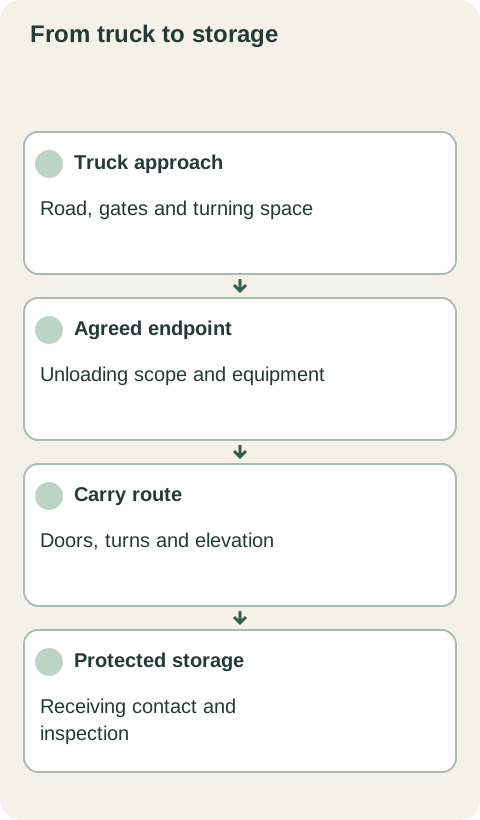
Diagram The delivery handoff begins the package record; item-level reconciliation still needs labels, packing information and the actual contents.
Find out how products map to packages
Use the current order and the packing information for this shipment, including any known separate deliveries. KraftMaid explains that a carton can contain multiple items and carry multiple labels. Its example shows why a box count cannot simply be substituted for an item count; confirm the actual packing arrangement for the supplier and order you are receiving.
Identify whether the packing list describes cartons, assembled cabinets, kits or separate components. If its unit is unclear, ask before treating the totals as comparable. An order line for a complete product and a packing entry for a carton may refer to overlapping information without representing the same counting unit. Write the relationship down rather than forcing the totals to match.
Record what was received and what remains unchecked
As packages are received, connect their readable labels to the shipment record and note which expected package identities are present. Keep observed exterior condition separate from the contents check. A label can help identify the intended contents, but it is not a substitute for verifying what is actually inside when the package is opened appropriately.
Use clear status descriptions such as carton received, contents awaiting check and components reconciled. This is especially useful when someone else will unpack the order. A simple tick beside a cabinet name can otherwise mean box seen to the receiver and all parts verified to the installer. Record the stage reached so the next person knows what remains to do.
Check components without losing their package identity
During organized unpacking, compare the actual items with the relevant packing entry and accepted order. Retain the link between contents and carton label until the check is complete. Keep associated hardware and separately packed accessories identifiable, and avoid mixing similar loose components from different cabinets before their intended use is established.
Imagine all expected cartons are present, but a box containing decorative trim and hardware has not been checked internally. Marking the order complete based on carton count would hide that uncertainty. Reconcile the listed contents of that mixed box, then record the result against the affected order lines. Extra pieces in another carton do not automatically offset a missing component with a different identity.
Investigate an unmatched item before assigning a cause
When something is missing from the check, distinguish not yet found from confirmed absent in a verified package. Review whether the item is included within another documented kit, packed with other components or assigned to a separate shipment. Ask the supplier to explain any unclear mapping. Do not assume an unlocated part is backordered or that the carrier lost it.
For an unexpected item, preserve its label and record what it appears to be without treating it as an accepted substitution. Compare identity, finish and quantity with the current order. The same number of boxes can still contain the wrong configuration. Send the supplier the precise mismatch and relevant package information so the inquiry concerns a specific item rather than an unexplained total difference.
Hand over an item-level result to the next person
Summarize the components confirmed present, the items still awaiting a check and the discrepancies sent for clarification. Keep separate-shipment information attached to the affected lines. Tell the installer which unresolved item may affect planned work; avoid a general all here statement while part of the purchase remains unverified or unidentified.
Preserve the necessary labels and packaging information while a discrepancy is being resolved, following the applicable seller or carrier instructions. Update the record when an item is located or a later shipment arrives, without counting the original entry again. This reconciliation does not determine condition or fit by quantity alone. It establishes a reliable inventory of the supplied components before the project depends on them.
Pure White
Cream White
Light Warm Gray
Gray
Navy
Black
Oak Tone
Dark Walnut Tone
Design study These finish studies are design references, not a list of currently orderable colors. Screens and lighting change the appearance; compare a physical sample before choosing.See all finish options →
The sample shows the door frame, a separate center panel, the face frame and the cabinet box. Each component has its own place in this Shaker construction.
Shaker construction: door frame, center panel, face frame and cabinet box. The cutaway helps locate these parts; confirm each material in the specifications for the selected cabinet.
01 / Door frame
The Shaker door has rails and stiles around a separate center panel. The frame and center panel are different components; confirm their materials in the specifications for the selected cabinet.
02 / Face frame
The face frame surrounds the opening at the front of the cabinet box and sits behind the doors. The face frame, door frame and cabinet box are separate parts.
03 / Cabinet box
The sample exposes the cabinet sides, interior surfaces and layered edges. The image does not establish the wood species or material specification of a selected cabinet.