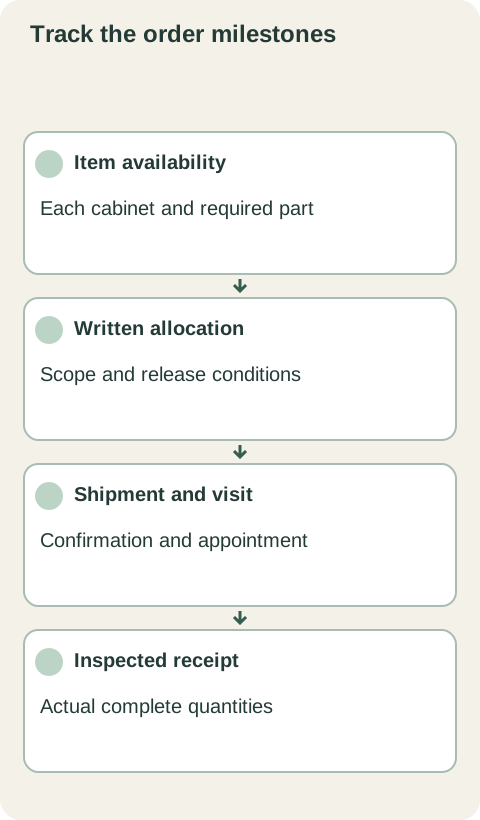
Available, reserved, shipped and delivered describe different points in a cabinet order. A finish appearing on a page does not show whether every cabinet in your plan is ready. Ask about the complete item list and record exactly which milestone has been confirmed. This keeps a planning estimate from becoming an installation promise that the supply record cannot support.
Check availability against the actual cabinet list
Use the current schedule, including panels, fillers, trim and accessories. Ask which items are available, which are expected and which need another selection. KraftMaid’s FAQ describes milestones for its own ordering process; it does not establish inventory or lead times for usaKT.com. Get order-specific answers rather than importing another manufacturer’s schedule. If a cabinet is offered as an alternate, review its drawing and effect on neighboring items before accepting it. A matching finish name alone does not make it equivalent.
If the seller offers allocation or a hold, request the written arrangement. Identify the covered SKUs, quantities, order revision, release conditions and any stated expiration or storage terms. Distinguish a quote from a confirmed allocation. Also consider where cabinets will be kept if the site is not ready. KraftMaid’s delivery-preparation guidance emphasizes protected storage for its products; your own order needs an agreed plan. Do not assume payment alone creates an indefinite hold or a guaranteed delivery slot.
Diagram Move the schedule forward only when the relevant milestone is confirmed.
Separate readiness, shipment and appointment
Record the requested site date, the seller’s current readiness estimate, shipment confirmation and the carrier appointment separately. Ask what event is needed to move from one to the next. If the order is incomplete, clarify whether the proposed date covers all items or a partial shipment. KraftMaid’s inspection guide is a reminder that arrival must still be followed by checking. A truck arriving does not mean the room is ready to install if essential items are missing or damaged.
A partial shipment can put useful items on site while other items remain outstanding, but it also creates receiving and storage work. Identify exactly what would ship and what installation can proceed without the remainder. Discuss additional freight or handling only from actual quoted terms. A missing finishing piece and a missing cabinet can affect the project differently. Have the installer review the proposed split before agreeing, and preserve the unresolved balance on the order record.
Update the plan when the facts change
When a date changes, note who provided it, which items it covers and whether it is an estimate or confirmation. Inform the receiving contact and installer using the updated status. If an appliance or cabinet selection changes, ask whether the earlier availability answer still applies. Do not transfer a confirmed date from one revision to another without checking. Keep site readiness visible too: a delivery appointment cannot solve wet work, blocked access or lack of protected storage.
Release only against a usable receiving plan
Before shipment, reconcile the release list with the accepted cabinet schedule and receiving instructions. Confirm the contact, destination, delivery endpoint and handling arrangements. Preserve any remaining items as open lines, with a follow-up owner and the latest status. After receipt, convert the record from expected quantities to actual inspected quantities. The installation plan should rely on the pieces checked on site and the work the team can perform, rather than a generic availability badge.
Keep a status line for every remaining item
An open-item list should show the cabinet position, expected quantity, current status, latest response and person following up. Review the items that affect the next installation task first. Do not give a replacement an expected arrival date merely by copying the original order’s schedule. If the seller cannot yet confirm a date, record the next information needed and keep that uncertainty in the work plan. Once the item arrives, match its identity and condition before closing the line. The list should get smaller through verified receipt, not by deleting inconvenient questions.
Before you release the order
Check every required item, not only the door style.
Record reservation conditions and covered quantities.
Separate estimates, shipment notices and appointments.
Use inspected on-site quantities to update installation planning.
Finish references
Pure White
Cream White
Light Warm Gray
Gray
Navy
Black
Oak Tone
Dark Walnut Tone
Design study These finish studies are design references, not a list of currently orderable colors. Screens and lighting change the appearance; compare a physical sample before choosing.See all finish options →
The sample shows the door frame, a separate center panel, the face frame and the cabinet box. Each component has its own place in this Shaker construction.
Shaker construction: door frame, center panel, face frame and cabinet box. The cutaway helps locate these parts; confirm each material in the specifications for the selected cabinet.
01 / Door frame
The Shaker door has rails and stiles around a separate center panel. The frame and center panel are different components; confirm their materials in the specifications for the selected cabinet.
02 / Face frame
The face frame surrounds the opening at the front of the cabinet box and sits behind the doors. The face frame, door frame and cabinet box are separate parts.
03 / Cabinet box
The sample exposes the cabinet sides, interior surfaces and layered edges. The image does not establish the wood species or material specification of a selected cabinet.