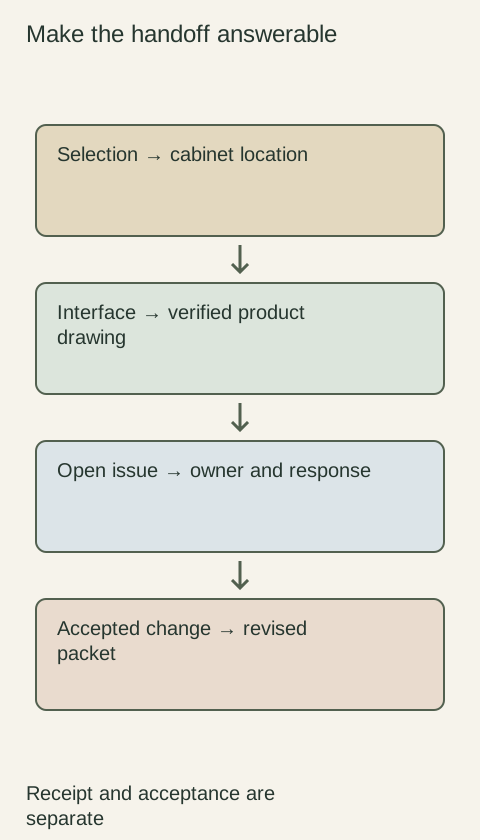
Before the installation crew starts, complete a product inventory that goes beyond the delivery driver's package count. Match the actual cabinets and related parts to the accepted order, record what has been checked and identify unresolved items. The resulting record should tell the installer what is physically available and where questions remain. A single received checkbox is not enough when a carton has arrived but its contents, condition or companion parts have not yet been reviewed.
Diagram An installation handoff needs the checked product inventory and its unresolved items, not only the delivery carton count.
Start from the order that will actually be installed
Use the accepted cabinet list and drawing, including confirmed revisions. Keep removed or replaced lines distinguishable from current requirements so an old selection is not reported as missing. Include separately ordered fronts, panels, hardware and other components that belong to the installation scope. Ask the seller to clarify any item description that cannot be connected to the product in front of you.
Separate the supplier's item reference from the project position and note both where useful. A repeated model may belong in several places, while similar-looking cabinets may have different configurations. The inventory should preserve those distinctions. Do not assign a carton to an empty position simply because its dimensions or appearance seem close to what the drawing shows.
Record the actual inspection, not an assumed result
Arrange the inspection with appropriate people and enough access to the products. KraftMaid recommends inspecting the full order shortly after arrival and protecting the cabinets again afterward. That supports checking before work proceeds; follow the actual supplier's instructions for your products and reporting process rather than assuming another manufacturer's procedure applies in full.
For each item, distinguish identified at the package level, contents reviewed and any condition needing attention. Record what was not inspected as well as what was. A sealed carton can be present without its contents having been confirmed. Do not convert a limited inspection into a statement that every surface and component is satisfactory, or use adjustments and touch-up work to make unresolved observations disappear from the record.
Reconcile the pieces that make each unit usable
Check related packages and supplied component lists so the cabinet assembly is not counted as complete while its required front or fitting remains unlocated. Identify shared accessory cartons and the items they contain for the relevant units. Distinguish included parts, separately purchased items and materials the installer must select for the actual application; clarify uncertain scope with the seller and installer.
Keep the associated instructions and product information available with the inventory. An unidentified hardware bag is not useful simply because it is physically present. Ask for the connection to the intended product instead of sorting by visual similarity. Where the contents cannot be verified immediately, record the uncertainty and assign a person to resolve it before the related work depends on those parts.
Write exceptions so somebody can act on them
For each unresolved item, name the exact product and observation, reference supporting photographs or correspondence and record the next action. Distinguish a missing component from a component received in a different finish, and an uninspected product from one known to have a problem. These require different follow-up even if none is ready for the planned task today.
Imagine the carton list matches the delivery record, but the installer will need a separately packed front that has not been located. The cabinet's status should show the body identified and the front unresolved. Marking the entire unit received hides the task; marking it entirely missing misstates the goods on site. An item-level record preserves what is known while directing attention to the actual gap.
Hand over a dated snapshot with the open work visible
Share the inventory, current product documents and exception list with the installer before the planned start. Confirm who will answer outstanding questions and which items remain pending. Let the installer assess what work is ready from that information. The inventory supports the decision but does not replace site assessment, product instructions or the installer's responsibility for the proposed method.
Update the record when a missing part is found, a replacement is checked or a supplier clarifies an item. Keep the previous observation understandable rather than silently erasing the history. At the next handoff, provide the current version and explain material changes. The useful outcome is a crew that can distinguish available products from assumptions and unresolved work before those differences become interruptions during installation.
Pure White
Cream White
Light Warm Gray
Gray
Navy
Black
Oak Tone
Dark Walnut Tone
Design study These finish studies are design references, not a list of currently orderable colors. Screens and lighting change the appearance; compare a physical sample before choosing.See all finish options →
The sample shows the door frame, a separate center panel, the face frame and the cabinet box. Each component has its own place in this Shaker construction.
Shaker construction: door frame, center panel, face frame and cabinet box. The cutaway helps locate these parts; confirm each material in the specifications for the selected cabinet.
01 / Door frame
The Shaker door has rails and stiles around a separate center panel. The frame and center panel are different components; confirm their materials in the specifications for the selected cabinet.
02 / Face frame
The face frame surrounds the opening at the front of the cabinet box and sits behind the doors. The face frame, door frame and cabinet box are separate parts.
03 / Cabinet box
The sample exposes the cabinet sides, interior surfaces and layered edges. The image does not establish the wood species or material specification of a selected cabinet.