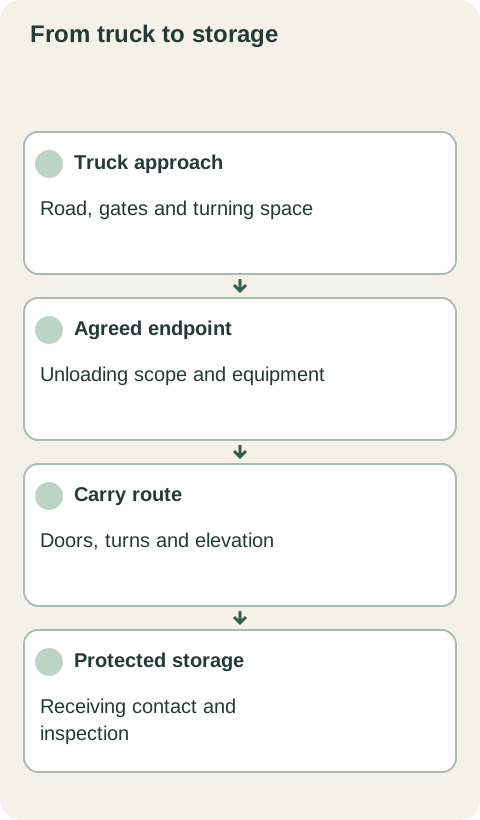
Do not decide how to stack cabinet cartons simply by finding the largest box for the bottom. Confirm the supplier's handling instructions for the actual cabinet packages, including any restrictions shown on the cartons, and have the receiving team plan the arrangement. A finished cabinet, a flat-pack component and a long trim package do not present the same storage question. If the allowed arrangement is unclear, resolve it before adding more weight or reducing access around the goods.
Diagram Confirm the handling requirements of the actual packages; this diagram is not a stacking plan or load rating.
Find the instructions that apply to these packages
Read the package markings and the supplier's storage directions together. Ask about permitted orientation, support and stacking for the specific product and packaging, especially if instructions appear incomplete or conflict. Keep any restrictions visible when the cartons are placed. Do not treat an image of cabinets stacked in a warehouse as permission to reproduce that arrangement in a home.
KraftMaid advises putting smaller, lighter cartons above larger, heavier ones when stacking is necessary. That relative-order guidance is not an allowable height or weight rating. It does not establish that every cabinet package may support another one, or override a specific instruction for the goods you received. Obtain the missing limits rather than invent them.
Identify cartons that arrived wet, crushed, torn or already opened, and tell the supplier or receiving lead before including them in a proposed stack. Record what is visible without trying to determine load capacity by appearance. A box that resembles an intact package may no longer have the same protection, and a clean exterior does not prove that every internal support remains in place.
Inspection can also change a package. If protective pieces were removed or the carton was opened, ask how the item should be protected and stored afterward. Returning a cabinet to its box does not by itself confirm that the original packaging arrangement has been restored. Do not press, climb on or add trial loads to a carton to see whether it feels strong enough.
Assess the whole arrangement, not just each box
Have the responsible team consider the supporting surface, package sizes, protruding contents and the route people need around the stored goods. Follow the relevant instructions for long or unusually shaped pieces rather than treating them as ordinary rectangular cartons. A package should not become an improvised bridge or work surface merely because there is an empty space nearby.
Leave the handling decisions to people with the appropriate information and equipment. If space is too limited for the approved arrangement, consider a different suitable storage area or revised receiving plan. More height is not automatically the answer to less floor space. The project needs a workable storage arrangement, not a compact pile that depends on assumptions nobody has checked.
Plan how the next item will be retrieved
Tell the receiving team which items will need inspection or installation access first. An arrangement that cannot release a needed carton without extensive rearranging may create avoidable handling later. Coordinate access without overriding the packaging restrictions, and keep labels readable so the crew can identify the intended item before moving anything around it.
Imagine a long finishing package is placed over an opened cabinet carton because both appear lightweight. The team then needs the cabinet for inspection, but the top package obstructs access and the supplier has not confirmed the opened carton as a suitable support. The problem is not solved by calling the top package small. Both the storage support and the retrieval plan need clarification.
Reassess after a change or visible problem
Do not assume an earlier arrangement remains appropriate after cartons are opened, goods are moved or other deliveries are added. Ask the receiving lead to review the changed conditions. If packages shift or show new crushing, keep people away from the affected arrangement and have qualified handlers assess it instead of trying to pull out a lower carton yourself.
Record the affected product identities and communicate any observed change to the supplier as appropriate. Keep the storage question separate from the assessment of the cabinet inside: damaged packaging does not automatically prove product damage, and an apparently sound cabinet does not establish a safe stacking plan. The decision should rest on specific instructions, current package condition and competent handling, with unknowns resolved before the arrangement is used.
Pure White
Cream White
Light Warm Gray
Gray
Navy
Black
Oak Tone
Dark Walnut Tone
Design study These finish studies are design references, not a list of currently orderable colors. Screens and lighting change the appearance; compare a physical sample before choosing.See all finish options →
The sample shows the door frame, a separate center panel, the face frame and the cabinet box. Each component has its own place in this Shaker construction.
Shaker construction: door frame, center panel, face frame and cabinet box. The cutaway helps locate these parts; confirm each material in the specifications for the selected cabinet.
01 / Door frame
The Shaker door has rails and stiles around a separate center panel. The frame and center panel are different components; confirm their materials in the specifications for the selected cabinet.
02 / Face frame
The face frame surrounds the opening at the front of the cabinet box and sits behind the doors. The face frame, door frame and cabinet box are separate parts.
03 / Cabinet box
The sample exposes the cabinet sides, interior surfaces and layered edges. The image does not establish the wood species or material specification of a selected cabinet.