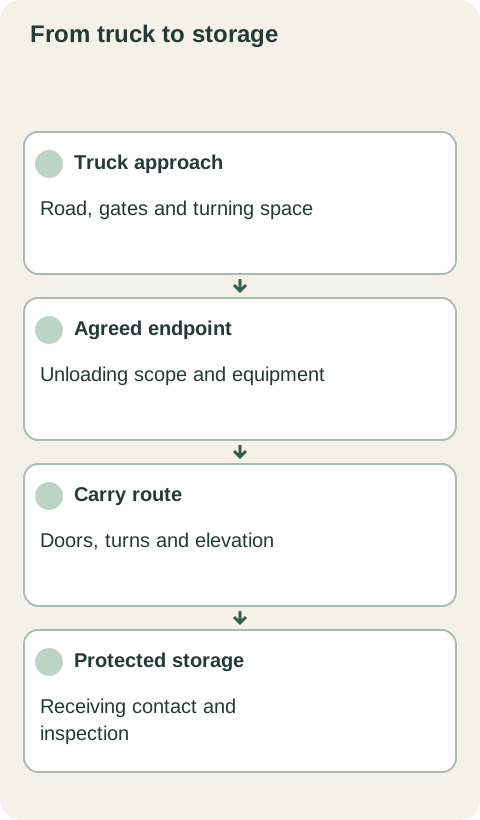
Before shipping cabinets back, obtain the seller's instructions for the specific products and reason for the return. A return request, a case number and permission to send the goods are not necessarily the same stage. Confirm what has actually been accepted, what remains subject to review and where the shipment must go. Preparing this information first helps prevent a cabinet from leaving the site without a receiving arrangement that matches the case.
Diagram A return needs its own accepted destination and handoff instructions; the original outward route does not determine them.
Describe the request before moving the goods
Contact the business that handles your purchase and provide the order reference, exact items and reason for the request. Explain whether the issue is an ordering mistake, an unwanted selection, an incorrect delivery or an observed condition problem. Keep the description factual. Different situations may follow different processes, so do not assume an ordinary return form also covers a reported delivery issue.
State the current condition accurately, including whether packaging was opened, assembly began or the item was modified. Provide requested photographs and identify missing packaging or related components. Do not change the product to make it appear closer to an assumed return condition. The seller needs the real state to answer the actual request, and you need that answer before planning its transport.
Obtain an item-specific response
Cabinets Bay, for example, asks customers to contact it before sending products back to request an RMA. That illustrates why a shipment should be connected to a seller's return process. Confirm the procedure for your own purchase instead of assuming every seller uses the same reference or accepts the same goods.
Ask whether the reply permits shipping the listed items or merely acknowledges that the request is being reviewed. Check the item identifiers and quantities in the response. If only part of the request is accepted, keep the remaining products out of that shipment. Clarify any stated timing requirement directly with the seller rather than applying a deadline copied from another store's website.
Confirm destination and the documents that travel with it
Obtain the return address and receiving instructions from the accepted arrangement. The original sender's address, a showroom address or a corporate office may not be the intended return destination. Ask what reference must appear on the shipment documents and what paperwork belongs with the goods so the receiving team can connect the arrival to your case.
Confirm which components and accessories should accompany the product. If the seller requests a particular part for assessment, do not assume it needs the entire cabinet. Conversely, a return of a complete unit may involve associated pieces stored elsewhere. Keep a record of exactly what is packed and any items the seller has specifically told you to retain at the project.
Settle packaging and transport responsibilities
Ask for packaging requirements for the actual goods and their present condition. An opened or damaged shipping carton may require a different arrangement before transport. Have suitable people prepare and move the shipment under those instructions; the fact that the packaging was retained does not establish that it is adequate for another trip without review.
Confirm who books collection, what delivery service is needed and how the relevant costs will be handled. A return reference by itself does not show that a carrier is scheduled or that freight is prepaid. Keep the seller's acceptance, any transport label and the actual booking distinguishable so a project coordinator can see which steps are complete and which still need action.
Follow the shipment through receipt and review
Imagine a buyer receives an email saying the return request has been received, then sends a cabinet to the address printed on its original carton. The email did not identify accepted items or a return destination. Both gaps could have been resolved before collection. Ask for the specific shipping instruction rather than treating a polite acknowledgment as the complete arrangement.
After dispatch, retain the handoff record and tracking reference, and confirm that the seller has associated the received goods with the return case. Keep arrival, product review and any resulting credit or other resolution as separate statuses. A delivered scan closes the transport leg; it does not by itself establish that every condition of the agreed return has been checked or that the product issue is finished.
Pure White
Cream White
Light Warm Gray
Gray
Navy
Black
Oak Tone
Dark Walnut Tone
Design study These finish studies are design references, not a list of currently orderable colors. Screens and lighting change the appearance; compare a physical sample before choosing.See all finish options →
The sample shows the door frame, a separate center panel, the face frame and the cabinet box. Each component has its own place in this Shaker construction.
Shaker construction: door frame, center panel, face frame and cabinet box. The cutaway helps locate these parts; confirm each material in the specifications for the selected cabinet.
01 / Door frame
The Shaker door has rails and stiles around a separate center panel. The frame and center panel are different components; confirm their materials in the specifications for the selected cabinet.
02 / Face frame
The face frame surrounds the opening at the front of the cabinet box and sits behind the doors. The face frame, door frame and cabinet box are separate parts.
03 / Cabinet box
The sample exposes the cabinet sides, interior surfaces and layered edges. The image does not establish the wood species or material specification of a selected cabinet.