A useful cabinet mockup record identifies what was built, what the team examined and which qualities were accepted for the project. It also states what the mockup did not represent and which corrections remain open. A photograph and a general statement that the sample looks good cannot explain all of that. Before repeating the work, connect the accepted physical reference to the drawings, product selections and instructions the supplier and installer will use.
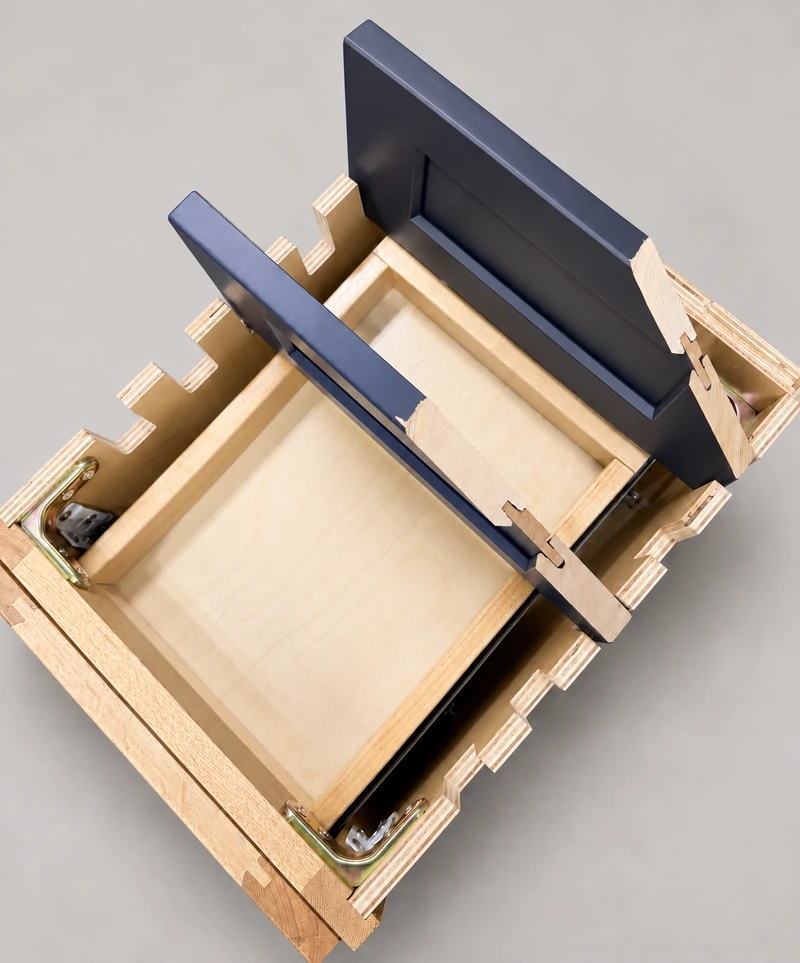
Physical sample This inspected physical sample illustrates limited surface review. It is not a completed cabinet mockup or a project acceptance record.
Decide which questions the physical assembly should answer
Set the review purpose before constructing the mockup. The team may need to judge a door-and-panel junction, the appearance of an exposed end, hardware operation or a repeated finishing detail. Choose an assembly that includes the relevant interfaces. A loose finish sample can help with surface appearance but cannot demonstrate how the completed components meet or move together.
Agree who supplies the mockup, what work is included and who participates in its review. Confirm any charge or project-material use before construction, rather than assuming the sample is free or automatically counts toward the final supply. Select reviewers according to the decisions needed so the person accepting appearance is not presumed to have checked every installation issue.
Record the actual components and viewing conditions
Identify the drawing revision, cabinet or component references, finish samples and hardware used. Note any temporary substitutes or incomplete portions. If the mockup uses a temporary pull while the selected pull is unavailable, record that fact plainly. The observed hand clearance or appearance cannot be attributed to a different product that was never installed on the sample.
Record where the mockup was viewed and the lighting relevant to the appearance decision. Keep overall photographs together with close views of the reviewed interfaces. Photos should locate observations, not stand in for every physical check. When a measurement matters, identify what was measured and preserve the result separately from a general visual comment about how the assembly looks.
Describe acceptance by feature rather than by enthusiasm
Record whether the reviewed finish, edge treatment, joint appearance and operation are accepted, require correction or were outside the review. Use observable descriptions that another person can find on the assembly. A note about an uneven visible gap is more useful when it points to the affected junction and records the required next action rather than simply calling the sample unacceptable.
Gainwell's written prototype guidance describes representative samples and clear records of comments, changes and accepted references. That supports keeping the physical reference and its decision record connected. It does not mean a mockup replaces the project's product information or proves long-term performance.
Recheck the changed detail before treating it as resolved
Imagine the team accepts the finish but asks for a different panel-to-trim junction. Record that the color is accepted while the junction remains pending. Obtain the revised detail or corrected physical sample appropriate to the question, and record the review result. Do not describe the entire assembly as unchanged and accepted if the feature intended for repetition has been altered.
Where a correction affects other components, update their product and drawing references as well. Confirm whether the accepted detail applies to all repeated locations or only to locations with the same conditions. A representative assembly does not establish fit in every dwelling. Keep site-specific differences visible instead of allowing the mockup label to override separate measurements or selections.
Preserve the reference people will actually follow
Create a dated record identifying the accepted mockup, reviewers, decisions and any remaining limits. Attach the relevant photographs and revised product references. Specify where the physical assembly or representative parts will be kept, and agree what happens if they are altered, incorporated into the project or removed. A reference that no longer exists unchanged should not be treated as an untouched benchmark.
Give the supplier and installation team the accepted record before the repeated work begins under the agreed process. Later changes should identify whether the mockup reference also needs updating. The record establishes an observable project reference and a defined decision; it does not guarantee every later item matches without checking. Use it to guide targeted comparisons of the features that the team actually examined and accepted.
Pure White
Cream White
Light Warm Gray
Gray
Navy
Black
Oak Tone
Dark Walnut Tone
Design study These finish studies are design references, not a list of currently orderable colors. Screens and lighting change the appearance; compare a physical sample before choosing.See all finish options →
Translate the design into identifiable products, details and responsibilities. A useful handoff lets another professional price and build the intended arrangement without reconstructing private conversations.
The sample shows the door frame, a separate center panel, the face frame and the cabinet box. Each component has its own place in this Shaker construction.
Shaker construction: door frame, center panel, face frame and cabinet box. The cutaway helps locate these parts; confirm each material in the specifications for the selected cabinet.
01 / Door frame
The Shaker door has rails and stiles around a separate center panel. The frame and center panel are different components; confirm their materials in the specifications for the selected cabinet.
02 / Face frame
The face frame surrounds the opening at the front of the cabinet box and sits behind the doors. The face frame, door frame and cabinet box are separate parts.
03 / Cabinet box
The sample exposes the cabinet sides, interior surfaces and layered edges. The image does not establish the wood species or material specification of a selected cabinet.