A professional cabinet account is useful when its actual pricing and support fit the way your team buys and manages projects. Compare the same product scope, then identify which purchasing tasks the supplier performs and which remain with your staff or another provider. A larger discount does not describe service quality, while a support label does not prove that a particular task is included. Keep the product price and the required coordination work visible in the decision.
Diagram Define each support task and its deliverable. The diagram does not describe a usaKT trade account or included service.
List the work your project will actually need
Consider product-list review, quote preparation, revision handling, sample coordination, order acknowledgment questions and replacement follow-up. Describe the expected result of each task rather than simply writing support needed. For example, a marked response to unresolved component questions is more specific than access to an account representative. Identify which tasks your own team already performs reliably.
Distinguish occasional help from work expected on every order. A project with accepted drawings may need accurate entry and straightforward communication, while a project with changing selections may need more repeated review. Do not automatically assign a high value to services you will not use, or assume that an attractive product price compensates for a task nobody has agreed to perform.
Translate program benefits into defined scope
Cabinets.com's trade-program page separately lists preferred pricing, design service, customer support and sample benefits. This is an example of a program offering more than a price category, not evidence that every service is included on every project or that usaKT offers the same program. Ask the prospective supplier to explain the specific work available for your order.
For each relevant service, confirm the required inputs, deliverable, responsible contact and any separate charge. Ask how revisions are handled and where the service ends. A product drawing service, for instance, should not be assumed to include field measurement or every installation coordination task. Record the actual boundaries rather than treating a broad benefit name as a complete assignment of work.
Compare the remaining workload as well as the quote
Obtain the net product quote for the same accepted selection and identify separately priced services. Then list work still required from your staff or outside providers. Use your own project records to estimate that effort where possible. Keep an uncertain allowance visible instead of inventing a precise savings figure for fewer emails or an expected faster response.
Imagine a buyer with a complete cabinet schedule compares a lower-priced supply-only offer with another offer that includes additional design review. The extra review may have limited value if the buyer has already completed it. For a different project with unresolved product options, defined review assistance could be useful. The better fit depends on the actual work and the team's capacity, not the service title alone.
Test communication against a real project question
Before relying on a service promise, use the quote process to observe how the supplier handles a specific inquiry. Submit a clearly identified product question and note whether the response addresses it, cites the relevant selection and leaves remaining uncertainty visible. A courteous reply is welcome, but it is not the same as resolving the technical or purchasing question you asked.
Ask how issues are routed after ordering and whether the account contact remains involved in shortages, replacements or revised documentation. Do not infer guaranteed response times or outcomes from a fast initial sales reply. If project continuity matters, identify the backup contact and the records another person would need to continue the discussion when the usual representative is unavailable.
Choose a support arrangement you can review later
Record the accepted product pricing and agreed service scope together, including tasks your team retains. Compare actual performance during a suitable project with those expectations: document completeness, unresolved questions, additional charged work and your own coordination effort. Keep observations separate from assumptions so a future account decision can use evidence rather than a remembered headline discount.
Revisit the arrangement when your project mix changes. Support useful during complex selections may contribute differently on a repeat order with stable requirements. This comparison does not promise that higher service cost produces fewer errors or that the largest discount is poor value. It helps identify a workable division of purchasing work and a price the team can understand for the package it will actually receive.
Pure White
Cream White
Light Warm Gray
Gray
Navy
Black
Oak Tone
Dark Walnut Tone
Design study These finish studies are design references, not a list of currently orderable colors. Screens and lighting change the appearance; compare a physical sample before choosing.See all finish options →
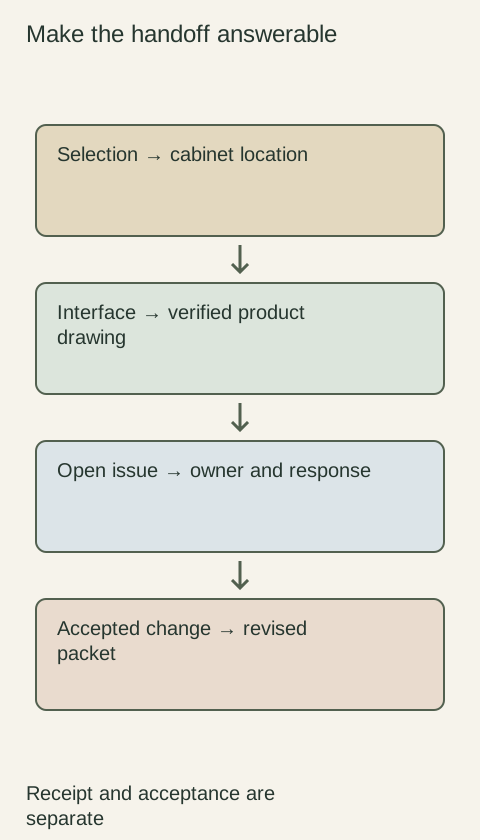
Translate the design into identifiable products, details and responsibilities. A useful handoff lets another professional price and build the intended arrangement without reconstructing private conversations.
The sample shows the door frame, a separate center panel, the face frame and the cabinet box. Each component has its own place in this Shaker construction.
Shaker construction: door frame, center panel, face frame and cabinet box. The cutaway helps locate these parts; confirm each material in the specifications for the selected cabinet.
01 / Door frame
The Shaker door has rails and stiles around a separate center panel. The frame and center panel are different components; confirm their materials in the specifications for the selected cabinet.
02 / Face frame
The face frame surrounds the opening at the front of the cabinet box and sits behind the doors. The face frame, door frame and cabinet box are separate parts.
03 / Cabinet box
The sample exposes the cabinet sides, interior surfaces and layered edges. The image does not establish the wood species or material specification of a selected cabinet.