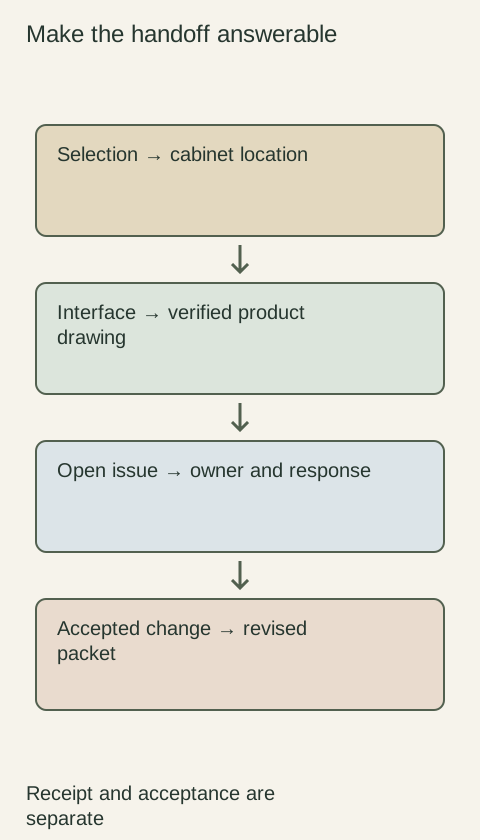
When a cabinet project is purchased in phases, give each release a defined product scope and preserve the connection from that scope to the goods received and their final locations. A purchasing release, a shipment and a manufacturing batch are different records. Ask what identifiers the supplier actually provides, retain them and avoid inventing a production-lot identity from a delivery date. Useful traceability explains where a component came from without claiming that a shared code guarantees a perfect visual match.
Diagram Connect actual supplier identifiers to release and destination records; the diagram provides no batch-matching guarantee.
Define the contents of each purchasing release
Identify the dwellings or project areas included, the accepted product revision and the quantities being released. Keep items planned for later phases separate from the current order. If the team has a broader forecast, show which part has actually been ordered and which remains provisional. A total project quantity is not evidence that every phase has been accepted for supply.
Before a later release, confirm the selected product details and any accepted changes affecting that phase. Do not assume an earlier quote or sample discussion has automatically carried every option into the new order. Retain the shared finish and component references, but have the supplier identify any difference in the actual proposed selection or availability that requires a decision.
Learn what the supplied identifiers mean
Ask which labels identify the customer order, product, carton and any production or finish batch information available for the goods. These identifiers may serve different purposes. Record their meaning rather than renaming every number a lot code. If the supplier does not provide a manufacturing batch identifier, retain the available order and shipment information without pretending it offers finer traceability.
KraftMaid explains that its cartons carry product SKUs and that some cartons contain several items with multiple labels. That example shows why product identity and carton count are not interchangeable. It does not describe every supplier's label format. Agree how the project will connect the actual supplied labels to its own release and destination records.
Retain the accepted finish sample identity and relevant product selection with each release. Where cabinets from different releases will be seen together, discuss how their appearance will be reviewed before installation. Do not rely only on photographs taken under different lighting or on the fact that the same finish name appears on both orders. Ask the supplier what comparison information it can provide.
KraftMaid notes that natural wood can differ among individual pieces. Consequently, tracking a batch is a recordkeeping tool, not a promise of identical grain or appearance. Compare the actual material under suitable common viewing conditions and refer concerns to the responsible project team. Do not decide that every variation is acceptable, or that every variation proves the wrong product was supplied.
Imagine a replacement door arrives after the original phase and is temporarily stored with materials for a later release. Record its supplier reference, intended cabinet and replacement status before it becomes mixed into general stock. Otherwise the delivery history may be correct while the installed location is wrong, leaving the team unable to explain which product is actually in place.
If a component is reassigned to another dwelling, update both the original allocation and its new destination. Preserve the supplier's identity labels and record any removed component separately. A transfer should not make the original location appear complete when it is now missing a part. Distinguish requested replacement, received replacement and installed replacement so those events do not collapse into a single checkbox.
Close each phase without losing the project history
Reconcile the released quantities with received, held, transferred and installed items, using the team's actual records. Resolve unexplained differences before using the phase as a model for the next purchase. Keep retained spare components identifiable and record where they are stored. Their relationship to a previous release may matter when they are considered for later service.
At handover, preserve the final location record, supplier order references, available batch information and finish approval references together. The record should support a targeted inquiry about a particular component without requiring a search through every project shipment. It does not guarantee future supply or establish material conformity by itself. Its value is a clear history that makes later comparison, replacement and supplier communication specific.
Pure White
Cream White
Light Warm Gray
Gray
Navy
Black
Oak Tone
Dark Walnut Tone
Design study These finish studies are design references, not a list of currently orderable colors. Screens and lighting change the appearance; compare a physical sample before choosing.See all finish options →
Translate the design into identifiable products, details and responsibilities. A useful handoff lets another professional price and build the intended arrangement without reconstructing private conversations.
The sample shows the door frame, a separate center panel, the face frame and the cabinet box. Each component has its own place in this Shaker construction.
Shaker construction: door frame, center panel, face frame and cabinet box. The cutaway helps locate these parts; confirm each material in the specifications for the selected cabinet.
01 / Door frame
The Shaker door has rails and stiles around a separate center panel. The frame and center panel are different components; confirm their materials in the specifications for the selected cabinet.
02 / Face frame
The face frame surrounds the opening at the front of the cabinet box and sits behind the doors. The face frame, door frame and cabinet box are separate parts.
03 / Cabinet box
The sample exposes the cabinet sides, interior surfaces and layered edges. The image does not establish the wood species or material specification of a selected cabinet.