V-front corner drawers: choose the usable shape, not the square cabinet footprint
A corner drawer can bring organized contents forward, but its angled front and special box change what fits. Compare complete drawer construction with trays using the objects you need to store.
Choose a V-front corner drawer when you want divided storage that comes out as a drawer and the proposed box suits your actual contents. Do not choose it simply because a square corner footprint looks large on the kitchen plan. The drawer has a shaped front, a special interior and a path into the room. A tray mechanism may suit a different group of objects, while ordinary drawers beside an unused corner may preserve the broad rectangular storage you need most.
What the angled front conceals
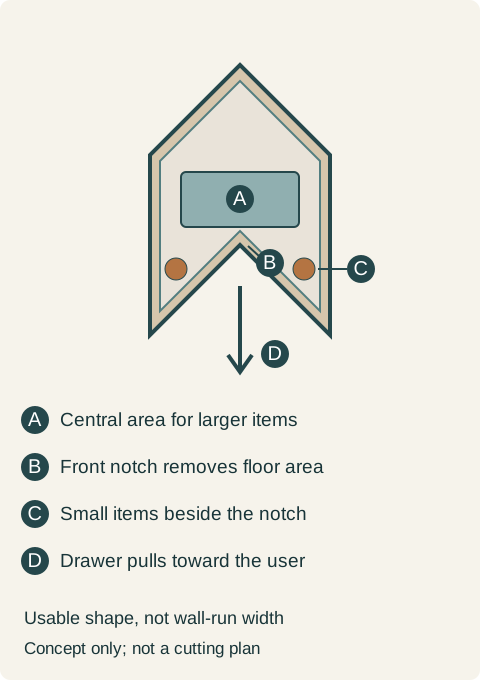
Blum's US MOVENTO SPACE CORNER sheet explicitly requires special cabinet and drawer construction. Its example uses long heavy-duty runners, and the plan shows a central body with angled portions and an inward notch at the front. This is a complete cabinet application, not an accessory that turns any existing blind-corner box into a corner drawer.
The important distinction is between the space allocated along the walls and the usable floor inside the moving drawer. Cabinet sides, the drawer structure and the shaped front do not disappear when the drawer opens. Nor can a rectangular organizer bridge the inward notch and still sit on a continuous drawer bottom. Look at the inside outline before comparing a nominal cabinet size with a straight drawer.
The illustrated arrangement is a particular manufacturer's construction example. Other corner drawer systems can use different fronts, boxes and movement. A photograph of an angled front does not identify the mechanism or establish that parts from another range are interchangeable. Ask for the finished interior and front arrangement of the offered cabinet, not merely the name of a runner.
Fit a group of belongings, not a volume claim
Place the largest awkward item first on the proposed inside outline. A roasting pan, a broad baking sheet and a circular mixing bowl test different parts of that shape. Include handles and rims. A rectangular pan may fit the center only in one orientation; rotating it could occupy the small spaces intended for utensils. Finding a place for everything individually does not show that the entire group fits together.
Then allocate the irregular areas deliberately. Small containers or short tools may use spaces beside the front notch. They still need a stable arrangement and enough room to grasp them. A diagram filled with tiny rectangles can overstate usefulness if those containers are hypothetical or if their lids cannot be lifted in place. Use the actual organizers being considered and include their walls, not just their advertised outside category.
The same discipline applies to a rotating or swinging tray. Its surrounding cabinet is not the tray itself; the platform outline, rim and mechanism govern where objects can sit. Compare the final layouts of the same belongings. There is no useful universal answer that all drawers hold more than all trays, or that a particular corner mechanism eliminates every unused space.
Teaching example Conceptual top view of a corner drawer: a central storage zone, angled rear and an inward front notch create different spaces. Small items occupy the side pockets; the arrow shows withdrawal toward the user. No dimensions or construction approval.
A baking corner with an oversized tray
Consider a planned baking area whose corner currently contains measuring tools, small decorating supplies, mixing bowls and a broad roasting tray. The proposed corner drawer layout gives the small tools separate homes beside the shaped front and keeps the bowls visible in a deeper drawer. The roasting tray, however, cannot lie flat in the offered drawer without occupying the same central space as the bowls.
The household chooses the corner drawers for the tools and bowls and moves the roasting tray into a dedicated upright slot in the adjoining run. That choice only works because the neighboring storage plan contains that slot. The household does not count the tray as fitting in both places or treat a possible future organizer as extra capacity. The result is a specific allocation: frequently used baking equipment moves forward together, while the broad tray has a separate reachable home.
If the adjoining run could not spare that slot, the decision would change. Preserving a wider straight drawer and leaving some corner space unused could be better than paying for a special corner cabinet that displaces the item the household most needs to store. The value comes from the complete baking arrangement, not from filling the corner at any cost.
Compare how each option opens in the room
A corner drawer travels out toward someone standing at the inside corner. Mark that open position with the neighboring drawers, doors and appliance openings. A successful interior arrangement is of little use if the baker must close the ingredient drawer every time a tool is needed. Test the intended sequence, including putting the bowl back after use, rather than only opening the empty corner drawer once.
A tray behind a door introduces a different sequence: open the door, move the tray as designed, lift the object, then return the tray and close the door. That can be perfectly acceptable for occasional bulky equipment. A drawer divided for small daily tools may be preferable when repeated access matters. Neither route removes the need to check the actual aisle and neighboring fronts.
Price the cabinet that delivers the layout
Compare the complete offered corner cabinet: its box, drawers, fronts, runners, organizers and installation coordination. A hardware-only price cannot be compared directly with a finished drawer cabinet. Also identify which matching fronts and internal dividers the quote actually includes. The construction and organization are part of the purchase, not free consequences of choosing a recognizable hardware brand.
Ask how the drawer can be removed for service and how its specified hardware will be identified later. Leave runner selection, load assessment and construction details with the cabinet maker using current instructions. For the buyer, the approval should show the belongings in their assigned spaces and the cabinet in its open position. A good corner drawer earns its place by improving that routine, even when the drawing honestly retains unused space.
Pure White
Cream White
Light Warm Gray
Gray
Navy
Black
Oak Tone
Dark Walnut Tone
Design study These finish studies are design references, not a list of currently orderable colors. Screens and lighting change the appearance; compare a physical sample before choosing.See all finish options →
Opening each drawer alone and opening both are different tests. Track front, box and handle movement in plan and height before deciding whether the corner needs a physical revision or an agreed sequence.
Recovering the corner is only part of the decision. Keep the room and inventory fixed, then compare adjacent cabinets, usable platforms and the full retrieval sequence.
The sample shows the door frame, a separate center panel, the face frame and the cabinet box. Each component has its own place in this Shaker construction.
Shaker construction: door frame, center panel, face frame and cabinet box. The cutaway helps locate these parts; confirm each material in the specifications for the selected cabinet.
01 / Door frame
The Shaker door has rails and stiles around a separate center panel. The frame and center panel are different components; confirm their materials in the specifications for the selected cabinet.
02 / Face frame
The face frame surrounds the opening at the front of the cabinet box and sits behind the doors. The face frame, door frame and cabinet box are separate parts.
03 / Cabinet box
The sample exposes the cabinet sides, interior surfaces and layered edges. The image does not establish the wood species or material specification of a selected cabinet.