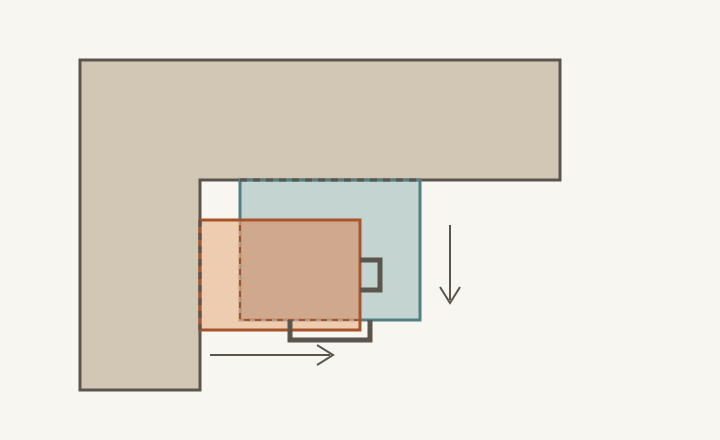
Check drawer and handle conflicts in every working state at an inside corner
Opening each drawer alone and opening both are different tests. Track front, box and handle movement in plan and height before deciding whether the corner needs a physical revision or an agreed sequence.
At an inside corner, test each drawer with its neighbor closed before testing them open together. These states answer different questions. A projecting handle can obstruct a drawer that is supposed to operate independently, while another arrangement may work individually but require sequential use. Identify the exact conflicting parts and their heights instead of treating every overlap on a plan as the same problem.
Draw the moving parts from finished references
Use the installed front positions, including any filler or offset between the perpendicular runs. Add the actual drawer front thickness, box movement and handle projection. A line representing the closed cabinet front does not show the parts that move beyond it. Obtain the travel of the selected drawer system and the handle geometry rather than estimating from a room photograph.
Pair the plan with an elevation or section identifying the vertical band occupied by each part. Overlapping outlines in plan flag a possible conflict; they do not prove collision if the parts are at different heights. Conversely, checking only the top drawer can miss a lower handle or a tall front that occupies another drawer’s path.
ABCD
Diagram The overlap is a candidate conflict in plan, not proof about a particular cabinet. Verify the relevant heights and all movement states. The drawing does not specify a required filler or product clearance.
A
Movement from the upper cabinet run.
B
Movement from the perpendicular run.
C
Plan overlap that needs an elevation check.
D
Handles extend beyond the drawer-front outline.
Test independent opening in both directions
Keep the adjacent drawer fully closed and open the first through its required travel. Follow the front, handle and other moving parts past the neighbor’s closed handle and front. Repeat with the roles reversed. The geometry may be asymmetric because the drawers, heights or handles differ, so success in one direction does not establish success in the other.
If a drawer contacts a closed neighbor before reaching the position needed for its contents, ordinary sequencing between open drawers does not solve that conflict. Record the contact location and consider a verified revision to the cabinet offset, front or handle arrangement. Retest after the change. Do not force the hardware or assume that a soft-close feature prevents physical interference.
Then test simultaneous use and the real task sequence
With independent operation established, examine the states in which both drawers would be open. Include partial travel rather than comparing only closed and fully extended positions. A pair may collide during movement even if a carefully arranged final position appears separate. Also check whether the person can stand where the proposed sequence requires without blocking another necessary drawer.
A household may accept closing a drawer before opening the adjacent one when the task naturally works that way. Record that as a use condition, not as unrestricted simultaneous access. Consider interruptions and another user. The condition becomes less practical when the cook repeatedly alternates between the groups or has no place to put an item while closing the first drawer.
Follow a bowl-and-tool task before accepting sequential access
In a hypothetical corner, mixing bowls are in a drawer on one run and measuring tools in the perpendicular drawer. Each operates with the other closed, but they cannot remain open together at the relevant height. The cook can collect tools, close their drawer and then retrieve a bowl. That sequence may be adequate for a predictable task with a receiving surface available.
During a different task, the user holds a bowl while searching for another tool, and the needed landing is occupied. The same arrangement now demands an interruption. Compare moving the tool group to a tested location or revising the corner geometry, while preserving the storage those changes affect. The example does not make all sequential access unacceptable; it shows which routine must be tested.
Save the state that passed and the conditions it needs
Record the cabinet and handle selections, relevant heights, independent-opening results and simultaneous-use restriction if any. Include the task sequence the household accepted and the locations changed to support it. Recheck after changing handle style, drawer front or internal assignment. A corner works when the actual parts and tasks coexist under clear conditions, not merely when the closed fronts line up.
Pure White
Cream White
Light Warm Gray
Gray
Navy
Black
Oak Tone
Dark Walnut Tone
Design study These finish studies are design references, not a list of currently orderable colors. Screens and lighting change the appearance; compare a physical sample before choosing.See all finish options →
An empty mechanism can move cleanly while a handle or lid obstructs the loaded path. Confirm which shelves move, what moves with them and how the contents return.
A balanced corner front can hide awkward access. Compare how each proposed opening exposes the assigned contents and where its open panels leave the user’s hands and transfer path.
The sample shows the door frame, a separate center panel, the face frame and the cabinet box. Each component has its own place in this Shaker construction.
Shaker construction: door frame, center panel, face frame and cabinet box. The cutaway helps locate these parts; confirm each material in the specifications for the selected cabinet.
01 / Door frame
The Shaker door has rails and stiles around a separate center panel. The frame and center panel are different components; confirm their materials in the specifications for the selected cabinet.
02 / Face frame
The face frame surrounds the opening at the front of the cabinet box and sits behind the doors. The face frame, door frame and cabinet box are separate parts.
03 / Cabinet box
The sample exposes the cabinet sides, interior surfaces and layered edges. The image does not establish the wood species or material specification of a selected cabinet.