Choose pantry shelves or inner drawers with the packages and door sequence present
Shelves and inner drawers solve different access problems. Compare the same inventory at its actual height, including the outer door, usable interior and restocking routine.
Choose between pantry shelves and inner drawers by testing the food packages you keep and the sequence used to reach them. An inner drawer can bring its contents forward, while a shelf leaves the group in the cabinet. Neither description settles the choice. The actual cabinet height, package arrangement, door clearance and usable interior determine whether the change improves everyday access.
Sort the inventory by handling, not just product name
List the packages in their normal stored form: upright bags, tall cartons, small jars, grouped packets and reserve quantities. Include the space each needs to be grasped and removed. If the household normally keeps goods in their original packaging, do not make an option appear workable by silently transferring everything into a new set of containers.
Identify which packages are selected individually and which travel as a group. A basket of baking packets and a frequently opened carton require different access. Also include the largest expected replenishment that the household normally buys. A cabinet arranged around nearly empty packages may not hold the same inventory after the regular shopping trip.
Test the shelf from the real viewing and handling position
Put representative packages at their proposed shelf heights and depths. Check whether the user can identify a rear item, grasp it and bring it out with the front row present. Visibility and removal are separate: a label may identify a package without providing a path for the hand or the package itself. Record what must move and where those temporary items go.
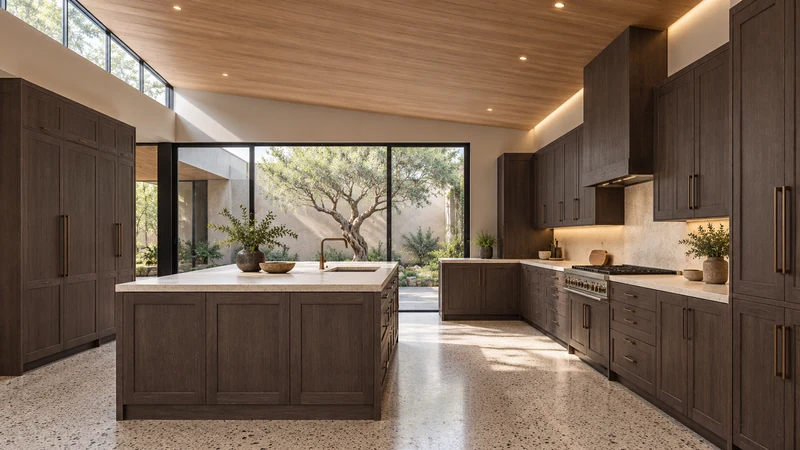
Design study The tall bank illustrates the scale of a pantry location. Closed fronts do not reveal shelves, inner drawers or compatible hardware; compare actual interiors before assigning contents.
A shelf can be appropriate for a clearly grouped collection with a manageable retrieval order. It need not be rejected merely because another mechanism is available. Check whether a shallow grouping, a different orientation or a defined reserve zone resolves the actual problem without creating new obstruction. Preserve the retained inventory in each trial.
Test the inner drawer after opening the outer door
Use the selected drawer system’s usable width, depth, clear height and loading information. Drawer sides, hardware and divisions affect the space available to packages. A moving platform with a generous outside dimension does not prove that a tall carton or wide grouped container will fit. Check the real loaded arrangement rather than comparing cabinet labels.
Perform the whole sequence: approach, open the outer door to the required position, extend the drawer, choose an item, close the drawer and close the door. Confirm compatibility and opening requirements for that exact cabinet and hardware. Include nearby handles and another person’s route. An inner drawer hidden behind a door has a different operation from a directly accessible drawer front.
Compare a rear-package problem without losing the tall cartons
In a hypothetical pantry, short bean packages sit behind tall cereal cartons on a lower shelf. Moving that group forward in an inner drawer may make the rear packages easier to identify and retrieve. However, the proposed drawer arrangement gives the cereal cartons a different height constraint. If those cartons no longer fit in their ordinary orientation, their new home belongs in the comparison.
Test a compatible mixed arrangement, with selected packages in drawers and tall cartons on a suitable shelf, alongside the all-shelf option. Do not assume every height in a tall pantry benefits equally from a drawer. A mechanism that helps a lower group still needs its own handling test higher up, and the whole proposed combination must be supported by the selected system.
Include replenishment and return before deciding
Restock the arrangement as the household normally would. Check whether new packages can be placed without blocking older ones, whether labels remain useful and whether the outer door can close with everything restored. These are organization checks, not a food-storage safety specification. Keep the package’s own storage instructions relevant to the chosen location.
Save the inventory, shelf or drawer assignments, tested opening sequence and any temporary landing needs. Note which package changes would trigger a recheck. A useful pantry interior makes finding, removing and putting away ordinary groceries predictable; it does not win simply by displaying more moving hardware or more empty shelf area.
Pure White
Cream White
Light Warm Gray
Gray
Navy
Black
Oak Tone
Dark Walnut Tone
Design study These finish studies are design references, not a list of currently orderable colors. Screens and lighting change the appearance; compare a physical sample before choosing.See all finish options →
The useful opening is bounded by finished sides, the upper cabinet and the counter. Test the objects and movements within that opening before refining the front proportions.
Horizontal door divisions can separate access, but they do not automatically change interior compartments or reduce a side-hinged door’s floor-plan sweep. Check both sides of the front.
The sample shows the door frame, a separate center panel, the face frame and the cabinet box. Each component has its own place in this Shaker construction.
Shaker construction: door frame, center panel, face frame and cabinet box. The cutaway helps locate these parts; confirm each material in the specifications for the selected cabinet.
01 / Door frame
The Shaker door has rails and stiles around a separate center panel. The frame and center panel are different components; confirm their materials in the specifications for the selected cabinet.
02 / Face frame
The face frame surrounds the opening at the front of the cabinet box and sits behind the doors. The face frame, door frame and cabinet box are separate parts.
03 / Cabinet box
The sample exposes the cabinet sides, interior surfaces and layered edges. The image does not establish the wood species or material specification of a selected cabinet.