For everyday cookware, a drawer often makes the simplest routine: pull once, see the contents, and lift out what you need. A cabinet with doors and a fixed shelf can suit tall or seldom-used equipment. Roll-out trays bring a shelf forward while keeping a door-front appearance, but you usually open the doors before moving the tray. Choose around the actual objects and the way you reach them. A kitchen does not need every base cabinet to have the same interior, even when all the fronts share a finish.
Match the opening to the job
Start with a small inventory beside the cooking and cleanup areas. Put your heaviest pot, its lid, a mixing bowl, a baking dish and the container holding your food-storage lids on the floor. Notice which items nest, which must stay upright and which you use together. A tall mixer may need a clear door bay rather than a stack of shallow drawers. A drawer for stacked plates needs a different interior than a drawer for loose spatulas. The name on the cabinet list tells you less than this group of objects does.
KraftMaid describes roll-out trays as shelves that slide toward the user, and lists separate drawer-organizer options. That distinction is useful when comparing a quote: a door cabinet with a fixed shelf, one with roll-out trays, and a drawer base are different configurations. Ask what is included rather than assuming a photograph of an organized interior is standard equipment. A tray, divider, peg system or soft-close mechanism shown in an inspiration picture may be a separate selection.
A drawer gives direct access to its own box. A roll-out tray sits inside a cabinet and has to clear the door, hinges and any face-frame projection as it moves. A fixed shelf does not move, so your hands and the loaded object must travel through the entrance. Full extension can improve the view of the back, but check the actual extension and inside dimensions of the selected system. The outside cabinet width is not the width available for a pot, and the drawer front height is not the closing clearance above the contents.
Measure your largest item in the position in which you will store it. Include a pot handle, lid knob and the outside rim of a storage bin. Note the weight of a normally loaded tray for the seller to check against the complete hardware rating.
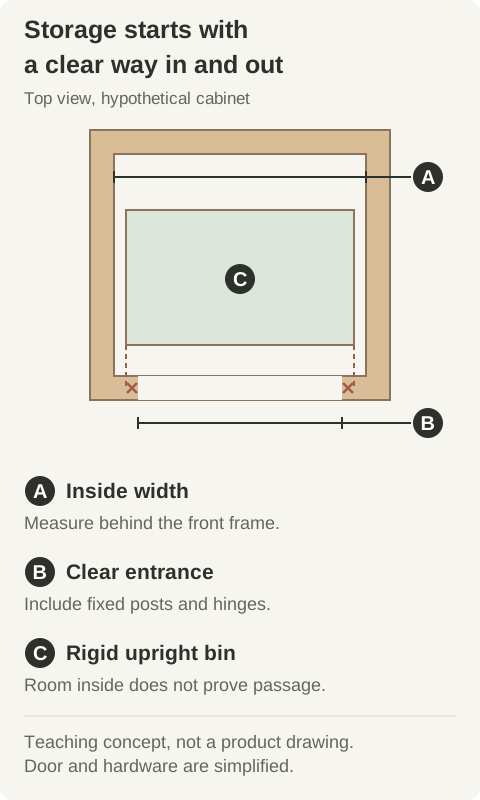
Record clear width at the narrowest entrance, including hinges and fixed stiles, then measure the usable width behind it. Check depth from the intended object position to the first obstruction; do not mix outside cabinet depth with an inside measurement.
For a drawer or tray, measure usable height along its complete closing path, above the inside floor. A cross rail or the shelf above can be lower than the apparent opening.
Open neighboring appliance doors and cabinet fronts on the proposed plan. Check whether a tray can extend without hitting an oven handle, a perpendicular door or a person using the adjacent work area.
Diagram A clear path matters as much as floor area. This is a hypothetical teaching layout, not a product drawing; the door and hardware are simplified.
Decide which convenience is worth buying
A drawer is attractive for frequently used pots because it presents the contents without a separate cabinet-door step. It also divides the vertical space permanently into boxes. Check whether your tallest item fits the selected drawer, not just whether the drawer stack looks spacious. A door bay can leave more flexibility for tall objects if its shelf arrangement allows them. Fixed shelves can be sufficient for infrequently used equipment, provided you can lift it out without an awkward reach. Do not pay for a moving mechanism simply to store an object that you rarely touch.
Roll-outs can be a practical middle choice when you like a door front or want several shelf levels behind it. They still have tray sides, runners and mounting requirements, and the doors must open far enough for travel. Ask for a demonstration with the type of pot or bin you intend to store. Check whether both doors have to be open, whether a center stile remains fixed, and how the tray is removed for cleaning. A smooth, empty display tray does not establish the capacity of the complete loaded system.
Make a small decision before placing a large order
For a cook who uses the same pans every evening, start the discussion with drawers near the cooking area, a separate place for lids, and a door bay for a tall appliance. For occasional roasting equipment, an accessible shelf may be enough. If an existing door cabinet is being considered for roll-outs, get written compatibility for that cabinet and the exact accessory. Do not cut a stile or relocate structural pieces to make an accessory fit on the strength of a generic online example. Let the selected system and cabinet drawing determine the arrangement.
Put the interior on the quote
Name which cabinet holds cookware, dishes, small tools and tall appliances. List the largest item assigned to each.
State fixed shelf, adjustable shelf, roll-out tray or drawer base explicitly. Identify accessories and hardware separately from the decorative fronts.
Ask for usable internal dimensions, opening restrictions, load ratings and the required door position for moving parts.
Check the price difference for the same cabinet selection with each proposed interior. Keep delivery, assembly and installation scope separate so the comparison remains readable.
Save the item measurements, cabinet locations and unresolved questions on your project-notes page before discussing a layout or quote. Copy or download the notes for your records; saving notes does not send an inquiry or upload photographs.
Keep the interior decision separate from the finish
A light wood-tone drawer base and a painted door cabinet can have very different storage interiors. Use the finish studies below to compare appearance, then request a physical sample and the construction information for the selection you are actually considering.
Pure White
Cream White
Light Warm Gray
Gray
Navy
Black
Oak Tone
Dark Walnut Tone
Design study These finish studies are design references, not a list of currently orderable colors. Screens and lighting change the appearance; compare a physical sample before choosing.See all finish options →
Buy a coordinated suite when every included appliance earns its place. Mix brands when a specific everyday task justifies the difference, after comparing the visible fronts and the complete installed purchase.
Compare the offered wood drawers by required length, opening method and complete construction. MOVENTO is not an automatic upgrade for every drawer, and one runner family need not serve every location in the kitchen.
Choose the dispenser package with your everyday glasses, bottles and ice routine. A plain refrigerator front can still conceal a water outlet, while a door dispenser changes access without creating a separate drinks station.
The sample shows the door frame, a separate center panel, the face frame and the cabinet box. Each component has its own place in this Shaker construction.
Shaker construction: door frame, center panel, face frame and cabinet box. The cutaway helps locate these parts; confirm each material in the specifications for the selected cabinet.
01 / Door frame
The Shaker door has rails and stiles around a separate center panel. The frame and center panel are different components; confirm their materials in the specifications for the selected cabinet.
02 / Face frame
The face frame surrounds the opening at the front of the cabinet box and sits behind the doors. The face frame, door frame and cabinet box are separate parts.
03 / Cabinet box
The sample exposes the cabinet sides, interior surfaces and layered edges. The image does not establish the wood species or material specification of a selected cabinet.