Single bowl, double bowl or low divider: choose the sink before the base cabinet
Compare the largest cookware, tasks that need separate bowls and the drain arrangement below. A lower divider changes how a pan crosses the middle; it does not remove the divider.
Choose the bowl arrangement around the cookware and simultaneous tasks you actually need, then coordinate the sink base and drains. A single bowl favors an uninterrupted working space. A double bowl separates tasks within one fixture. A low divider offers a compromise, but it still occupies the middle of the basin. Equal outside widths do not make these arrangements functionally equivalent.
Start with the largest routinely washed object
Use the roasting pan, sheet pan or stockpot that regularly reaches the sink, including its handles. Compare its shape with the usable interior of each bowl, not the sink's outside rim. The ability to place a pan diagonally is different from being able to turn it, hold it and clean its far edge without striking the faucet or divider.
A large single bowl removes the central obstacle. That can be useful for cookware, but it also means there is no built-in second compartment to remain separate while something soaks. A removable wash basin can create separation for some tasks; it occupies space and must have somewhere to go when the larger cookware returns.
Decide whether separation is part of the daily routine
A divided sink may suit someone who frequently holds items in one bowl while using the other. Specify what each side does and which hand moves the object between them. Unequal bowls should be evaluated in their actual orientation beside the dishwasher, trash and preparation surface.
Do not assume two bowls provide two independent workstations. They still share the immediate counter, faucet area and approach. If the problem is two people colliding at one position, dividing the same fixture may not solve it. That is a layout decision distinct from choosing a divider.
KOHLER's cited Cairn specification describes unequal bowls and a lower Smart Divide partition. The product demonstrates that divider height and bowl split are separate choices. It does not establish a universal divider height or prove that a particular pan will fit across it.
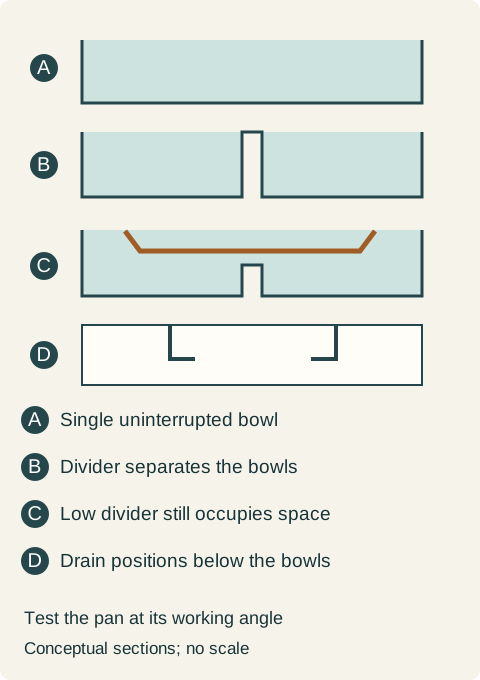
Teaching example Conceptual sections: an uninterrupted single bowl, a divided bowl and a lower divider. The pan outline can cross above the lower divider but cannot lie flat through it. The lower sketch marks separate drain locations that must be coordinated inside the sink base.
A lower divider changes the available height
A pan can extend across the middle only above the remaining divider. Below that level, the bowls are still separate. Check how the object is supported and held during washing, rather than treating the advertised total width as a flat unobstructed bottom. Do not rest a heavy pot on a divider unless the product's instructions permit that use.
Use the model's section and interior dimensions, or a physical sample, to examine that interaction. A large pan that crosses the rim while being washed is not the same requirement as a pan that must sit flat for soaking. Name which action matters to the household.
Carry the decision into the cabinet interior
Locate the selected drain outlets and any disposal, strainer or other chosen equipment on the sink-base drawing. A divided sink can introduce a different below-counter arrangement even where the outside sink width is unchanged. The installer resolves the actual piping; the cabinet plan must preserve its space and access.
Recheck a pullout bin or organizer against that arrangement. An organizer approved beside a single outlet cannot simply inherit approval after the sink changes. Avoid buying the internal fitting before the bowl and drain configuration is settled.
A choice based on the pan, not the label
In a hypothetical remodel, the household hand-washes a wide roasting pan and usually puts everyday dishes directly into the dishwasher. The proposed divided sink accepts the pan only tilted, which makes its far corner awkward to clean. A single-bowl alternative within the verified cabinet envelope permits the needed movement. The household selects that bowl, keeps a removable basin for occasional soaking and confirms where that basin is stored.
A household that frequently separates soaking from rinsing could choose differently. The order should record the tested cookware, bowl orientation and coordinated drain arrangement so that changing the sink's finish or model does not silently change the decision.
Pure White
Cream White
Light Warm Gray
Gray
Navy
Black
Oak Tone
Dark Walnut Tone
Design study These finish studies are design references, not a list of currently orderable colors. Screens and lighting change the appearance; compare a physical sample before choosing.See all finish options →
Match the selected sink to the cabinet interior, front and countertop drawing. Worked examples show why bowl width and nominal cabinet size do not settle the fit.
The basin, disposal, filter and their access requirements share the same cabinet. Resolve that complete arrangement first, then assign storage to the remaining usable regions.
Give each cook a useful dry position and a clear handoff surface, then test the moments when both need the sink. More counter space alone does not remove that shared demand.
The sample shows the door frame, a separate center panel, the face frame and the cabinet box. Each component has its own place in this Shaker construction.
Shaker construction: door frame, center panel, face frame and cabinet box. The cutaway helps locate these parts; confirm each material in the specifications for the selected cabinet.
01 / Door frame
The Shaker door has rails and stiles around a separate center panel. The frame and center panel are different components; confirm their materials in the specifications for the selected cabinet.
02 / Face frame
The face frame surrounds the opening at the front of the cabinet box and sits behind the doors. The face frame, door frame and cabinet box are separate parts.
03 / Cabinet box
The sample exposes the cabinet sides, interior surfaces and layered edges. The image does not establish the wood species or material specification of a selected cabinet.