Refrigerator drawers or a door unit: compare the shape of the load
A drawer favors a view from above, while a door unit presents shelf openings from the front. Choose from the containers you keep, not from matching cabinet-panel lines.
Start with upright height and the way you find things
Choose refrigerated drawers when the intended load fits their closed height and can be usefully arranged for viewing from above. Choose a door unit when its actual shelf configuration better serves tall containers or groups that need front access. Neither appliance shape is automatically more spacious because its external cabinet width is the same.
Sub-Zero's ID-24R reference sheet identifies refrigerator drawers with adjustable dividers. The dividers organize the drawer's footprint; that feature does not establish the clear height available for a particular bottle or covered bowl.
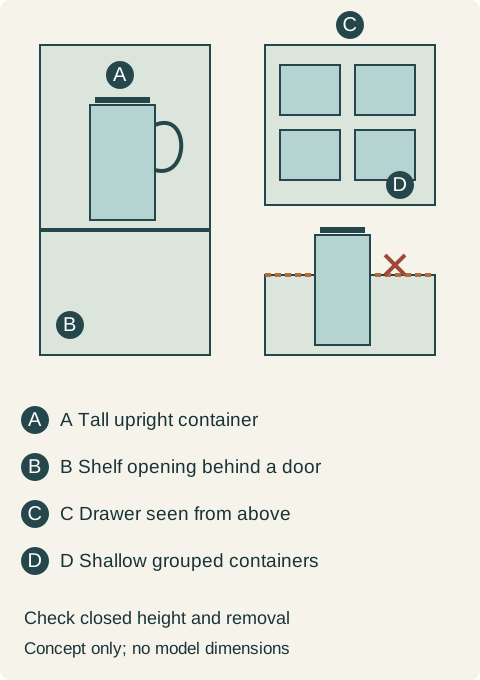
A tall pitcher may fit the total volume of a drawer while being too tall to close upright. Laying it down is not a storage solution unless the container is intended for that position. Conversely, a deep shelf behind a door can leave small jars hidden behind taller items; a drawer arrangement may make the same group visible from above.
Use the retained containers with lids, handles and any carriers. Check the opening needed to remove them, not just the space where they rest. Stacking shallow containers may increase the quantity that fits but hides the lower group and adds a lifting step. Removing a divider changes the floor arrangement, not the appliance's closed-height limit.
Teaching example Conceptual comparison: a tall upright container needs an uninterrupted vertical opening, while shallow containers can be arranged across a refrigerated drawer. The drawing shows storage shapes, not the usable dimensions of any appliance.
Follow a real assignment through both alternatives
The proposed supplement to the main refrigerator holds small covered preparation containers. They fit the checked drawer height and can stand in separate groups across its floor. Tall pitchers remain in their existing verified home in the main refrigerator. Refrigerated drawers are selected for this limited assignment because the group can be surveyed and taken out without reaching behind a deep row of bottles.
A different proposal moves the tall pitchers into that same location. They do not fit the checked drawer upright, while the compared door unit has a supported shelf arrangement that accepts them. For that assignment the door unit wins. Calling the drawer a preparation station does not make the pitcher disappear, and removing the divider does not create more vertical space.
Account for the base cabinet that is lost
Installing either appliance replaces potential dry storage. Keep a home for the bowls, pans or utensils displaced by the opening. A drawer appliance also extends into the aisle during use; check the standing position and the opposite fronts with the selected model's actual travel. A door unit needs its own hinge and shelf-access check. These are different operating envelopes even when both appear flush in elevation.
Confirm whether the specified appliance is all-refrigerator or includes a freezer compartment. A stack of drawer fronts does not identify its temperature functions. Keep the agreed contents and operating configuration with the appliance schedule, so a later change from drawers to a door, or from all-refrigerator to a combination, reopens the storage comparison.
Pure White
Cream White
Light Warm Gray
Gray
Navy
Black
Oak Tone
Dark Walnut Tone
Design study These finish studies are design references, not a list of currently orderable colors. Screens and lighting change the appearance; compare a physical sample before choosing.See all finish options →
A flush front does not establish a working installation. Confirm enclosure permission, keep the required ventilation opening effective and test the door with the actual bottles and neighboring fronts.
An open-depth dimension may start at the appliance back, while the aisle starts at its closed front. Reconcile the reference points before testing full drawer travel and retrieval.
The sample shows the door frame, a separate center panel, the face frame and the cabinet box. Each component has its own place in this Shaker construction.
Shaker construction: door frame, center panel, face frame and cabinet box. The cutaway helps locate these parts; confirm each material in the specifications for the selected cabinet.
01 / Door frame
The Shaker door has rails and stiles around a separate center panel. The frame and center panel are different components; confirm their materials in the specifications for the selected cabinet.
02 / Face frame
The face frame surrounds the opening at the front of the cabinet box and sits behind the doors. The face frame, door frame and cabinet box are separate parts.
03 / Cabinet box
The sample exposes the cabinet sides, interior surfaces and layered edges. The image does not establish the wood species or material specification of a selected cabinet.