Powder-coated MDF cabinet fronts: the edge is part of the process
Powder coating can cover shaped MDF fronts without a separate foil wrap, but the board, profile, film coverage and cure must work as a qualified process.
Consider powder-coated MDF when the design calls for a continuous coated surface around shaped edges, routed pulls or cut-outs. Compare the finished front and the process used to make it, not just the color of a flat powder-coated sample. MDF needs a different coating approach from a metal part. A finish that looks even across the broad face can still leave the more demanding edge or recess inadequately covered or cured. The purchase should establish that the proposed geometry has been produced successfully with the selected board and coating.
The board participates in electrostatic coating
TIGER identifies MDF as nonconductive or partly conductive, with board condition, preparation and cure affecting the result. Its process is project-specific. For the buyer, selecting a powder color therefore leaves a component decision unresolved. The board underneath and the routed shape have to belong to the combination that produced the accepted sample. A color swatch can identify appearance, but it cannot carry the manufacturing information needed to repeat that appearance around a recessed pull or shaped edge.
IGP describes preheating to improve conductivity and measuring the actual coated part’s surface temperature. These are distinct controls: making application possible is not the same as completing cure. A buying comparison should preserve that distinction rather than reduce the process to the statement that the part went through an oven. The useful production record follows the actual part from its prepared condition through its completed coating. A demonstration on another substrate, such as a metal color chip, does not document that MDF component.
The face and the routed edge may need different coverage
TIGER’s published Series 551 sheet advises 80 to 100 µm on the MDF face and at least 150 µm on edges and routings. Keep those requirements tied to that product. They make the relevant measurement locations clear: a face reading does not answer the edge question. For a different coating system, the applicable document must supply its own requirements. A purchaser should not combine a convenient face value from one system with an edge value from another and call the resulting mixture a demonstrated process.
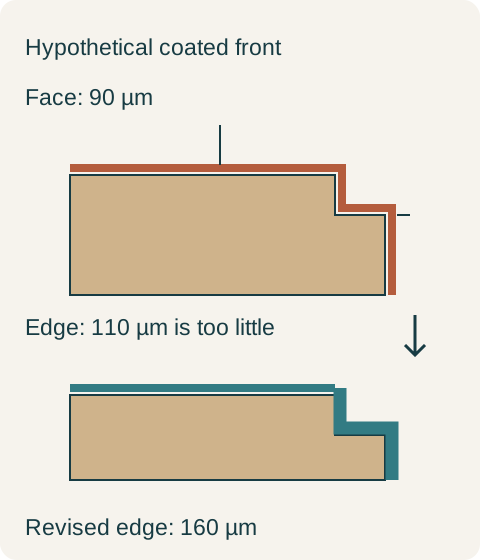
Teaching example Hypothetical readings compared with the named TIGER Series 551 sheet: face 80 to 100 µm, edge at least 150 µm. Geometry is exaggerated; thickness alone does not qualify the finished part.
A good face reading can still fail the edge requirement
For a hypothetical review using that Series 551 document, the front face measures 90 µm and a routed edge measures 110 µm. The face lies within the stated range, while the edge is below the stated 150 µm minimum. The shop does not release this sample solely because its broad face looks good. It revises application on representative routed parts and produces a new sample with a 90 µm face and a 160 µm edge. With the actual cure and the agreed finished-part qualification also accepted, the buyer approves the revised process for the fronts. Passing the thickness comparison alone would not complete that approval.
The revision is not an instruction to pile powder onto every surface. It targets the part of this example that failed its applicable requirement. A thicker film on an already acceptable face would not, by itself, establish adequate coverage inside the routed feature. The practical sample should therefore include the real edge shape and recess, rather than a flat offcut painted in the same color. If the production design later changes the pull profile or creates a new cut-out, that altered geometry needs to remain within the process that was demonstrated.
Cure means the coating reached its conditions
Series 551 specifies actual MDF-surface or coating temperature for cure and warns that insufficient cure can produce brittle, cracking film. The production implication is to separate the oven’s control setting from evidence about the part. A nominal setting is a command to equipment, while the coating’s condition is the result that matters. For a routed front, the accepted process must account for the geometry actually placed in that equipment. Repeating the setting alone is not enough information to explain what happened at the face, edge and recess.
Keep thickness acceptance and finished-part acceptance as separate judgments. The hypothetical revised sample resolves the measured shortfall at the edge, but its approval also depends on the agreed qualification of the completed front. That prevents a single favorable measurement from becoming permission to ignore the rest of the component. Retain the accepted part and the locations associated with its records so a later production question can be compared with something concrete. A generic statement that the coating passed gives less useful information than a record connected to the actual routed front.
Compare the benefit at the places it is used
A continuous powder finish can be attractive where the design would otherwise require separate edge material or a wrapped profile. Judge that benefit around the pull, corner and opening as well as across the face. Keep the selected texture and sheen in the finished sample: a very fine texture and a smooth appearance are different design choices, even when the nominal color is the same. The sample accepted in the hypothetical case includes those visible details, so the process correction is judged against the desired appearance as well as the technical conditions.
For the final purchase, retain the identified board and coating system, the representative finished front and the qualification tied to that geometry. The customer is buying a manufactured part, not a bag of powder or a generic claim that powder coating is tougher than paint. A controlled process can make the continuous surface useful. A substitute board, changed routing or altered curing method is significant because it changes the combination that produced the accepted front. Evaluate that change as a component decision before assuming the original sample still describes the order.
Pure White
Cream White
Light Warm Gray
Gray
Navy
Black
Oak Tone
Dark Walnut Tone
Design study These finish studies are design references, not a list of currently orderable colors. Screens and lighting change the appearance; compare a physical sample before choosing.See all finish options →
Judge a painted MDF door by its actual profile, finished edges and construction, with a sample that represents the size and details you intend to order.
Compare the actual countertop products, heat-source routine and fabrication proposal. A fired porcelain slab and resin-bound quartz are different materials, but neither label replaces a complete kitchen specification.
The sample shows the door frame, a separate center panel, the face frame and the cabinet box. Each component has its own place in this Shaker construction.
Shaker construction: door frame, center panel, face frame and cabinet box. The cutaway helps locate these parts; confirm each material in the specifications for the selected cabinet.
01 / Door frame
The Shaker door has rails and stiles around a separate center panel. The frame and center panel are different components; confirm their materials in the specifications for the selected cabinet.
02 / Face frame
The face frame surrounds the opening at the front of the cabinet box and sits behind the doors. The face frame, door frame and cabinet box are separate parts.
03 / Cabinet box
The sample exposes the cabinet sides, interior surfaces and layered edges. The image does not establish the wood species or material specification of a selected cabinet.