Painted MDF Cabinet Doors: Profiles, Edges and Construction
Judge a painted MDF door by its actual profile, finished edges and construction, with a sample that represents the size and details you intend to order.
MDF can be a sensible choice when a cabinet door needs a smooth painted surface and a precisely shaped profile. The useful question is whether the actual door design, finish and hardware suit the job. A generic material label cannot tell you how crisp the inside corners look, how the edge feels or whether a small sample represents the finished door you plan to buy.
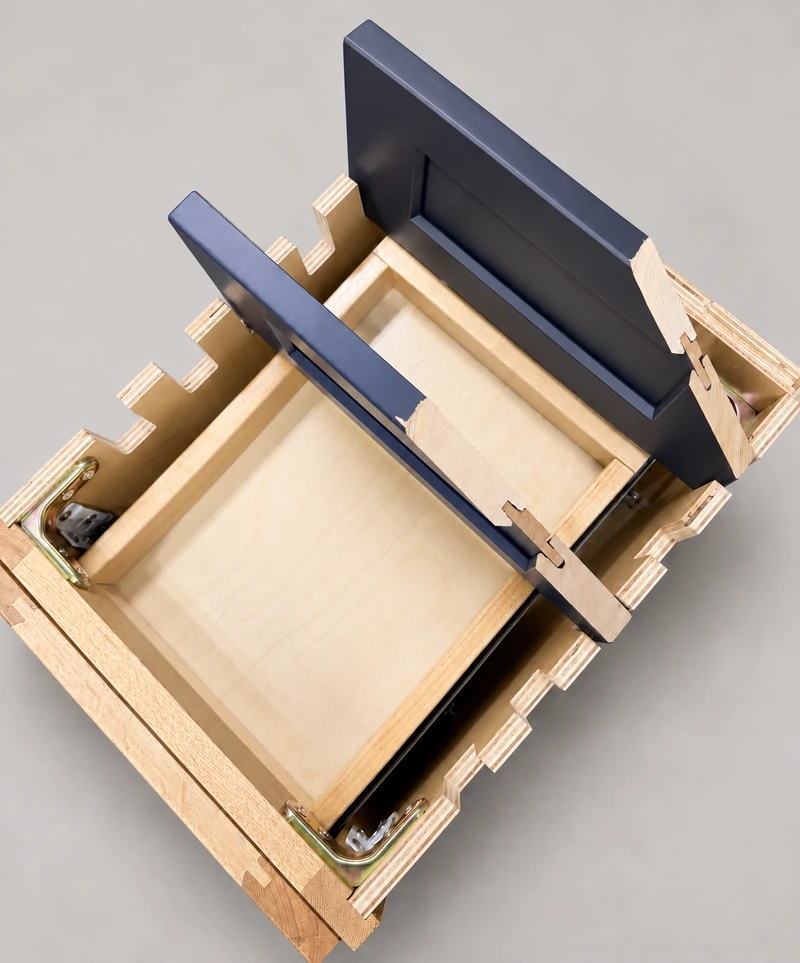
Physical sample The cut surfaces distinguish the painted shape from its interior and neighboring parts. They help locate profile details; the photograph alone does not identify MDF or establish a door specification.
Understand what the material makes possible
The Composite Panel Association describes MDF as a fiber-based panel with a smooth, uniform surface that allows intricate machining and finishing. That explains why it appears in painted profiles. It does not establish the grade, construction or durability of a particular cabinet door.
Ask whether the door is routed from a single panel or assembled from separate pieces, and whether MDF is used throughout or only for the center. A recessed outline can look similar from across a room even when its construction differs. Those differences should be written in the order description instead of inferred from a style name such as Shaker.
Inspect the profile where the tool changes direction
Look closely at the transition between the flat face and the recessed area. Examine inside corners, short curves, narrow ridges and the outside edge. Compare the sample with the approved drawing or profile image: is a corner intended to be rounded, or was a square-looking reference mistaken for a promise of a sharp corner? Resolve that visual expectation before ordering.
Tilt the finished sample under ordinary room light. The recess should be evaluated as a painted surface, not just as a machining outline. A finish can draw attention to a rough-looking area or soften a fine detail. Check the actual finished sample rather than approving an unfinished profile and assuming paint will make every transition look the same.
Compare the small drawer front as well as the tall door
A detailed profile must still work on the smallest front in the order. Request an illustration or sample of that front, including any change to its frame appearance or recessed area. Do not assume that a large door photograph tells you how a shallow drawer front will be handled. A supplier may offer a different front treatment for that situation; the selection needs to be explicit.
Also check where the pull will sit. Hold the proposed hardware against the front, with permission and without drilling. Look at whether its feet sit on a flat area and whether fingers can use it comfortably without catching a nearby ridge. Final drilling and fastening details belong to the approved door and hardware instructions.
A worked choice between similar-looking doors
Imagine that a painted cabinet package includes broad doors and narrow drawer fronts. A deep recessed profile is appealing on the full door sample, but the supplier’s small-front example uses a plain face. Another available profile keeps a visible recess on both sizes. Neither arrangement is automatically wrong. The decision is whether you prefer the intentional mix or want the front treatment to continue across the package.
Place the examples together and compare the areas that will be adjacent in the room. If you choose the mixed treatment, identify the affected drawer fronts on the order. If you choose continuity, confirm the smallest ordered front can actually receive that profile. This resolves a real appearance question that “MDF versus wood” by itself would leave unanswered.
Check the limitations before approving
Inspect the back and all edges as well as the face, and obtain the product’s care instructions. Do not treat a smooth painted face as proof that exposed cuts or damaged edges can tolerate water. Any planned site trimming, new drilling or refinishing should be reviewed against the product requirements before work begins.
Finish the selection by saving the profile name, door construction, paint selection, approved sample and any exceptions for small fronts. Include the actual hardware selection when it affects the front. If future replacement matters, ask how the profile and finish are identified for reorders. That record is more useful than a photograph labeled only “painted MDF door.”
Pure White
Cream White
Light Warm Gray
Gray
Navy
Black
Oak Tone
Dark Walnut Tone
Design study These finish studies are design references, not a list of currently orderable colors. Screens and lighting change the appearance; compare a physical sample before choosing.See all finish options →
A painted door, a wood-grain side and a plywood cabinet box can belong to the same cabinet. Here is how to read those parts, what the sample photos actually show, and which details to put on a quote.
Check the edge-to-face transition, corners and visible match on a finished sample, and separate appearance questions from claims about hidden bonding quality.
The sample shows the door frame, a separate center panel, the face frame and the cabinet box. Each component has its own place in this Shaker construction.
Shaker construction: door frame, center panel, face frame and cabinet box. The cutaway helps locate these parts; confirm each material in the specifications for the selected cabinet.
01 / Door frame
The Shaker door has rails and stiles around a separate center panel. The frame and center panel are different components; confirm their materials in the specifications for the selected cabinet.
02 / Face frame
The face frame surrounds the opening at the front of the cabinet box and sits behind the doors. The face frame, door frame and cabinet box are separate parts.
03 / Cabinet box
The sample exposes the cabinet sides, interior surfaces and layered edges. The image does not establish the wood species or material specification of a selected cabinet.