Porcelain slab or engineered quartz countertops: choose for the working kitchen
Compare the actual countertop products, heat-source routine and fabrication proposal. A fired porcelain slab and resin-bound quartz are different materials, but neither label replaces a complete kitchen specification.
Choose between porcelain slab and engineered quartz by testing the benefits you expect against the actual kitchen. If the attraction is a particular porcelain design, a documented countertop assembly and a price you accept, porcelain can be a complete choice. If the selected quartz already gives you the appearance, fabrication and care routine you want, switching categories needs a concrete benefit. “More heat resistant” is not permission to ignore a manufacturer’s hot-appliance instructions.
Different manufacturing processes, not two grades of the same slab
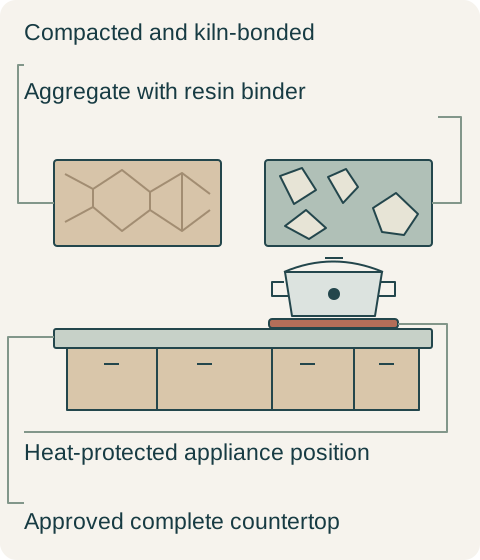
Caesarstone’s professional explanation describes porcelain manufacture through mineral compaction and kiln bonding: pressure forms the compact, then heating bonds the particles. This describes a ceramic manufacturing route, not a resin-bound quartz slab.
Caesarstone separately describes its engineered quartz as ground quartz aggregate combined with polymer resin and pigments. That is a different binding system. The comparison here concerns conventional engineered quartz; a newer surface sold under another material category should be identified on its own terms.
These distinctions explain why instructions should follow the selected product. A porcelain fabrication drawing is not automatically a quartz fabrication drawing, and a familiar quartz cleaning practice should not be copied to a different surface without checking its directions. Do not turn the manufacturing distinction into a claim that one entire category is indestructible or that all products within a category perform identically.
Teaching example Original conceptual comparison, not a microscopic view or fabrication specification. The lower sketch shows the hypothetical selected kitchen with an appliance on heat protection. The diagram does not assign a universal heat limit or strength ranking.
Test the promise against your countertop appliances
MSI’s Stile porcelain needs no sealing; its care instructions still recommend hot pads under heat-generating appliances because of rapid temperature change or sustained heating.
MSI’s Q quartz likewise needs no sealing and requires trivets or hot pads under heat-generating devices. Its instructions also identify rapid temperature change and sustained heat as concerns.
Walk through an ordinary cooking day before selecting a surface. Where does the slow cooker run? Where is a pan set down while serving? Where will the approved heat protection be stored when it is not in use? Those questions can reveal that the hoped-for advantage is not an advantage under the actual care instructions. A kitchen can accommodate protective accessories neatly; the mistake is designing as if they will never be needed.
Buy a countertop assembly, not simply a thinner-looking sample
Ask each proposal to show its finished top height, exposed front, cabinet support and appliance openings. Separate the visible front depth from the slab thickness. A deep-looking edge may be an assembly, and a slim appearance does not establish that the same cabinet support works beneath every product. Have the responsible fabricator show the proposed construction for the named material rather than choosing from loose samples by weight.
Review the sink and cooktop as part of that proposal. If keeping an existing appliance is essential, establish its actual fit and mounting arrangement before approving the surface. If one proposal changes the sink, support work or front detail, compare that complete alternative. Do not hide the change in a material allowance and discover it after the cabinet order is fixed.
Look at the finished perimeter and an example of the sink opening, not only the face design. The visible body and surface pattern can differ by product in either category. A blanket rule that all porcelain is surface-patterned while all quartz is patterned throughout would be an unreliable way to choose. Keep the edge appearance tied to the specific design and fabrication you accept.
A quartz kitchen remains the better fit after the heat comparison
In a hypothetical renovation, the owners initially prefer a softly mottled quartz design but consider paying more for porcelain because they believe it would eliminate hot pads under their slow cooker. Both shortlisted proposals use products whose instructions require that protection. The expected daily-use difference disappears when they read the actual care requirements.
The quartz proposal has an approved sink detail, the desired exposed edge and the support work included. The porcelain proposal is also feasible, but its selected pattern is less appealing to these owners and its completed price is higher in their particular quotes. They choose the quartz, keep a designated heat-protected appliance position, and retain the approved fabrication scope. They are not ranking every quartz against every porcelain product.
Had the porcelain’s actual appearance or a documented application capability been essential, that could have justified a different choice. In this kitchen, however, the extra expenditure would not deliver the benefit they had imagined. The purchasing decision is complete because the chosen assembly, routine and appearance all work together; it does not rely on treating heat protection as optional.
Keep the financial comparison on the same scope
Compare material, fabrication, finished edges, cutouts, seams, supporting work, delivery and installation. Identify who removes an old top and who reconnects the fixtures when that work is part of the renovation. A slab-only number and an installed countertop total are not competing prices for the same result. Nor does the lower slab price prove the lower completed project price.
Discuss the proposed piece layout and access route with the fabricator before assuming a large slab means a joint-free kitchen. The actual room, transport and selected design determine what must be planned. Where a seam is proposed, approve its location and appearance as part of the selection instead of treating it as evidence that one material category failed.
Keep product identity and care instructions with the final drawing. If a substitution changes the material category, do not carry over approvals for the support, openings or daily-use routine automatically. Reopen those affected details. The worthwhile purchase is the kitchen you can actually install and use, including the ordinary accessories that make its care manageable.
Pure White
Cream White
Light Warm Gray
Gray
Navy
Black
Oak Tone
Dark Walnut Tone
Design study These finish studies are design references, not a list of currently orderable colors. Screens and lighting change the appearance; compare a physical sample before choosing.See all finish options →
A patterned surface and a patterned slab body are different features. Compare an actual cut edge and sink opening before choosing the fabrication detail.
A laminate top is a surfaced assembly; quartz is an engineered slab. Judge the finished edge, sink system, care and installed scope before treating a stone-like pattern or a material reputation as the answer.
Compare a complete tile-and-grout installation with a specified slab surface. The choice changes the wall’s repeated joints, material transitions, care and finished edges.
The sample shows the door frame, a separate center panel, the face frame and the cabinet box. Each component has its own place in this Shaker construction.
Shaker construction: door frame, center panel, face frame and cabinet box. The cutaway helps locate these parts; confirm each material in the specifications for the selected cabinet.
01 / Door frame
The Shaker door has rails and stiles around a separate center panel. The frame and center panel are different components; confirm their materials in the specifications for the selected cabinet.
02 / Face frame
The face frame surrounds the opening at the front of the cabinet box and sits behind the doors. The face frame, door frame and cabinet box are separate parts.
03 / Cabinet box
The sample exposes the cabinet sides, interior surfaces and layered edges. The image does not establish the wood species or material specification of a selected cabinet.