NKBA’s 2026 labor findings: an easier market can still leave your installation unbooked
The public labor study separates shortage severity from how widely shortages occur. Use that distinction to plan cabinet delivery and installation together.
NKBA’s September 24, 2026 summary reports significant or moderate labor shortages at 40%, versus 58% in 2024, while 84% experienced some shortage. Its survey covered more than 500 kitchen-and-bath professionals in the United States and Canada.
Public information reviewed October 23, 2026. For a cabinet buyer, the useful response is to connect the delivery decision to an actual installation arrangement. A less severe industry problem can coexist with a particular crew having no opening when a household needs one. The figures do not establish the availability of any local installer.
Severity and reach answer different questions
Think of severity as how difficult a shortage feels to a business, and reach as how many businesses encounter it at all. Those measures can move differently without contradicting each other. A business might have enough people for its scheduled work but little room for another project. Another might accept a job only after moving its start date. Neither situation can be resolved by knowing that cabinets are available to ship.
Do not add the reported shortage categories as if they describe separate groups of projects. Nor does a change between survey years mean that each individual respondent improved. For your project, the missing evidence is a named team’s commitment to a defined scope. A national headline supplies context for that conversation; it does not supply the appointment.
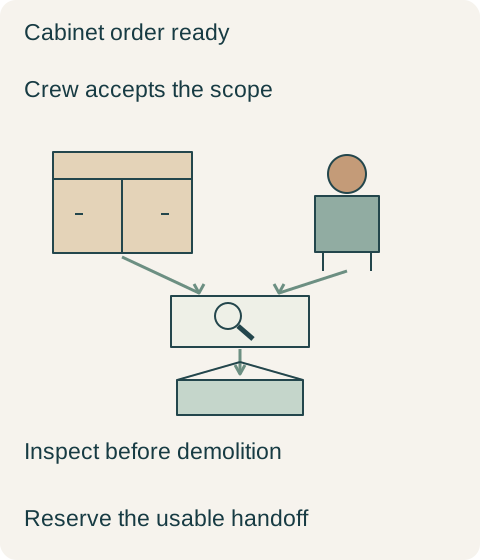
Teaching example Hypothetical planning diagram: cabinet readiness and crew availability must meet before the installation handoff. No duration or local labor availability is predicted.
Work backward from the installation handoff
Start with what the installer must receive: a usable room, the approved cabinet arrangement, the complete order and decisions about visible ends and trim. Then identify who resolves a missing or damaged part. An installer arriving before that handoff is ready may be unable to finish the agreed work, even if the delivery itself arrived on time. Buying faster does not automatically make the project ready faster.
Separate an estimated opening from a reserved start. An estimate says when a crew might be available if other work proceeds as expected. A reservation should describe the job being accepted, its prerequisites and the process if the delivery changes. This distinction helps both parties avoid treating a casual scheduling conversation as a complete installation commitment.
A ready order does not justify an early demolition
In a hypothetical renovation, the household can obtain its preferred cabinet set promptly. Its chosen installer has accepted the scope but cannot start until after another job. The household initially considers removing the old kitchen as soon as the new cabinets arrive. That would create an unusable room without advancing the installer’s availability.
Instead, it keeps the functioning kitchen until the agreed preparation window. The buyer arranges delivery, inspection and storage before demolition, with the actual delivery and storage conditions included in the plan. The installer receives the final drawing and a list of required trim pieces before the start is reserved. The household accepts the later start because it shortens the period when neither kitchen can be used. This is a planning choice for this hypothetical household, not a promised project duration.
When an earlier crew is a real alternative
An earlier installer is worth comparing when that team can accept the same scope. Compare the visible finished result: assembled cabinet placement, end panels, fillers, trim, door adjustment and the handling of incomplete items. A narrower quotation may look faster because some finishing work has been left for someone else. Establish who will do that work before exchanging a known start for an earlier but incomplete offer.
If the existing kitchen cannot remain usable, the decision changes. Temporary meal preparation, access through the work area and the household’s tolerance for disruption become part of choosing the schedule. The useful purchase result is a cabinet order and an installation plan that can meet each other, with a clear response when a component is missing. The labor news is a reason to make that connection early, not evidence that every project must be delayed.
Pure White
Cream White
Light Warm Gray
Gray
Navy
Black
Oak Tone
Dark Walnut Tone
Design study These finish studies are design references, not a list of currently orderable colors. Screens and lighting change the appearance; compare a physical sample before choosing.See all finish options →
A useful punch list identifies the exact location, missing or incorrect part and the evidence needed to finish. Keep unresolved work visible instead of treating delivery or a closed door as completion.
The quarter’s current-activity and near-term readings pointed in different directions. For cabinet businesses, that distinction matters when choosing between preparing for demand and committing to additional inventory.
The sample shows the door frame, a separate center panel, the face frame and the cabinet box. Each component has its own place in this Shaker construction.
Shaker construction: door frame, center panel, face frame and cabinet box. The cutaway helps locate these parts; confirm each material in the specifications for the selected cabinet.
01 / Door frame
The Shaker door has rails and stiles around a separate center panel. The frame and center panel are different components; confirm their materials in the specifications for the selected cabinet.
02 / Face frame
The face frame surrounds the opening at the front of the cabinet box and sits behind the doors. The face frame, door frame and cabinet box are separate parts.
03 / Cabinet box
The sample exposes the cabinet sides, interior surfaces and layered edges. The image does not establish the wood species or material specification of a selected cabinet.