A cabinet trend survey is useful for finding ideas to investigate. Before it changes your cabinet order, check who answered and what they were asked. A forecast from designers, a preference poll among website visitors and a record of completed purchases describe different things. None can choose the right drawer arrangement, finish or cabinet size for your kitchen without a separate fit check.
Read the question behind the headline
A headline may call a finish “popular” while the underlying question asks whether professionals expect more requests for it. That is an expectation about direction, not necessarily the most common current choice. Another report may ask respondents to select every feature they consider desirable. Its results should not be read as mutually exclusive shares of cabinet sales.
Find the original wording, response choices and relevant note below the chart. AAPOR’s survey guidance explains why the population, sample and question design matter to interpreting results. Apply that distinction before repeating a cabinet statistic: name the respondents and the action they reported, rather than replacing both with the broad phrase “American homeowners.”
In a hypothetical example, 80 responding designers answer a question about whether requests for a cabinet feature will increase. Of those respondents, 48 say yes, giving 60%. The defensible description is that 60% of the responding designers expected an increase. It does not say 60% of homeowners bought the feature, and it does not say the feature will occupy 60% of next year’s orders. These are invented figures for explaining the distinction, not findings from a real report.
Also look for who was eligible to respond and how people were invited. A survey of a particular professional membership can describe that group without representing every remodeling project. A large response count does not automatically remove a mismatch between the surveyed audience and your question. If the report does not explain its sample, keep the uncertainty with the claim.
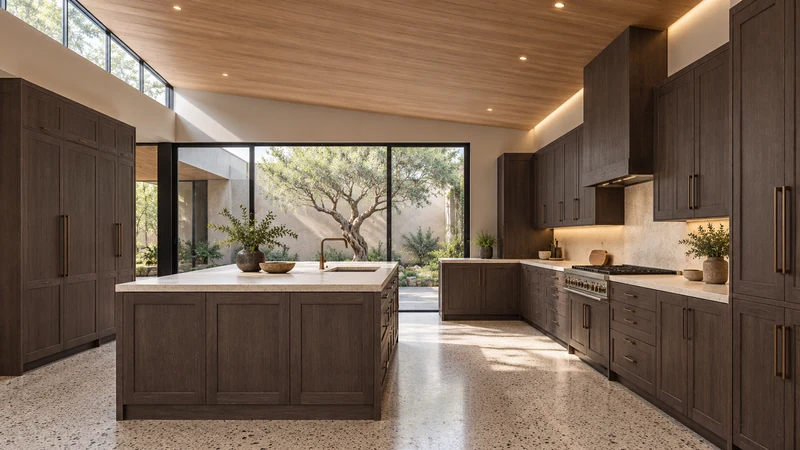
Design study This room is a design study, not a data point from a trend survey. Its appearance can help you describe a preference; it cannot establish how often that preference is purchased.
Compare the surveyed projects with your own
Check whether respondents describe new construction, full remodels, replacement cabinet orders or a mixture. A feature reported in large custom kitchens may be difficult to reproduce in a retained layout. If your sink and refrigerator must stay in place, an enthusiastic report about oversized islands is less relevant than the actual circulation and storage you can achieve.
Geography and price range can also affect relevance. Do not assume that a national design forecast establishes local stock or a particular project budget. Use the report to ask a better question of the supplier: which compatible product creates the desired effect, and what does it change in the written order? Availability and pricing still require a current, specific proposal.
Treat “growing” as a comparison that needs context
When an article compares reports from different periods, check that it is comparing the same question and audience. A new response option or a different group of respondents can change a percentage without showing the same people changed their preferences. Look for the report’s own explanation before calling a movement a lasting trend.
A rising percentage also says little about whether you will enjoy the feature. Consider the daily consequence. An open shelf may suit someone who keeps a small display tidy but be a poor substitute for concealed food storage in another household. Ask what the feature adds and which useful cabinet space it displaces.
Use the report to refine a shortlist
Write down the specific feature you want to test, the source’s exact audience and any uncertainty in the finding. Then compare a sample, layout or product drawing with your room and routine. Keep the feature if it works even without the popularity claim. This leaves you with a cabinet choice supported by your own needs, while the report has done its useful job of introducing an option you might otherwise have missed.
Pure White
Cream White
Light Warm Gray
Gray
Navy
Black
Oak Tone
Dark Walnut Tone
Design study These finish studies are design references, not a list of currently orderable colors. Screens and lighting change the appearance; compare a physical sample before choosing.See all finish options →
The sample shows the door frame, a separate center panel, the face frame and the cabinet box. Each component has its own place in this Shaker construction.
Shaker construction: door frame, center panel, face frame and cabinet box. The cutaway helps locate these parts; confirm each material in the specifications for the selected cabinet.
01 / Door frame
The Shaker door has rails and stiles around a separate center panel. The frame and center panel are different components; confirm their materials in the specifications for the selected cabinet.
02 / Face frame
The face frame surrounds the opening at the front of the cabinet box and sits behind the doors. The face frame, door frame and cabinet box are separate parts.
03 / Cabinet box
The sample exposes the cabinet sides, interior surfaces and layered edges. The image does not establish the wood species or material specification of a selected cabinet.