Q2 2026 KBMI: stronger expectations did not equal stronger current orders
The quarter’s current-activity and near-term readings pointed in different directions. For cabinet businesses, that distinction matters when choosing between preparing for demand and committing to additional inventory.
The gap matters before placing a larger purchasing commitment
Cabinet businesses can prepare for a possible improvement without immediately buying all the stock that improvement would require. The useful distinction is between being ready to respond and becoming committed to goods that need future customers. The second-quarter KBMI offers a concrete example of why those decisions should not be merged.
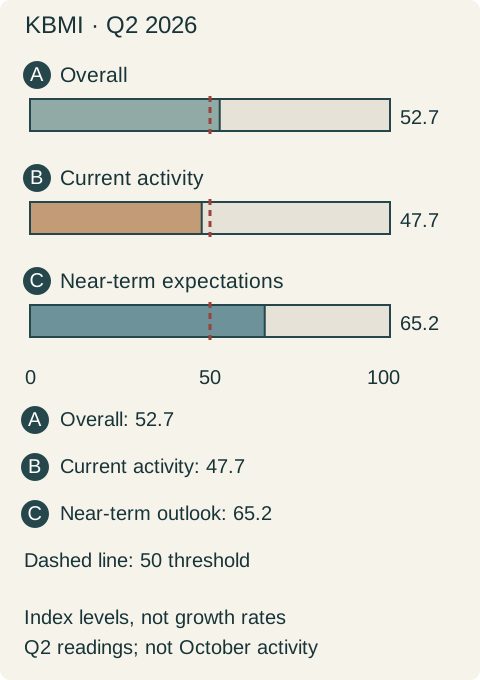
NKBA's Q2 2026 public summary reports an overall index of 52.7, current activity of 47.7 and near-term expectations of 65.2, against a 50 expansion threshold.
The overall result and the stronger outlook could encourage a business owner. The current-activity reading, however, supports a different immediate question: what work is already supporting the next purchase? A prospective improvement can justify preparation, but it does not turn inquiries into customer orders or make an undedicated cabinet batch self-financing.
Keep this quarter's evidence in its own time
A subsequent Q3 2026 report was published on October 22. The figures discussed here remain the earlier quarter's readings; they are not a measurement of October trading or proof that the earlier expectations were realized.
Treat this as a dated business case. An owner reviewing purchasing today should use the firm's present commitments, actual order movement and current supplier terms. The earlier published gap remains useful because it shows how a positive overall headline can coexist with a weaker measure of activity already taking place.
The index levels are not percentage sales changes. Subtracting the current bar from the expectations bar would not give a promised increase in revenue. Nor does the higher expectations level describe the share of cabinet customers who signed orders. The measures answer different questions and do not convert into a stock quantity for a particular dealer.
Diagram Original chart of the published Q2 2026 KBMI readings: A overall index, B current activity, C near-term expectations. Bar lengths share the same scale; the dashed line marks 50. These are index levels, not sales-growth percentages or a forecast fulfillment rate. The near-term bar describes expectations held during that quarter, not later observed sales.
Prepare the response before increasing the obligation
Preparation can mean refreshing the available product information, confirming current supplier terms, reviewing an alternative supported cabinet line or checking which existing team resources could handle more orders. Each action should have a defined purpose and cost. None should be described as free flexibility if it actually requires a payment or commitment.
An additional stock order is a different decision. Once released under noncancelable terms, it may occupy cash and warehouse space before a customer has chosen its widths, front family or finish. Cabinet products are not interchangeable simply because they serve the same room. Demand for complete customer-specific kitchens may not match the speculative assortment being offered to the dealer.
Separate purchases already tied to accepted customer work from additional inventory meant for possible future sales. Holding the latter does not require delaying the former. Equally, releasing committed jobs does not establish a reason to expand every stock category. The distinction should be visible in the purchasing proposal before an industry outlook is used to support it.
Test the dealer's own evidence against the proposed assortment
Review the actual movement from inquiry to selected layout, agreed scope and customer commitment. A busy quotation desk can coexist with postponed decisions. Look at whether the projects being discussed need the cabinet family and configuration in the proposed additional order. Generic interest in remodeling does not resolve that product match.
Then review the supplier's actual terms: what is ordered now, when changes stop being possible, when payment and delivery occur and what cancellation or return rights exist. Do not assume a deposit buys a production reservation or that a blanket order remains editable. The available agreement determines the obligation.
The stock itself needs a credible route to use. Check the complete combinations customers would need, including relevant ends, fillers and companion fronts, rather than evaluating only the most common boxes. A low unit price on an incomplete assortment can leave the dealer buying additional pieces later to finish each sale. That is an operating issue the headline index cannot resolve.
A distributor retains readiness and declines an unmatched bulk order
In a hypothetical quarter-end review, a cabinet distributor has accepted customer jobs ready for release and a larger group of inquiries that have not settled their layouts. A supplier offers an additional noncancelable stock purchase in a limited finish and width assortment. The offer is separate from the goods needed for the accepted jobs.
The sales manager points to the stronger industry outlook as a reason to buy the extra stock. The purchasing review finds that the open inquiries are not concentrated in that assortment. Several prospects are still choosing between materially different cabinet families. The proposed stock therefore cannot be assigned to those prospects without assuming both a sale and a product choice that have not occurred.
The alternative releases the accepted customer orders under their agreed scope while retaining the current stock plan. The team refreshes supplier information and prepares quotations for the unresolved prospects. It also verifies the supplier's current ordering conditions so a future customer commitment can be translated into an actual purchase promptly. No unpromised production slot is counted as reserved.
The distributor chooses the alternative and declines the additional noncancelable batch. This does not express a forecast that the market will fall. It reflects the mismatch between this stock proposal and the firm's present customer commitments. The firm accepts the possibility that a later order may arrive on different terms rather than buying an assortment it cannot currently justify.
The decision can change when a defined group of customer orders requires that assortment and the complete supplier proposal remains acceptable. The trigger is evidence supporting the specific goods and obligation, not another optimistic conversation. The firm does not need to wait for every uncertainty to disappear, but it does need a purchase it can explain without treating expectations as completed business.
A stronger outlook can support action without dictating the stock order
The practical lesson from this quarter is not to freeze the business whenever current activity is weaker. It is to choose actions appropriate to what is known. Preparing people and product information, fulfilling committed work and adding speculative inventory expose the business to different obligations.
Review each proposed expansion on that basis. An industry outlook can prompt the discussion; the firm's current orders, usable assortment and contractual terms should determine the commitment. That gives a cabinet business a way to remain responsive while keeping a prospective recovery separate from goods it has already agreed to buy.
Pure White
Cream White
Light Warm Gray
Gray
Navy
Black
Oak Tone
Dark Walnut Tone
Design study These finish studies are design references, not a list of currently orderable colors. Screens and lighting change the appearance; compare a physical sample before choosing.See all finish options →
The association’s monthly release reports lower sales than a year earlier. That result does not establish a matching discount on a particular cabinet order.
The sample shows the door frame, a separate center panel, the face frame and the cabinet box. Each component has its own place in this Shaker construction.
Shaker construction: door frame, center panel, face frame and cabinet box. The cutaway helps locate these parts; confirm each material in the specifications for the selected cabinet.
01 / Door frame
The Shaker door has rails and stiles around a separate center panel. The frame and center panel are different components; confirm their materials in the specifications for the selected cabinet.
02 / Face frame
The face frame surrounds the opening at the front of the cabinet box and sits behind the doors. The face frame, door frame and cabinet box are separate parts.
03 / Cabinet box
The sample exposes the cabinet sides, interior surfaces and layered edges. The image does not establish the wood species or material specification of a selected cabinet.