Which folded stroller dimensions should determine a mudroom cabinet?
Use the configuration the household will actually store, including any removed seat and accessories. The smallest published folded size may describe only part of the complete kit.
Size a stroller compartment from the complete stored configuration the household will use. A published folded dimension may describe the frame without its seat, while the family's normal routine keeps the seat attached. A cabinet that fits the smaller state has not solved storage unless every removed part also has a practical place.
Read the condition beside the dimensions
Look for what remains attached when the measurement is taken. Seat, wheels, adapters and other accessories can affect the relevant configuration, but do not assume which parts may be removed or left in place. Use the selected stroller's own instructions and specifications. The cabinet discussion should record that condition rather than copy the smallest number from a comparison chart.
UPPAbaby's US Vista V3 specification separates unfolded dimensions, folded dimensions with the seat attached and folded dimensions without the seat. Its product description also distinguishes the seat-on and seat-off fold. That is a clear example of why the word folded does not identify a single complete object for a furniture drawing.
Frame-only storage can be a sensible choice if it matches the household's routine and the detached component has suitable storage. It is not automatically the more efficient arrangement. The seat may occupy another substantial volume, and separating it adds a repeated step. Count the whole kit and the return sequence before selecting a shallower cabinet.
Keep the empty-equipment trial separate from use
Carry out the layout review with an empty stroller and follow its instructions; a cabinet mockup is not a place to test child use. Confirm the stored orientation permitted for that product and the way the adult actually handles it. A dimensioned rectangular envelope is useful, but it does not establish where the hands can grip or how the equipment passes the furniture opening.
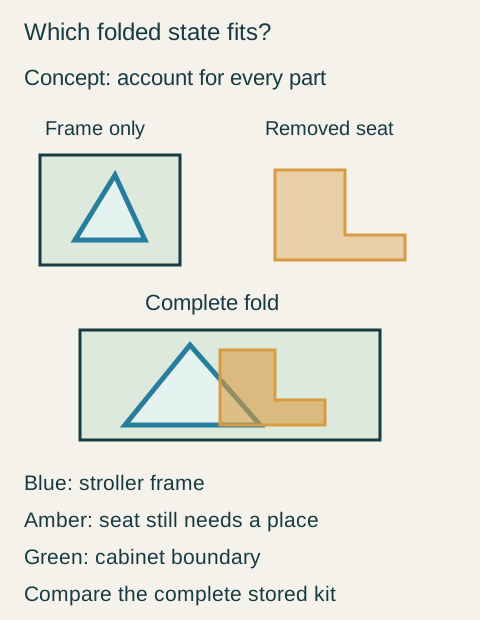
Teaching example Concept comparison of stored parts: the blue frame fits the shallow green cabinet in the first proposal, but its removed amber seat has no assigned place. The deeper alternative contains the folded frame with the seat attached. These are simplified configuration outlines, not Vista V3 dimensions or folding instructions.
Show the cabinet doorway, hinges, bottom edge and nearby room door. A folded object can fit inside yet require an awkward lift over a raised lip or a turn that is unavailable outside the opening. If an open parking bay is being compared, identify how its boundary and surrounding storage preserve the necessary route without assuming that every stroller stores identically.
The smaller specification leaves a seat behind
In a hypothetical entry remodel, the first tall-cabinet proposal uses the stroller's smallest listed folded state. The frame fits neatly, so the drawing labels the compartment complete stroller storage. The review then establishes that the cited state excludes the seat, which the household normally keeps attached. No other compartment has been assigned to that seat.
The owner compares a frame-only bay plus a separate seat location with a single deeper compartment for the normal folded combination. The separated option requires handling and parking the seat during every arrival and departure. The available shelf also fails the actual seat outline, so the proposal is incomplete even before that routine is accepted.
The revised order provides one compartment sized and opened for the verified seat-attached fold. A trial confirms the equipment can be placed and removed with the cabinet doors and the room entrance in their normal relationship. Neighboring storage keeps its selected depth; the entire wall is not deepened merely because this one bay needs a different configuration.
Preserve the configuration in the order
The household chooses that deeper bay because it matches the routine it will maintain. The storage schedule includes the ordinary accessories in their permitted stored condition, and any items removed before folding have identified destinations. The upper compartment is counted only where its shelf and contents leave the verified withdrawal space intact.
The final drawing names the stored state beside the measured outline. If the seat, accessory combination or stroller changes, the fit must be reconsidered. Reusing a generic folded-stroller label would lose the very information that made the cabinet purchase workable.
Pure White
Cream White
Light Warm Gray
Gray
Navy
Black
Oak Tone
Dark Walnut Tone
Design study These finish studies are design references, not a list of currently orderable colors. Screens and lighting change the appearance; compare a physical sample before choosing.See all finish options →
Entry gear and clean laundry can share a room without sharing every surface. Assign the arrival, washing and departure tasks before choosing one continuous cabinet run.
Separate daily supplies, reserve packages and objects that belong elsewhere. Cabinet size should reflect a usable inventory, not everything temporarily piled in the laundry room.
The sample shows the door frame, a separate center panel, the face frame and the cabinet box. Each component has its own place in this Shaker construction.
Shaker construction: door frame, center panel, face frame and cabinet box. The cutaway helps locate these parts; confirm each material in the specifications for the selected cabinet.
01 / Door frame
The Shaker door has rails and stiles around a separate center panel. The frame and center panel are different components; confirm their materials in the specifications for the selected cabinet.
02 / Face frame
The face frame surrounds the opening at the front of the cabinet box and sits behind the doors. The face frame, door frame and cabinet box are separate parts.
03 / Cabinet box
The sample exposes the cabinet sides, interior surfaces and layered edges. The image does not establish the wood species or material specification of a selected cabinet.