Blotchy maple or cherry stain: darker color or a more even finish?
A stain name does not guarantee an even cabinet finish. Evaluate the complete preparation and coloring process, including the tradeoff between depth and uniformity.
If a maple or cherry sample stains unevenly, do not assume a darker stain will make the variation disappear. Choose the finished appearance through a controlled shop trial using the proposed wood and complete finishing process. The colorant name is only one part of that process. A buyer may need to choose between a deeper, more varied result and a lighter, more uniform result, or approve a different finish system.
Why the same stain can produce different patches
The American Hardwood Information Center links staining behavior to wood grain and cell structure and notes blotching on maple and cherry. It describes a wash coat as a way to improve uniformity, while warning that it may make deep stain colors harder to achieve.
That tradeoff explains why changing preparation can change the final color even when the stain label stays the same. A pretreatment that limits uneven penetration also changes how the color develops. It should be treated as part of the selected finishing system, with compatibility and application controlled by the finisher. A generic wash-coat explanation is not a recipe to mix or apply to an installed cabinet.
The useful comparison holds the wood selection, profile, sanding preparation and final topcoat as consistent as the trial permits, while clearly identifying the process change being assessed. If every sample changes wood, stain and sheen together, a more even result cannot be attributed to one step. Include the completed topcoat in the approval; an intermediate stained surface is not yet the finished appearance the buyer will receive.
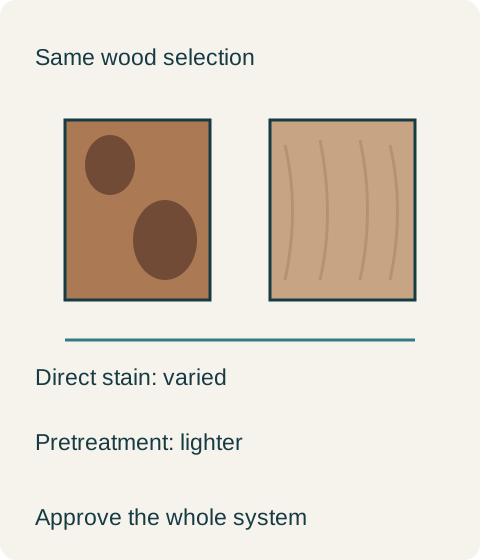
Teaching example Hypothetical process comparison. Patch contrast and lighter tone illustrate a possible tradeoff, not a prediction for a named coating or an instruction for field refinishing.
Choose between deeper color and a more even appearance
Suppose a hypothetical customer wants dark, transparent maple doors. The shop presents completed trials on representative material: the direct-stain trial has the preferred depth but conspicuous dark patches; the compatible pretreatment trial is more even but lighter. The customer decides that uniformity matters more and approves the lighter completed trial with its exact process. The accepted order now targets that result, not the original dark reference plus an unsupported promise that blotches will vanish.
In that hypothetical choice, the shop does not simply add more stain until the pretreatment sample looks as dark as the first. That would be another process change needing its own completed trial. If neither result is acceptable, the unresolved choice is a different documented finish package, not an instruction to reproduce contradictory sample attributes. The buyer should not approve the color from one sample and the uniformity from another as though a combined result had already been demonstrated.
What a stain trial can and cannot explain
Blotching does not automatically identify bad workmanship, but the natural tendency does not excuse every delivered patch. A sample trial establishes the proposed result and its accepted variation. It does not diagnose contamination, preparation differences or an incorrect finish on a delivered piece. Compare the actual part with the approved complete sample and process record before deciding whether it represents expected variation or a separate issue.
Pay particular attention to a framed door’s transitions. The center, frame and shaped edges may not present the same surface orientation or construction. A flat scrap is useful for a process trial, but it cannot stand in for every feature of the final door. The final approval should include representative details where unevenness would be most visible, so the shop and buyer agree on the actual object rather than an easier-to-finish surrogate.
For a later replacement, preserve both appearance identity and process identity. Recording only the commercial stain name leaves pretreatment and topcoat unresolved. A replacement trial should be assessed against the current installed group as well as the retained reference. That permits a deliberate match decision without assuming the name on the stain container carries the whole manufacturing specification.
Pure White
Cream White
Light Warm Gray
Gray
Navy
Black
Oak Tone
Dark Walnut Tone
Design study These finish studies are design references, not a list of currently orderable colors. Screens and lighting change the appearance; compare a physical sample before choosing.See all finish options →
A color name does not identify a finish system. Compare the decorative surface, the core, the edge and the repair method before choosing a cabinet front.
A cabinet color that looks warm online can read differently next to your floor. Compare an identified physical sample in the positions and lighting where the cabinets will live.
The sample shows the door frame, a separate center panel, the face frame and the cabinet box. Each component has its own place in this Shaker construction.
Shaker construction: door frame, center panel, face frame and cabinet box. The cutaway helps locate these parts; confirm each material in the specifications for the selected cabinet.
01 / Door frame
The Shaker door has rails and stiles around a separate center panel. The frame and center panel are different components; confirm their materials in the specifications for the selected cabinet.
02 / Face frame
The face frame surrounds the opening at the front of the cabinet box and sits behind the doors. The face frame, door frame and cabinet box are separate parts.
03 / Cabinet box
The sample exposes the cabinet sides, interior surfaces and layered edges. The image does not establish the wood species or material specification of a selected cabinet.