Will a long utensil fit diagonally in a kitchen drawer?
The corner-to-corner measurement is only a first check. A spoon, whisk or spatula also needs room for its head, your hand and the movement that brings it out.
A long utensil may fit diagonally when it does not fit front to back, but the drawer’s diagonal is not its usable storage length. That measurement describes a line between corners. A real spatula has a broad head, a whisk has a rounded cage, and both need a way to leave the drawer without dragging everything else with them. Test the whole outline before assigning the drawer.
Start inside the drawer box
Measure the clear floor where the utensil will actually rest, after allowing for a liner, organizer and any divider. The width of the drawer front is not the width of that space. If the sides slope, measure at the height occupied by the utensil, and note any corner shape that prevents its tip from reaching the mathematical corner.
For a hypothetical clear rectangle 20 inches long and 10 inches wide, the corner-to-corner line is approximately 22.36 inches. A 22-inch utensil is shorter than that line, but the calculation does not establish fit. Its head and handle occupy width on either side, and those edges may hit the box before the ends reach their proposed positions.
Trace the object rather than drawing a single line
Lay the actual utensil on paper and trace its outline, including a hanging loop or a curved handle. Place that shape inside a paper outline of the available drawer floor. Turn it as a complete shape. If you shorten the head to make the sketch fit, you have removed the very part most likely to cause the conflict.
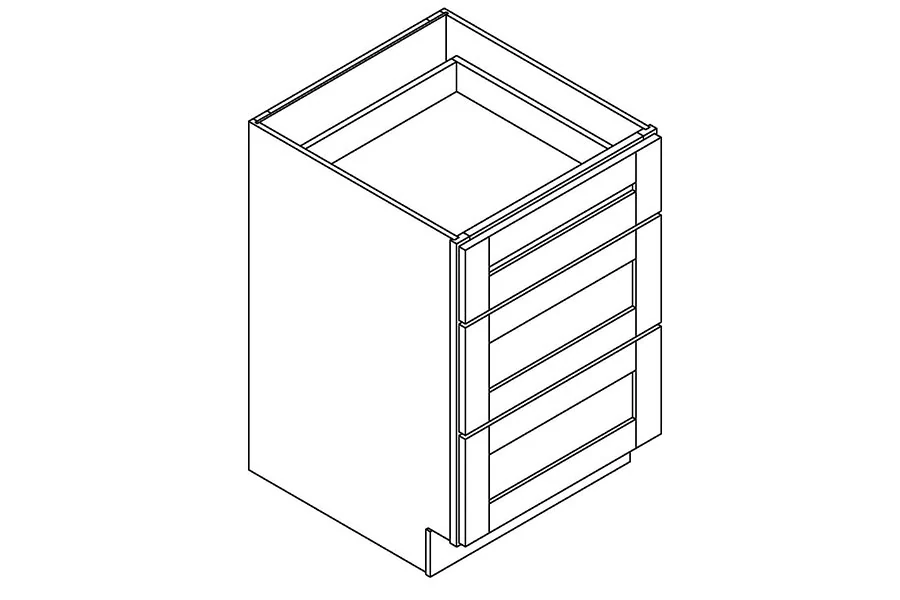
Diagram A wide front does not establish usable drawer length. Measure the selected drawer box and organizer before testing a diagonal arrangement.
Try the utensil in its normal resting position. A whisk can roll; a scoop may stand higher at its bowl; a bent spatula may leave its handle elevated. Check the closed-drawer envelope as well as the floor. Do not plan to shut the drawer by pressing the utensil into a different shape or trapping its handle beneath another item.
Give the handle somewhere to be picked up
Open the drawer to its normal stop and try the intended grip. A handle wedged into a rear corner may fit on the floor but be difficult to reach. Leave a practical place for the fingers to get underneath or beside it, then follow the movement out past the drawer front and countertop edge.
Repeat with neighboring utensils present. Diagonal storage can cross the paths of straight compartments, so removing a long spoon may disturb shorter tools in several areas. A dedicated open compartment can work better than forcing the item across a fitted tray. If it only comes out after other utensils are removed, decide whether that is acceptable for how often you use it.
Choose between a dedicated drawer area and another location
Compare the diagonal arrangement with a longer clear drawer, a differently oriented divider or another suitable storage location. The useful choice preserves ordinary access to the rest of the tools. Maximum item count is a poor reason to make the utensil used every evening the hardest one to retrieve.
Keep the traced outline, actual floor dimensions and organizer model with the cabinet plan. Before ordering, confirm the interior of the specific drawer rather than transferring dimensions from a display with a similar front. Rehearse returning the utensil too: a position that works only when everything is arranged precisely may not survive routine unloading and cleanup.
Pure White
Cream White
Light Warm Gray
Gray
Navy
Black
Oak Tone
Dark Walnut Tone
Design study These finish studies are design references, not a list of currently orderable colors. Screens and lighting change the appearance; compare a physical sample before choosing.See all finish options →
Start with an agreed task and a small selected dish set. Place it outside active cooking movements and make both taking and putting away understandable.
The sample shows the door frame, a separate center panel, the face frame and the cabinet box. Each component has its own place in this Shaker construction.
Shaker construction: door frame, center panel, face frame and cabinet box. The cutaway helps locate these parts; confirm each material in the specifications for the selected cabinet.
01 / Door frame
The Shaker door has rails and stiles around a separate center panel. The frame and center panel are different components; confirm their materials in the specifications for the selected cabinet.
02 / Face frame
The face frame surrounds the opening at the front of the cabinet box and sits behind the doors. The face frame, door frame and cabinet box are separate parts.
03 / Cabinet box
The sample exposes the cabinet sides, interior surfaces and layered edges. The image does not establish the wood species or material specification of a selected cabinet.