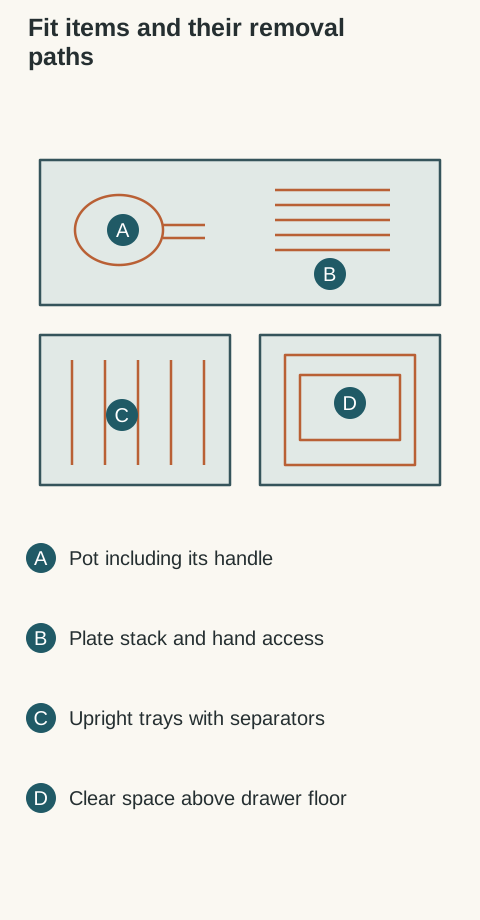
Choose storage around the cookware you intend to keep. The largest pot diameter is only part of its footprint: handles, lids and the way you lift it out can determine the usable cabinet. Put the collection on a table, remove duplicates you no longer want and record the remaining objects before comparing cabinet interiors.
Measure the way the item will be stored
For a pan, record the full handle-to-handle envelope and its height with the lid in the intended position. For plates, measure the actual stack and the space needed to grasp its sides. Trays need their outside rim, not the cooking surface printed on the package. Write down whether objects nest, stack or stand separately.
Blum's organization guide shows purpose-made arrangements for cookware, plates and containers. Treat them as examples of how dividers can control movement, not proof that a named accessory fits your cabinet. The selected drawer box, organizer and hardware must be compatible, and their load information must describe the actual installed assembly.
A deep drawer presents its contents when opened, while a door cabinet may offer a more flexible tall compartment. An interior rollout adds access but requires the outer door to open far enough first. Compare these options with the same pot collection and include the extra opening motion rather than looking only at nominal cabinet width.
Measure clear interior width and depth, then the vertical space above the drawer floor when closed. A tall front does not equal tall usable space. Include runners, rails, hinges and any upper drawer bottom. Check the lifting path for the largest pot: fitting it inside after a careful tilt does not make daily removal comfortable.
Diagram Conceptual storage map separates cookware footprints, plate stacks and upright tray slots. Shapes are not standard sizes or a cabinet load recommendation.
Make plate storage match unloading and serving
Locate everyday plates where the person unloading the dishwasher can put them away without crossing the main preparation task. Compare an accessible upper shelf with a supported plate arrangement in a base drawer. Test the actual grip and lifting motion. Some users prefer lifting a small stack from below; others find a reachable shelf easier.
A plate holder or divider should fit the plate shape and remain within its intended use. Check its effect on clear width and the total loaded drawer weight. Avoid using a hardware rating as a promise for an entire cabinet or wall attachment. Keep heavier serving pieces in a separately reviewed location rather than adding them to a drawer simply because there is room.
Give trays a slot and an exit route
Vertical dividers can separate baking sheets, cutting boards and cooling racks so that retrieving one does not disturb the whole stack. Set slot spacing from the actual edges, handles and thicker boards. Check the clear height and depth with the door and hinges installed. A sloped rack may suit a low compartment but changes how the tray is removed.
Test the exit path using a cardboard outline of the largest tray. A tray can fit behind a door yet fail to turn past a neighboring pull. Storage over a refrigerator can be visually convenient but difficult for a heavy board or for the person who bakes. Compare a reachable vertical bay near the preparation surface before assigning that high space.
Control movement without making cleaning difficult
Use compatible dividers or holders to keep pans and dishes from moving as the drawer operates. Leave access for fingers and allow organizers to be cleaned as their instructions permit. Avoid packing nested cookware so tightly that coatings scrape or the entire pile must be lifted every time a frequently used pan is needed.
Make a final storage map that identifies the largest item in each compartment and the actual drawer or shelf assembly. Include its permitted load and installation requirements in the specification review. If the collection grows, reassess the arrangement instead of assuming an empty corner is an approved place for more heavy cookware.
A useful order pairs cabinet interiors with a realistic collection. Bring those measurements to the drawing review and keep the removal test alongside the storage capacity calculation.
Pure White
Cream White
Light Warm Gray
Gray
Navy
Black
Oak Tone
Dark Walnut Tone
Design study These finish studies are design references, not a list of currently orderable colors. Screens and lighting change the appearance; compare a physical sample before choosing.See all finish options →
Buy a coordinated suite when every included appliance earns its place. Mix brands when a specific everyday task justifies the difference, after comparing the visible fronts and the complete installed purchase.
Compare the offered wood drawers by required length, opening method and complete construction. MOVENTO is not an automatic upgrade for every drawer, and one runner family need not serve every location in the kitchen.
Choose the dispenser package with your everyday glasses, bottles and ice routine. A plain refrigerator front can still conceal a water outlet, while a door dispenser changes access without creating a separate drinks station.
The sample shows the door frame, a separate center panel, the face frame and the cabinet box. Each component has its own place in this Shaker construction.
Shaker construction: door frame, center panel, face frame and cabinet box. The cutaway helps locate these parts; confirm each material in the specifications for the selected cabinet.
01 / Door frame
The Shaker door has rails and stiles around a separate center panel. The frame and center panel are different components; confirm their materials in the specifications for the selected cabinet.
02 / Face frame
The face frame surrounds the opening at the front of the cabinet box and sits behind the doors. The face frame, door frame and cabinet box are separate parts.
03 / Cabinet box
The sample exposes the cabinet sides, interior surfaces and layered edges. The image does not establish the wood species or material specification of a selected cabinet.