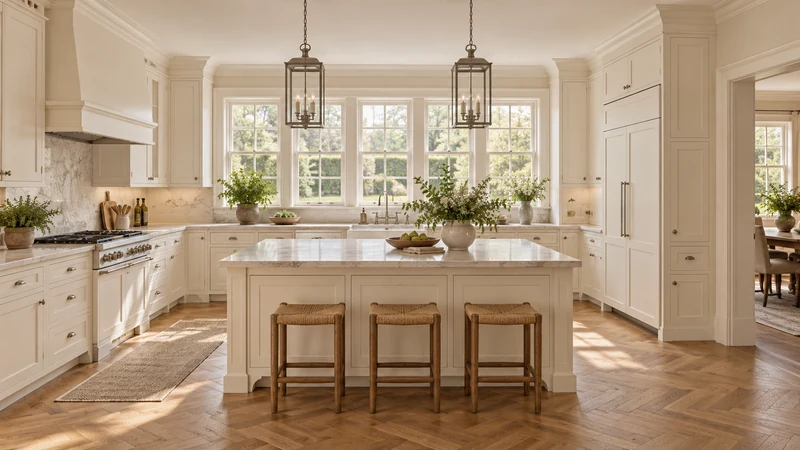
Give dining-table dishes a useful home at the kitchen boundary
Choose the access face and the return route together. Storage near the table can simplify setting it, but only if clean dishes can also be put away and retrieved during meals.
Place dishes at the kitchen-dining boundary when that location improves their complete daily route. Near the table is useful only if the intended person can reach the storage face while the room is in use. Follow clean dishes from cleanup to storage, then to the table and back through the household’s normal clearing routine. The best face for setting the table may differ from the easiest face for putting everything away.
Separate table items from preparation items
Start with the dishes actually used at the table: everyday plates, eating bowls, serving pieces and the accessories the household collects with them. Mark which items also participate in preparation inside the kitchen. A bowl that mixes ingredients and later serves them has a different journey from a plate carried directly to a place setting. Do not move every object called tableware to the boundary without checking these differences.
Record the normal meal and the moments when someone returns for an extra item. Setting an empty table is only part of the use. A person may need another bowl while diners occupy chairs, or a serving piece while cooking continues. Include those positions when choosing the cabinet’s face, rather than testing access only with the dining area cleared.
Choose the accessible face, not merely a nearby cabinet
On the plan, mark where the user stands and which front opens. A cabinet close to the dining area but opening toward the cooking aisle may still draw table-setting traffic through the kitchen. A room-facing cabinet might avoid that trip, yet require the person unloading dishes to walk around a peninsula. Compare both directions with the same objects and household roles.
Design study The adjoining-room opening makes the kitchen-dining relationship visible. The image does not show cabinet interiors or establish a tableware home; those assignments require an actual cabinet and task plan.
Check the storage itself with the intended stacks. Confirm the opening, shelf or drawer setting, grip and space to put a clean piece back without emptying the group. A cabinet can be conveniently located yet poorly suited to the plate or serving dish. Preserve the actual furniture positions so the standing place is not borrowed from an occupied chair.
Compare the household route before moving all the dishes
In a hypothetical household, the everyday plates live beside cleanup. Putting them away is direct, but a person setting the dining table enters the active cooking area to collect them. A boundary cabinet opening toward dining could shorten that collection trip. The person putting clean plates away would now carry them to the boundary, so the improvement is a redistribution of effort rather than a free reduction in every journey.
Test the arrangement with the usual person performing each task. If the table-setting helper often overlaps cooking, avoiding that entry may matter more than a longer return from cleanup. If the same person does all the work and the boundary requires awkward carrying, the original home may be preferable. Keep the comparison specific to the household instead of declaring that all plates belong beside either the table or the dishwasher.
Define a primary home and a manageable split
A split can work when the groups have distinct jobs, such as everyday place-setting dishes at the boundary and preparation bowls inside. Avoid dividing an interchangeable stack without a clear rule: users may search both locations while neither contains the group they expect. Write down what returns to each home and check that the assignment fits the inventory already owned.
Include the serving pieces used less often without allowing them to consume the opening needed for daily dishes. If the boundary cabinet is too small, prioritize a useful group and give the remainder an identified home. Do not assume extra capacity behind a decorative panel or a cabinet face that has not been selected.
Record the complete loop, including an occupied table
Save the item groups, opening direction, unloading route and table-setting route. Add the extra-item retrieval with chairs occupied and the return of clean dishes after the meal. Review the plan when the table position or cabinet configuration changes. A successful boundary cabinet connects the kitchen’s cleanup and the dining task without leaving either side dependent on an unexplained detour.
Pure White
Cream White
Light Warm Gray
Gray
Navy
Black
Oak Tone
Dark Walnut Tone
Design study These finish studies are design references, not a list of currently orderable colors. Screens and lighting change the appearance; compare a physical sample before choosing.See all finish options →
An uncluttered view and an accessible appliance are different tests. Use the household’s real viewpoints and routine to decide what stays visible and what gets stored.
A short route to the patio still needs a workable door and a place to set things down. Plan tray access, final assembly and the return of used dishes together.
The sample shows the door frame, a separate center panel, the face frame and the cabinet box. Each component has its own place in this Shaker construction.
Shaker construction: door frame, center panel, face frame and cabinet box. The cutaway helps locate these parts; confirm each material in the specifications for the selected cabinet.
01 / Door frame
The Shaker door has rails and stiles around a separate center panel. The frame and center panel are different components; confirm their materials in the specifications for the selected cabinet.
02 / Face frame
The face frame surrounds the opening at the front of the cabinet box and sits behind the doors. The face frame, door frame and cabinet box are separate parts.
03 / Cabinet box
The sample exposes the cabinet sides, interior surfaces and layered edges. The image does not establish the wood species or material specification of a selected cabinet.