Choose island end storage by what you can retrieve from the short side
An end door changes the direction of access. Check the opening, depth, grip and standing position before assigning the rear of an island cabinet to everyday items.
Choose the contents of an island end cabinet by a complete retrieval from the short side. The door may be conveniently located on a passing route, yet the storage can extend away from the user along the island. Seeing an object at the back is not the same as reaching, gripping and removing it. Determine the usable task depth before filling the full cabinet depth on a storage plan.
Confirm what the end opening actually serves
Ask for the selected cabinet’s internal arrangement and opening, including any partitions or fixed shelves. An end panel may be decorative, and an end door does not necessarily open the full island interior. Identify the front edge from which usable depth is measured. Include hinges and the door position, because they can make the user approach from the side rather than squarely in front.
Mark the standing position with adjacent room furniture and stools in their ordinary places. If the user reaches from a corner of the opening, the task differs from reaching along its center. Keep the island top and its overhang in the mockup where they affect posture or lifting. Do not evaluate the cabinet as an isolated open box on a bench.
Mock up the grasp and removal, not just a fingertip reach
Use the intended item or an appropriate light representative at the actual shelf height. Ask the user to retrieve and return it from the expected standing position, without stretching beyond a position they find workable. Record where the whole task can be completed. A fingertip touching the back of a container does not demonstrate a usable grip, room to lift it or control while drawing it through the opening.
ABCD
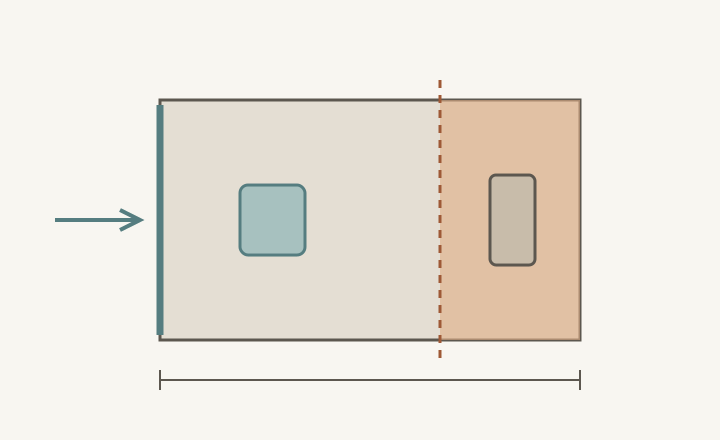
Diagram The dashed line represents a result from a hypothetical user-and-item mockup. It is not a universal reach limit or a cabinet specification; actual shelf height, opening and grip require their own test.
A
The inner front edge used as the depth reference.
B
An item located near the opening.
C
The tested task line, specific to the user and object.
D
Rear storage beyond that line needs a different retrieval solution.
Compare cabinet depth with the tested task depth
In a hypothetical mockup, usable storage extends 30 inches from the inner front edge. For the selected item and shelf height, the user can complete the tested grasp at 20 inches from that same edge. The rear 10 inches extend beyond that task line. This arithmetic describes this mockup only; it is not a recommended reach dimension. It also does not prove that every item in the nearer area can be lifted or returned.
Recheck with neighboring contents present. An empty approach to the rear can vanish when bowls or containers occupy the front. If the rear item requires removing the entire front row, count that handling and the temporary landing area as part of the retrieval. Labeling the back as reserve storage reduces how often the task occurs, not the need for a workable way to complete it.
Choose an access strategy that suits the actual items
Daily items may belong near the opening, while a clearly identified reserve can sit farther back if its removal has been tested. A removable container can bring a group forward, but its loaded size, grip and landing place must also work. A specified pullout changes the task again and needs its own cabinet fit, opening path and manufacturer load instructions. None of these options should be assumed from the appearance of an end door.
A shallower end compartment may be more useful than a deeper space that the household cannot manage. If the remaining volume is used from another island face, show the partition and separate ownership of that volume. If it is closed, mark it honestly. The decision should compare usable storage rather than rewarding depth that only exists on paper.
Make the inventory readable from the approach as well. If similar containers hide each other, a front-facing label or a simple location list can reduce searching, but it cannot replace a retrieval path. After the test, return the front row to its normal position and check that the rear item’s location remains identifiable without emptying the cabinet merely to discover what is stored there.
Save an item-based assignment for the end cabinet
Record the approach, opening, shelf setting, representative item and successful retrieval position. List any front-row removal or temporary setting-down step. Repeat the check when shelves, contents or nearby seating change. An end cabinet earns its place when the household can take out and put back the assigned objects through that short-side approach, not merely when a door can open there.
Pure White
Cream White
Light Warm Gray
Gray
Navy
Black
Oak Tone
Dark Walnut Tone
Design study These finish studies are design references, not a list of currently orderable colors. Screens and lighting change the appearance; compare a physical sample before choosing.See all finish options →
An uncluttered view and an accessible appliance are different tests. Use the household’s real viewpoints and routine to decide what stays visible and what gets stored.
The sample shows the door frame, a separate center panel, the face frame and the cabinet box. Each component has its own place in this Shaker construction.
Shaker construction: door frame, center panel, face frame and cabinet box. The cutaway helps locate these parts; confirm each material in the specifications for the selected cabinet.
01 / Door frame
The Shaker door has rails and stiles around a separate center panel. The frame and center panel are different components; confirm their materials in the specifications for the selected cabinet.
02 / Face frame
The face frame surrounds the opening at the front of the cabinet box and sits behind the doors. The face frame, door frame and cabinet box are separate parts.
03 / Cabinet box
The sample exposes the cabinet sides, interior surfaces and layered edges. The image does not establish the wood species or material specification of a selected cabinet.