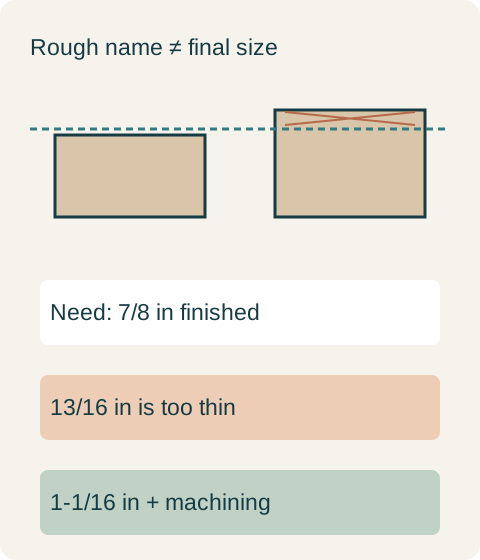
A 4/4 hardwood label is not a finished cabinet-part thickness
Separate rough-stock designation, surfaced delivery and final component thickness. A thicker-looking trade name cannot replace the actual machining requirement.
Specify the finished thickness required by the component drawing, then choose stock and preparation that can deliver it. A quarter-thickness label describes a lumber category; it does not promise that a finished part retains the rough thickness. This matters when a replacement rail must align with existing work or a visible edge has a deliberately chosen section.
Rough and surfaced describe different stages
AHEC identifies 4/4 as nominal 1-inch rough lumber. Its surfaced-thickness method subtracts 3/16 inch in this range: 4/4 gives 13/16 inch, while 5/4 gives 1-1/16 inch. These reference sizes distinguish the stages; they are not measurements of your delivery.
Surfacing removes material to establish the required faces. Additional preparation may still be necessary before a component reaches its drawing size and finish. The purchasing question is therefore not simply which rough category sounds large enough. It is what thickness arrives, what work remains, and whether the actual selected blanks have enough material for that work.
Do not assume a smooth-looking board is already the final component. A quote may include face surfacing while leaving other preparation to the fabricator. Conversely, a completed-part quote may include all of that work. Comparing those offers only by rough lumber name hides the processing cost and the remaining dimensional responsibility.
Teaching example Hypothetical rail purchase using explicitly offered blank sizes. The thicker blank is selected with confirmed machining scope, not as a universal yield promise.
The finished rail needs enough thickness after surfacing
Suppose a hypothetical rail drawing requires a finished thickness of 7/8 inch. Offer A supplies surfaced blanks explicitly at 13/16 inch; Offer B supplies suitable blanks at 1-1/16 inch with final machining included. A is already 1/16 inch thinner than the required part, so further machining cannot solve the shortfall. B leaves 3/16 inch above the required thickness. In this hypothetical case the fabricator has accepted that allowance for the selected blanks and completes the rail to the drawing, so the buyer chooses B.
The hypothetical decision is based on the stated delivery sizes and accepted machining scope, not a blanket claim that a particular rough category always yields the target. It also avoids changing the rail drawing merely to accommodate the thinner offer. A deliberate design revision could be a separate choice, but it would require revisiting the affected alignments rather than calling the original requirement satisfied.
Put the final requirement where receiving can use it
Keep the rough designation in the material record and the required finished thickness on the component drawing. State which surfaces are prepared at delivery and who completes the remaining work. Where a dimensional tolerance is necessary, define it for the actual component; the trade designation does not supply that project tolerance.
At receiving, assess stock against the agreed stock condition, and assess finished parts against their approved dimensions. Rejecting prepared stock solely because it is thinner than a rough name can be as mistaken as accepting an undersized finished rail because the invoice says premium hardwood. The useful comparison follows the material through its specified stage of work.
Pure White
Cream White
Light Warm Gray
Gray
Navy
Black
Oak Tone
Dark Walnut Tone
Design study These finish studies are design references, not a list of currently orderable colors. Screens and lighting change the appearance; compare a physical sample before choosing.See all finish options →
A painted door, a wood-grain side and a plywood cabinet box can belong to the same cabinet. Here is how to read those parts, what the sample photos actually show, and which details to put on a quote.
Compare the actual countertop products, heat-source routine and fabrication proposal. A fired porcelain slab and resin-bound quartz are different materials, but neither label replaces a complete kitchen specification.
The sample shows the door frame, a separate center panel, the face frame and the cabinet box. Each component has its own place in this Shaker construction.
Shaker construction: door frame, center panel, face frame and cabinet box. The cutaway helps locate these parts; confirm each material in the specifications for the selected cabinet.
01 / Door frame
The Shaker door has rails and stiles around a separate center panel. The frame and center panel are different components; confirm their materials in the specifications for the selected cabinet.
02 / Face frame
The face frame surrounds the opening at the front of the cabinet box and sits behind the doors. The face frame, door frame and cabinet box are separate parts.
03 / Cabinet box
The sample exposes the cabinet sides, interior surfaces and layered edges. The image does not establish the wood species or material specification of a selected cabinet.