Store foil and wrap according to how you dispense them. If you lift each carton onto the counter, the drawer needs an easy removal route. If you want to pull and cut material while the carton stays inside, you must test that motion with the actual dispenser. Those are different arrangements, even when the same boxes fit in both.
Measure the carton, not the roll printed on it
The length advertised for the product inside does not describe the outer package. Include carton end flaps, protruding tabs and any cutter housing. A reusable dispenser has its own outside dimensions and installation instructions; do not order an insert from the nominal roll description and assume the assembled dispenser will match it.
Sort the collection by what remains in a box and what moves into a separate dispenser. Parchment sheets, loose bags and rolls need not share the same compartment simply because they are all used for food preparation. Grouping by the motion you perform can produce a more useful drawer than lining up every long package together.
Choose whether the box leaves the drawer
For lift-out storage, check that you can grasp the carton without pushing neighboring packages aside. A close-fitting row may look tidy but leave no place for fingers. Try retrieving a nearly empty carton as well as a full one: the lighter box can shift when its neighbor is lifted, and a loose end can catch on a divider.
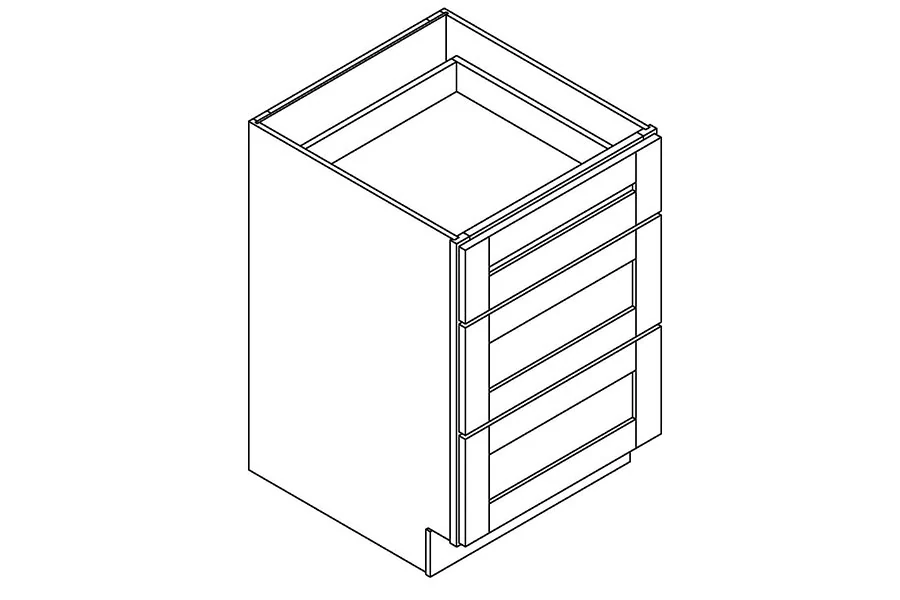
Diagram The drawing identifies a drawer configuration. It does not show a wrap organizer, cutter or the clear dimensions inside a drawer.
For in-place dispensing, pull a practical length of material and complete the cut without crossing a sharp edge with your hand. Check the product instructions for the intended support and operation. A box that slides forward with the wrap is not stabilized merely because the drawer contains it. Avoid improvising exposed blades or treating a generic divider as a dispenser mount.
Keep the working surface in the test
Place the pan, food container or item being covered on its usual preparation surface. Does the open drawer sit directly where your body needs to stand? Can the material reach the task without dragging over the drawer front? A drawer beside the work zone may be easier to use than one directly beneath the only comfortable standing position.
If the carton goes onto the counter, allow a clear landing spot for it while the pan is present. Then put the carton away and close the drawer. Repeating that simple sequence exposes a common mismatch: a generous storage compartment paired with a crowded preparation surface. Enlarging the drawer alone would not solve that problem.
Plan for a different replacement package
Compare the package normally purchased with the occasional larger carton before selecting a fixed insert. An adjustable or separate compartment may handle variation better, but its moving parts must remain stable during ordinary use. Keep spare rolls elsewhere if storing the replacement beside the working carton makes retrieval unnecessarily tight.
Write the drawer requirement as a task: lift out and return the carton, or dispense safely with the specified product in place. Add the outer package measurements, the opening and finger space, the adjacent preparation task and the likely replacement format. This gives the cabinet planner something testable instead of a request for a drawer that merely looks organized.
Pure White
Cream White
Light Warm Gray
Gray
Navy
Black
Oak Tone
Dark Walnut Tone
Design study These finish studies are design references, not a list of currently orderable colors. Screens and lighting change the appearance; compare a physical sample before choosing.See all finish options →
Compare the working counter space with the steps needed to retrieve and put away the bread. The right location must also suit the bread and storage container instructions.
Plan the trip from unloading groceries to the next shopping run. Separate bags ready to leave from bags waiting for care and the reserve you actually use.
The sample shows the door frame, a separate center panel, the face frame and the cabinet box. Each component has its own place in this Shaker construction.
Shaker construction: door frame, center panel, face frame and cabinet box. The cutaway helps locate these parts; confirm each material in the specifications for the selected cabinet.
01 / Door frame
The Shaker door has rails and stiles around a separate center panel. The frame and center panel are different components; confirm their materials in the specifications for the selected cabinet.
02 / Face frame
The face frame surrounds the opening at the front of the cabinet box and sits behind the doors. The face frame, door frame and cabinet box are separate parts.
03 / Cabinet box
The sample exposes the cabinet sides, interior surfaces and layered edges. The image does not establish the wood species or material specification of a selected cabinet.