Bread box on the counter or bread storage in a cabinet?
Compare the working counter space with the steps needed to retrieve and put away the bread. The right location must also suit the bread and storage container instructions.
Moving bread off the counter can free a useful work area, but it can also add an awkward cabinet-door and container-lid sequence to breakfast. Choose between countertop and enclosed storage by testing the complete routine. Keep the bread’s own storage requirements and the container instructions in the decision; cabinetry alone does not establish how long a loaf remains suitable to eat.
Start with the bread you actually bring home
Compare the packaged outline of a sliced loaf, the round loaf or long bread you sometimes buy, and any separate items you expect to keep together. A container that neatly holds the regular loaf may not accept a differently shaped purchase. Decide where those exceptions belong instead of quietly turning the surrounding counter into permanent overflow.
Include the closure of the bread package if it remains in use. A bag gathered at the end can require a different outline from the loaf itself. Do not squeeze food into an undersized compartment simply to preserve the appearance of a clear counter. Choose an arrangement compatible with the applicable storage directions.
Compare the container while it opens
A lift-off lid needs a place to land, a hinged lid needs its movement space, and a roll-top design uses a different opening path. Brabantia’s regular roll-top bread bin describes a lid that retracts inside the box. That model-specific detail illustrates why closed dimensions alone do not describe access; it is not a claim about every bread box.
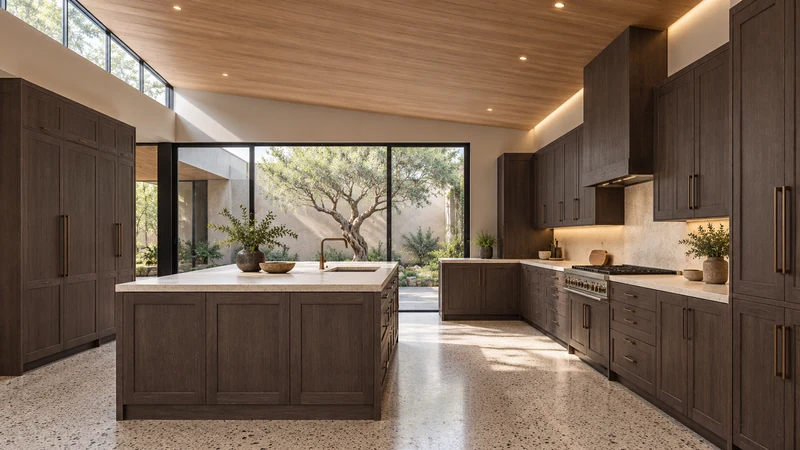
Design study Counter and cabinet storage make different demands on the preparation surface. This image does not show a bread box or establish food storage performance.
Inside a cabinet, test the outer door and the container opening together. Can the container be used in place, or does it have to be pulled out before the lid works? A box that must be lifted onto the counter each morning still needs a landing area there. Hiding it has not eliminated that working-space requirement.
Protect the useful counter task, not every empty inch
Choose a countertop location by what would otherwise happen there. A bread box that displaces the only comfortable sandwich-preparation area may be costly in daily convenience. In another kitchen, a suitable position at the edge of the breakfast area may make the whole routine simpler. Follow the container and food guidance when assessing that location.
Try the task with the cutting board, serving plate and other ordinary breakfast items present. Keep sharp tools in their appropriate storage arrangement rather than dropping them loosely into the bread container. The test should show whether taking bread, preparing it and restoring the work surface can happen without repeatedly moving an unrelated appliance.
Include crumbs and the return trip
Check access for the cleaning required by the container and cabinet finish. A concealed compartment that is difficult to empty can make routine care less convenient than a removable counter box. Conversely, a clear shelf with a suitable removable container may be straightforward to maintain. Compare the actual items, not a rule that all hidden storage is better.
Record normal and exceptional package shapes, the opening path, the preparation surface and the cleanup method before allocating cabinet space. You may choose a counter box, a cabinet location or a mixed arrangement for occasional purchases. The decision is complete when each part of the routine has a place, rather than when the countertop happens to look empty in a photograph.
Pure White
Cream White
Light Warm Gray
Gray
Navy
Black
Oak Tone
Dark Walnut Tone
Design study These finish studies are design references, not a list of currently orderable colors. Screens and lighting change the appearance; compare a physical sample before choosing.See all finish options →
Start with what the food requires, then decide whether a room-temperature basket belongs in the plan at all. Visibility and cleaning matter as much as the empty basket size.
The sample shows the door frame, a separate center panel, the face frame and the cabinet box. Each component has its own place in this Shaker construction.
Shaker construction: door frame, center panel, face frame and cabinet box. The cutaway helps locate these parts; confirm each material in the specifications for the selected cabinet.
01 / Door frame
The Shaker door has rails and stiles around a separate center panel. The frame and center panel are different components; confirm their materials in the specifications for the selected cabinet.
02 / Face frame
The face frame surrounds the opening at the front of the cabinet box and sits behind the doors. The face frame, door frame and cabinet box are separate parts.
03 / Cabinet box
The sample exposes the cabinet sides, interior surfaces and layered edges. The image does not establish the wood species or material specification of a selected cabinet.