Built-in griddle or removable griddle: what should occupy the cooking surface?
A dedicated griddle keeps that surface ready but commits part of the appliance to it. A compatible removable griddle changes use at the cooking surface and needs a real cleaning and storage plan.
Buy a dedicated griddle when it is a regular cooking surface and the rest of the selected appliance still accommodates the household’s pans. Choose a supported removable griddle when the household wants to change that area’s use and accepts storing and handling the accessory. The important distinction is a permanent allocation versus a changeable one, not whether a photograph makes the appliance look more professional.
Look at the cooking surface on an ordinary evening
A large griddle may be attractive during a weekend breakfast demonstration. Now place the cold, empty cookware for an ordinary dinner on the same proposed appliance. Include the large skillet and accompanying pots, their handles and access to the controls. Identify which positions remain available beside the dedicated surface rather than mentally using the griddle area as additional ordinary burners.
A different model may provide the desired griddle and all the pan positions the household needs. Evaluate that actual layout. If obtaining it requires a larger appliance, show the effect on the cabinet run, neighboring preparation area and complete installation. Do not enlarge the appliance on paper while leaving every adjacent drawer and counter segment unchanged.
This is a spatial and purchasing comparison. Cooking performance belongs to the selected appliance and its permitted cookware, with a suitable demonstration if useful. A paper outline cannot establish even heating or determine a cooking temperature.
Fixed configurations should not be sold as future flexibility
Wolf states that the griddle in its cited range and rangetop configurations is not removable for ordinary use, and that the surface-burner, griddle, charbroiler and French-top configurations cannot be interchanged. Replacing that griddle requires service.
That named example explains why a buyer should resolve the allocation before ordering. A cover, where specified, does not convert the surface into another burner configuration. Nor should a salesperson’s statement that the cooking top is modular replace the actual manufacturer’s information for the selected appliance.
Keep this distinct from a countertop assembled from separate cooking modules. A documented multi-module installation is a different product arrangement. The presence of several visual sections on a rangetop does not make those sections independently exchangeable.
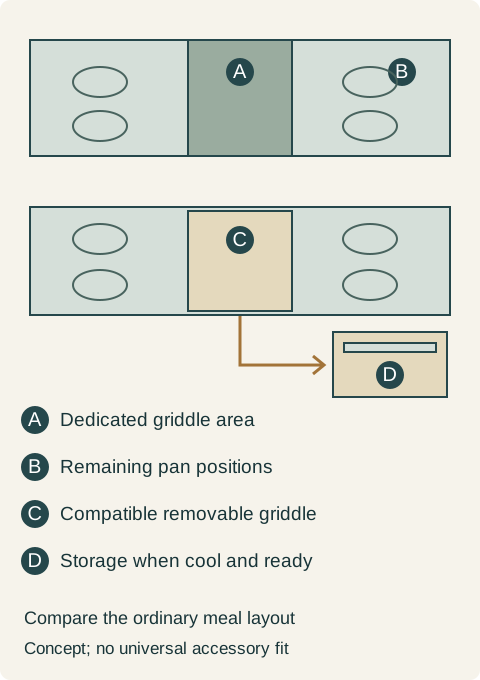
Teaching example Conceptual cooking-surface plans. A is a dedicated griddle area beside B, the remaining pan positions. C shows a removable griddle assigned to its supported appliance position; D is its separate storage place when cool and ready to put away. The arrow represents storage allocation, not handling of a hot accessory. No burner count, dimensions or compatible product pairing is specified.
A removable accessory still has an assigned operating position
GE’s cited reversible griddle accessory belongs to specified range models and is used at the center burner in place of its grate where present. A removable plate is therefore not automatically an accessory for any cooking surface that appears large enough.
Identify the supported accessory together with the appliance. Do not select a broad metal plate by size alone, bridge unrelated cooking zones without permission or assume a similar part number establishes compatibility. A regular griddle pan is also cookware with its own requirements; it does not create manufacturer approval for an arbitrary appliance arrangement.
Show the ordinary state with the accessory put away and the griddle-use state with it correctly located. Account for any grate that changes position. This avoids crediting the same space simultaneously to ordinary pan use and griddle cooking when the selected arrangement cannot provide both there.
Cleaning and storage can change which option is easier
For the fixed proposal, understand the selected product’s routine surface and grease-collection care. Ask for the relevant parts and access to be shown rather than assuming that the entire metal cooking surface lifts out for washing. A fixed installation may suit an owner who wants the surface in place, but it still brings a care task.
For the removable proposal, check the entire cool accessory against the sink and cleaning arrangement permitted by its instructions. Include its handles, weight and the household’s comfortable grip. Removable does not mean dishwasher safe or easy for every person to carry. Do not use a hot plate to demonstrate the route.
Then assign its ready-to-store condition to an actual cabinet. A long, heavy accessory can be inconvenient in a high slot, and an attractive narrow gap may not allow a usable grip. Confirm a suitable supported storage arrangement without treating the appliance cavity or countertop preparation area as its permanent home. If a grate also needs temporary storage, allocate that separately.
One family preserves ordinary pan positions
Consider a hypothetical household attracted by a fixed griddle during a breakfast demonstration. Its everyday dinners use a broad skillet alongside saucepans. In the fixed-griddle candidate they initially chose, those actual pans do not work conveniently in the remaining permitted positions. The owners do not want to increase the appliance footprint and give up the neighboring preparation segment.
They compare another supported appliance configuration with a compatible removable griddle. The ordinary pan arrangement works when that accessory is stored. On the less frequent occasions when they want the griddle, they accept the supported change of configuration and the different pan allocation during that meal.
The storage trial includes the cool accessory and any displaced grate. A reachable lower cabinet can hold them in a suitable arrangement without taking the everyday cookware’s assigned spaces. The owners also accept the actual cleaning and handling routine. Without those answers, the removable option would merely move the inconvenience from the cooking surface into an already full cabinet.
They choose the removable arrangement and retain the preparation segment. The completed purchase includes the matched appliance and accessory, its ordinary and griddle-use layouts, and the lower storage assignment. They have not purchased a promise to turn a fixed griddle into burners later.
Pay for the configuration the household will use
An owner who uses a griddle frequently and has enough remaining pan positions may reasonably prefer the dedicated option. That choice avoids the planned accessory swap and storage task, provided the owner accepts the fixed allocation and care. It does not follow that every large kitchen needs a griddle or that every small kitchen should avoid one.
Compare the complete appliance, supported accessories, cabinet changes and installation work for the viable alternatives. Include the actual ventilation review without claiming that either format has a universal ventilation requirement. A cooking-surface preference can affect the surrounding kitchen, so keep those consequences visible in the price.
Choose after both the routine dinner and the griddle meal have a workable layout. The cabinet plan should preserve the needed preparation surface and give every removable part a realistic home. That is a more dependable purchase than reserving a large permanent surface for an imagined habit or buying a removable accessory with nowhere to put it.
Pure White
Cream White
Light Warm Gray
Gray
Navy
Black
Oak Tone
Dark Walnut Tone
Design study These finish studies are design references, not a list of currently orderable colors. Screens and lighting change the appearance; compare a physical sample before choosing.See all finish options →
Choose the supported combination and its interface parts before defining the opening. Product width, finished assembly width and countertop cutout are different measurements.
A rangetop is not simply a cooktop with different knobs. Its front opening and supporting cabinet can differ, while some cooktops also place controls through the cabinet face.
The sample shows the door frame, a separate center panel, the face frame and the cabinet box. Each component has its own place in this Shaker construction.
Shaker construction: door frame, center panel, face frame and cabinet box. The cutaway helps locate these parts; confirm each material in the specifications for the selected cabinet.
01 / Door frame
The Shaker door has rails and stiles around a separate center panel. The frame and center panel are different components; confirm their materials in the specifications for the selected cabinet.
02 / Face frame
The face frame surrounds the opening at the front of the cabinet box and sits behind the doors. The face frame, door frame and cabinet box are separate parts.
03 / Cabinet box
The sample exposes the cabinet sides, interior surfaces and layered edges. The image does not establish the wood species or material specification of a selected cabinet.