Cooktop or rangetop: the cabinet front is part of the choice
A rangetop is not simply a cooktop with different knobs. Its front opening and supporting cabinet can differ, while some cooktops also place controls through the cabinet face.
Match the cooking appliance to the cabinet construction
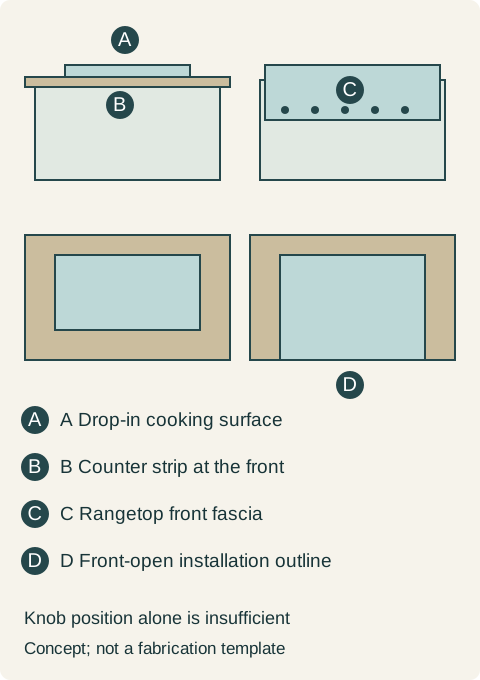
Choose between a cooktop and a rangetop before ordering the cooking base or cutting the countertop. A drop-in cooktop typically occupies an opening surrounded by counter, while a rangetop can extend through the front with its own control fascia. The difference can remove the counter strip and cabinet front area assumed by another design.
Wolf distinguishes an SRT rangetop with a front cutout for its bullnose from a drop-in CG cooktop. It also lists a contemporary CG cooktop with separate knob cutouts through the front. Front-facing knobs alone therefore do not identify a rangetop or its required opening.
Read the front, top and supporting structure together
For the selected appliance, distinguish the countertop opening from the opening in the cabinet face and from the support below. A drawing showing only a rectangle on top misses the front fascia and its depth. A familiar nominal width does not establish that the old countertop or drawer bank can remain.
Compare the finished front with the upper drawers beside it. The appliance's controls and face are not an ordinary cabinet drawer front. Their relationship to neighboring handles matters during use, but matching the visual line cannot override the product's supported mounting position.
Teaching example Conceptual front and top relationships: a drop-in cooktop retains a counter strip in front; a rangetop occupies a front opening with its appliance fascia. The lower sketches distinguish the opening outlines, not their dimensions.
An oven below is a separate compatibility choice
Wolf states that its SRT rangetops cannot be installed over a wall oven, while cooktop-over-oven installations require the relevant compatible product details. That is a family-specific limitation, not a rule that every cooktop accepts every oven.
A kitchen brief calls for an oven directly below the cooking surface to preserve the only tall pantry. A proposed switch from a compatible cooktop-and-oven arrangement to an SRT rangetop defeats that brief. The household retains the compatible pair. The alternative rangetop proposal would need an oven elsewhere and a revised pantry allocation; it cannot be priced as an isolated appliance upgrade.
Compare the whole change, including a retained countertop
Replacing a rangetop with a cooktop can leave a front opening where the new product expects a different countertop detail. Reversing the change can require a front opening that is not present. Neither direction is solved merely by selecting the same advertised width. Have the actual edge condition and supporting construction evaluated before committing to reuse.
The meaningful quote includes the appliance arrangement, affected cabinet fronts, countertop work, support and required installation coordination. Performance and control preferences still matter, but they should be compared between arrangements that preserve the kitchen's intended storage and oven location.
Pure White
Cream White
Light Warm Gray
Gray
Navy
Black
Oak Tone
Dark Walnut Tone
Design study These finish studies are design references, not a list of currently orderable colors. Screens and lighting change the appearance; compare a physical sample before choosing.See all finish options →
A drawer front fitting under the counter does not establish usable storage. Verify the supported installation, reserve the required underside space and check the highest stored item through the drawer’s movement.
The slide-in label does not tell you whether the cooking surface overlaps the counter or how the rear junction finishes. Check the exact design before assuming the existing opening is suitable.
A tower can change appliance access while removing a prep surface and dividing what remains. Test the same cooking task and retained contents in both complete layouts.
The sample shows the door frame, a separate center panel, the face frame and the cabinet box. Each component has its own place in this Shaker construction.
Shaker construction: door frame, center panel, face frame and cabinet box. The cutaway helps locate these parts; confirm each material in the specifications for the selected cabinet.
01 / Door frame
The Shaker door has rails and stiles around a separate center panel. The frame and center panel are different components; confirm their materials in the specifications for the selected cabinet.
02 / Face frame
The face frame surrounds the opening at the front of the cabinet box and sits behind the doors. The face frame, door frame and cabinet box are separate parts.
03 / Cabinet box
The sample exposes the cabinet sides, interior surfaces and layered edges. The image does not establish the wood species or material specification of a selected cabinet.