A countertop scrap bin trades an open surface for a permanent opening
An inset waste bin can accept scraps from the worktop without opening a cabinet front. Decide whether its fixed position and bucket below are worth giving up that part of the prep surface and storage.
A countertop waste bin is most useful when scraps are repeatedly produced beside the same opening. It lets the cook dispose of them from above without pulling a cabinet front into the aisle. The trade is a permanent interruption in the worktop and a bucket occupying the cabinet below. A removable prep caddy may suit a kitchen whose working area changes from meal to meal.
The visible lid is only part of the assembly
BLANCO's SOLON-IF installation aid shows a lid, removable sealing rim, bin, fixed base sealing rim and countertop as separate components. It also requires the proposed location to be free of obstructions. The lid's position on a plan therefore cannot stand in for the complete assembly below it.
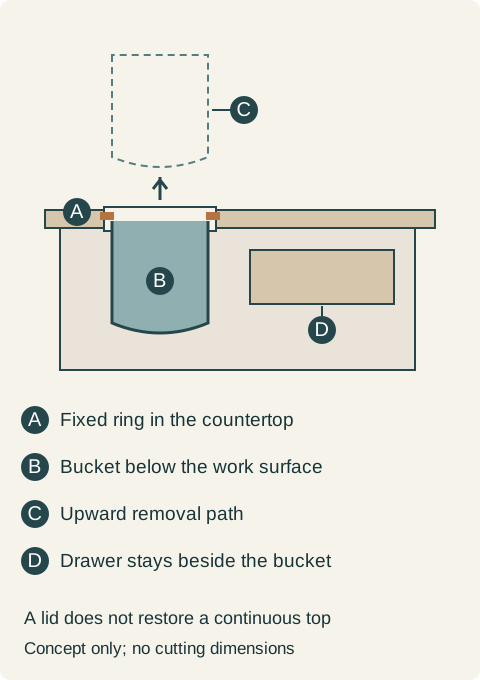
In a cabinet section, draw the bucket under the worktop before drawing a full-depth utensil drawer through that space. A normal drawer box cannot occupy the same volume. A different drawer arrangement might be possible in a coordinated cabinet design, but shortening or cutting an existing drawer is not a default solution.
The fixed base ring remains when the bin is removed. Emptying the bucket does not return an uninterrupted countertop. This matters if the household expects to clear everything away for rolling dough, assembling serving platters or using a large cutting board.
Choose the position by the board, not by an empty-counter photograph
Place the actual cutting board, bowl for prepared ingredients and tools where the cook normally uses them. An opening immediately beside the board may be convenient. An opening underneath it requires moving the board before scraps can go into the bin. Moving the bowl to reveal the lid can also consume the convenience the fitting was meant to provide.
A portable caddy can move with the board and disappear after preparation. It occupies space above the counter while in use and needs a storage home afterward. The integrated bin has a fixed home, but the lid and its operating space remain part of every future use of that worktop. Compare those consequences rather than assuming concealed means space-free.
Consider a kitchen with a wide board centered over the preferred utensil drawer. In the proposed inset-bin layout, the board overlaps the lid and the bucket conflicts with that drawer. Moving the opening to the far end would separate it from the main prep position. The household chooses a removable caddy beside the board, stores the empty caddy on a designated shelf after use, and keeps the continuous top and drawer. It buys the simpler accessory because the fixed assembly would impair both activities it was intended to support.
Teaching example Conceptual section: the removable bucket occupies cabinet space below a permanent worktop ring. The dashed bucket above shows the removal path. An adjacent drawer is shown beside the bucket, not passing through it. No dimensions or installation approval.
Removing the lid and removing the bucket are different movements
Trace the bucket's upward removal through the opening with the worktop in use. A low shelf or a permanently parked appliance above that position can obstruct the path even when there is room to open the lid. Leave a place for the lid and removable rim during emptying, and check how the bucket is held and carried.
The manufacturer's exploded view separates the removable pieces from the base ring bonded to the worktop. Use the selected product's instructions for assembly and care; do not treat the fixed ring as another loose part that comes out for every emptying. The illustrated assembly does not establish the construction of every countertop bin.
Price the permanent work as well as the accessory
An integrated arrangement may still be worthwhile for a dedicated prep station with a clear removal path and cabinet space intentionally assigned to the bucket. Compare the fitting, suitable worktop fabrication and the affected cabinet configuration with the cost of a portable container and its shelf space. No published accessory price represents that complete comparison.
Keep the exact installation detail with the surface order. The countertop fabricator must determine the permitted opening and attachment for the chosen surface and product; a diagram showing a circle is not a cut template. Choose the integrated version when its permanent location earns its place in the routine, rather than solely because the closed lid looks tidy.
Pure White
Cream White
Light Warm Gray
Gray
Navy
Black
Oak Tone
Dark Walnut Tone
Design study These finish studies are design references, not a list of currently orderable colors. Screens and lighting change the appearance; compare a physical sample before choosing.See all finish options →
Bin volume does not tell you how much of a cabinet run the system consumes. Compare complete assemblies, their operating tasks and the neighboring storage left after each allocation.
The sample shows the door frame, a separate center panel, the face frame and the cabinet box. Each component has its own place in this Shaker construction.
Shaker construction: door frame, center panel, face frame and cabinet box. The cutaway helps locate these parts; confirm each material in the specifications for the selected cabinet.
01 / Door frame
The Shaker door has rails and stiles around a separate center panel. The frame and center panel are different components; confirm their materials in the specifications for the selected cabinet.
02 / Face frame
The face frame surrounds the opening at the front of the cabinet box and sits behind the doors. The face frame, door frame and cabinet box are separate parts.
03 / Cabinet box
The sample exposes the cabinet sides, interior surfaces and layered edges. The image does not establish the wood species or material specification of a selected cabinet.