Define which front should align when choosing a counter-depth refrigerator
Cabinet face, counter edge, refrigerator body, door and handle are separate reference planes. Compare installed positions before describing a refrigerator as flush.
Specify what you want to align before using “counter-depth” as a design decision. The cabinet door face, countertop edge, refrigerator body front and appliance door front are different surfaces. A product can align one of them while projecting beyond another. Decide which relationship matters visually and functionally, then check the exact refrigerator in its supported installed position.
Name the intended alignment on the drawing
Mark the finished wall, cabinet door face and counter edge in a plan or side section. Include any end panel rather than treating every nearby cabinet surface as the same line. Write the desired result plainly, such as appliance door front near cabinet fronts, or refrigerator body behind the counter edge with doors projecting beyond. Those requests can lead to different product choices.
Whirlpool’s measuring guide tells readers to review depth with and without doors and handles because models vary. Use those separate dimensions rather than treating the category name as a complete installed outline. Read the selected model’s drawing to determine exactly which physical surfaces each published depth includes.
Place the appliance using its installation requirements and actual rear conditions. Required space, connections and an uneven or stepped rear surface can affect where the body sits. A body-depth measurement beginning at the appliance back does not by itself locate the door relative to the room’s wall or the neighboring cabinets.
Use a consistent wall reference for both the cabinets and refrigerator. Do not compare a cabinet measured from the wall with an appliance measured from its own back without accounting for the difference. Also check whether a published overall depth already includes doors or handles; adding a component twice can make a suitable arrangement appear deeper than it is.
A hypothetical body alignment can still leave projecting doors
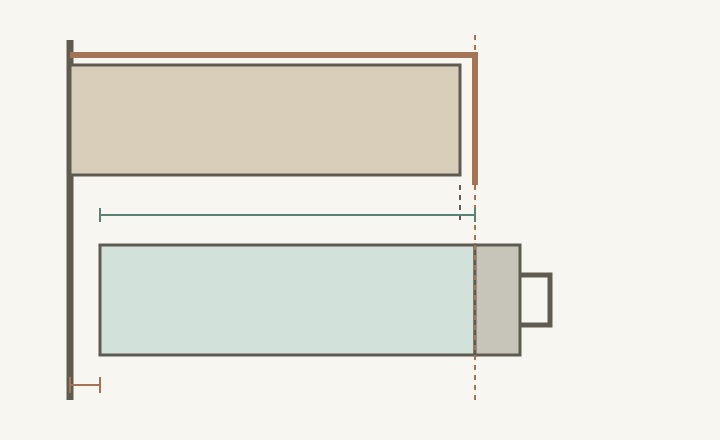
In a hypothetical example in inches, rear reserved space of 2 plus body depth of 25 places the body front at 27 from the wall. A door projection of 3 puts its front at 30; a further handle projection of 2 reaches 32. The cabinet face is at 26 and counter edge at 27. The body aligns with the counter edge, while door and handle do not. These invented values are not installation clearances or product sizes.
ABCD
Diagram Horizontal positions match the hypothetical example. The dashed counter-edge line meets the refrigerator body front, leaving the door and handle beyond it. Vertical separation is for reading the diagram, not an actual appliance width or a prescribed installation detail.
A
Cabinet face and counter edge are different lines.
B
The body front meets the illustrated counter-edge reference.
C
The door front projects beyond the body.
D
The outer handle is another distinct projection.
This arrangement may be acceptable if the intended result allows the doors to project. It fails a request for the appliance door face to align with the cabinet face. Neither judgment can be made from the phrase “counter-depth” alone. Record the expected front relationship so an attractive rendering does not silently substitute a different requirement.
Check closed appearance and opening as separate states
Once the closed front relationship is understood, verify the selected model’s opening path next to end panels, walls and adjacent fronts. Do not push the appliance farther into its enclosure just to make the elevation flatter. The supported location, ventilation and movement requirements still apply even when a deeper recess appears visually preferable.
Consider the view along the cabinet run as well as the front view. A visible side strip, handle projection or panel ending behind the appliance door can be missed in a straight-on image. Use a section or oblique drawing to show the agreed result. Treat the opening test separately from this visual review; a neat closed outline does not establish usable access.
Compare complete installed options rather than body depths
When comparing models, place each at its own required installation position and show the same reference surfaces. Include the selected handle option and surrounding panel design. If aligning the door front is the priority, evaluate an appliance and cabinet arrangement designed to support that relationship instead of assuming every shallow-bodied refrigerator can provide it.
Keep a marked section showing wall, rear position, body, door, handle, cabinet face and counter edge, together with the model documentation. Confirm which alignment is accepted and which projections remain visible. Recheck after changing handles, end panels or countertop overhang, because any of those changes can alter the appearance even when the appliance body stays in place.
Pure White
Cream White
Light Warm Gray
Gray
Navy
Black
Oak Tone
Dark Walnut Tone
Design study These finish studies are design references, not a list of currently orderable colors. Screens and lighting change the appearance; compare a physical sample before choosing.See all finish options →
A useful door direction keeps the intended transfer route workable and the required opening possible. Check both compartments and confirm the actual model supports the chosen arrangement.
A neat closed reveal does not establish opening clearance. Use the selected appliance’s hinge information with the actual panel profile, neighboring fronts and handles.
The sample shows the door frame, a separate center panel, the face frame and the cabinet box. Each component has its own place in this Shaker construction.
Shaker construction: door frame, center panel, face frame and cabinet box. The cutaway helps locate these parts; confirm each material in the specifications for the selected cabinet.
01 / Door frame
The Shaker door has rails and stiles around a separate center panel. The frame and center panel are different components; confirm their materials in the specifications for the selected cabinet.
02 / Face frame
The face frame surrounds the opening at the front of the cabinet box and sits behind the doors. The face frame, door frame and cabinet box are separate parts.
03 / Cabinet box
The sample exposes the cabinet sides, interior surfaces and layered edges. The image does not establish the wood species or material specification of a selected cabinet.