Check integrated refrigerator panel movement before approving the front gaps
A neat closed reveal does not establish opening clearance. Use the selected appliance’s hinge information with the actual panel profile, neighboring fronts and handles.
Approve an integrated refrigerator front only after checking the moving panel against its neighbors. A consistent closed gap can look correct while a panel edge, handle or adjacent front enters the opening path. Use the exact appliance’s design and installation information with the actual decorative panel assembly; a generic cabinet-door arc is not a substitute for the appliance hinge geometry.
Start with the supported panel assembly
Sub-Zero identifies panel dimensions, weight limits and full-scale hinge templates among its design-guide resources. Match the applicable guide to the product and configuration before reviewing your custom fronts. These resources illustrate why the panel and appliance need coordinated information, rather than an elevation alone.
Record the panel’s complete profile, including its thickness at the edge, any projecting shape and the selected handle. Confirm the assembly against the model’s panel requirements. A panel that meets a size requirement still needs the other applicable checks; do not treat an attractive face dimension as permission for any thickness, weight or attachment arrangement.
Check the moving edge, not just the closed seam
A reveal is the visible gap between neighboring fronts. Locate that gap in the closed position, then use the manufacturer’s applicable hinge detail to follow the panel through opening. Preserve the actual relationship between the appliance, panel and neighboring cabinet face. Moving only the drawn front to improve alignment can invalidate the geometry being checked.
If a full-scale template is used, verify its printed reference scale and page settings before measuring against it. Keep the relevant model, hinge side and assumed panel profile attached to the drawing. A correctly printed template for the wrong configuration is still the wrong test. If the proposed profile falls outside the documented detail, resolve that difference before fabricating it.
ABC
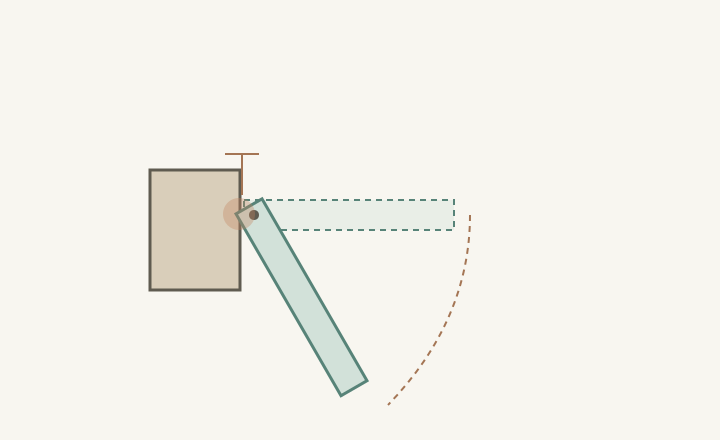
Diagram This is a simple pivot illustration of why closed separation does not prove moving clearance. It is not an integrated refrigerator hinge template, an allowable reveal or a permitted opening position. Use the selected model’s actual movement detail for the project.
A
The dashed closed panel has a small visible separation.
B
The same illustrative panel occupies different space as it turns.
C
The marked rear corner reaches the neighboring block.
Draw what the neighboring cabinetry actually presents
Include the adjacent door profile, side panel, trim and handles at the heights where they can interact. A flat neighboring box on the plan can omit a projecting rail or pull. Check the refrigerator handle against the neighboring surface as well as checking the decorative panel edge; the first contact may occur away from the reveal being visually matched.
For any intended combined opening, test both fronts in the relevant positions. If normal use depends on closing the neighboring cabinet first, record and evaluate that sequence rather than assuming simultaneous operation. Keep finger access and ordinary gripping in the user trial without inventing a universal clearance from the diagram.
A small decorative change can require a new check
In a hypothetical design, the original flat panel passes the selected model’s documented geometry review. A later front revision adds a projecting edge profile while leaving the closed reveal visually unchanged. That new profile is absent from the earlier check. The correct response is to review the revised assembly and opening path, not to declare it acceptable because the front gap still looks the same.
Sub-Zero’s Designer Series guidance says reducing its specified reveal can cause the panel to bind on adjacent cabinetry. That product-family example supports keeping the required gap; it does not establish a universal gap for every integrated appliance. Do not tighten a seam or enlarge a panel on the assumption that hinge adjustment will recover the missing movement space.
Keep the reviewed configuration attached to fabrication
Record the appliance model, hinge side, panel drawing, handle, neighboring profiles and approved front positions together. Distinguish a closed alignment review from the movement check and from confirmation that the panel meets all applicable product requirements. This prevents a later cabinet drawing from retaining the appearance while silently changing a controlling physical detail.
Recheck after a change in panel profile, handle, reveal or neighboring front. During installation, verify the completed arrangement using the manufacturer’s procedures before treating it as ready for normal use. If the door does not move as intended, resolve the cause with the responsible installer and applicable guidance; do not use force or improvised panel cutting as a layout solution.
Pure White
Cream White
Light Warm Gray
Gray
Navy
Black
Oak Tone
Dark Walnut Tone
Design study These finish studies are design references, not a list of currently orderable colors. Screens and lighting change the appearance; compare a physical sample before choosing.See all finish options →
Cabinet face, counter edge, refrigerator body, door and handle are separate reference planes. Compare installed positions before describing a refrigerator as flush.
Document the fixed opening and any deliberately adaptable parts, then test real alternative installation envelopes. Extra space improves options only when the controlling constraints also work.
The sample shows the door frame, a separate center panel, the face frame and the cabinet box. Each component has its own place in this Shaker construction.
Shaker construction: door frame, center panel, face frame and cabinet box. The cutaway helps locate these parts; confirm each material in the specifications for the selected cabinet.
01 / Door frame
The Shaker door has rails and stiles around a separate center panel. The frame and center panel are different components; confirm their materials in the specifications for the selected cabinet.
02 / Face frame
The face frame surrounds the opening at the front of the cabinet box and sits behind the doors. The face frame, door frame and cabinet box are separate parts.
03 / Cabinet box
The sample exposes the cabinet sides, interior surfaces and layered edges. The image does not establish the wood species or material specification of a selected cabinet.