If a delivered cabinet appears to have the wrong style or finish, keep it identifiable and pause installation of the affected item while you reconcile the records and physical product. Start with the final accepted configuration, then check the shipping label and the cabinet itself. A mismatch can involve the order, the packing identity or the product inside. Establishing which information disagrees gives the supplier a much clearer problem to resolve than a photograph captioned “wrong color.”
Diagram Use the accepted physical reference to describe an appearance concern; the diagram is not a photograph of an incorrect delivery.
Use the final accepted selection as the comparison
Find the accepted style and finish names or codes, including any later approved changes. Keep the retained approval sample available if one was used. An early mood board, an unaccepted quote revision or a screenshot from a product page is not necessarily the selection that was released for this order.
Identify the exact ordered component under review. A finished end panel, cabinet front and unfinished installation component may have different roles in the same order. Before treating their appearance as a mismatch, confirm what the disputed piece was specified to be and which face was intended to be finished. The supplier needs that component context along with the overall finish name.
Compare the label with the physical item
Record the carton identification and any product label without removing their connection to the cabinet. Check whether their style, finish or item codes match the accepted configuration. If the label differs, report the text as received instead of silently relabeling the box to match the project drawing. Preserve the information that may explain the packing error.
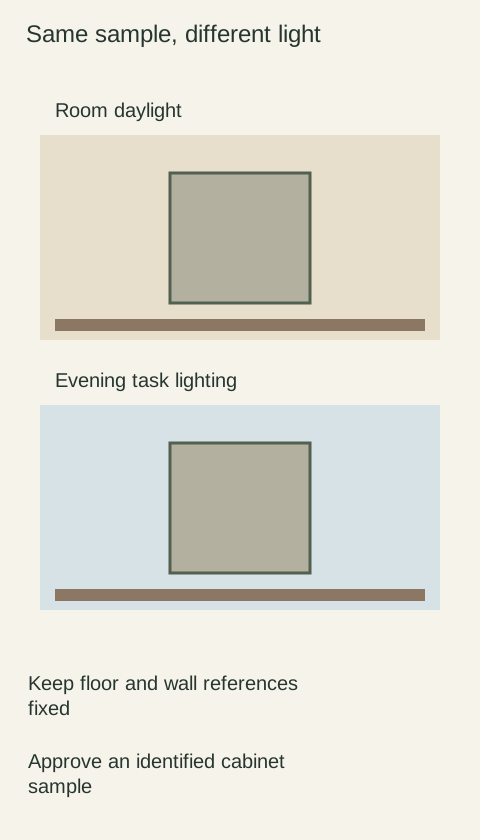
If the label matches but the product appears different, say that explicitly. Show the physical profile or affected surface alongside the relevant approved reference where useful. For a finish question, compare under consistent viewing conditions and explain any limits of the photographs. A phone image can help locate and describe the concern without becoming the sole proof of an exact color match. Identify whether the concern affects a particular component or appears across the inspected fronts; leave unexamined items out of that conclusion.
Determine whether the unexpected item replaced something
IKEA's US guidance distinguishes an additional item from an incorrect item received while an ordered item is missing. Apply that distinction before describing the cabinet order as complete or requesting a duplicate. An unexpected carton may be extra, while another situation may leave the correct cabinet still unreceived. The follow-up needs to reflect which situation the inventory supports.
Check the current shipment list and any separate deliveries, then identify what remains missing from the accepted order. Keep the wrong-looking item, the expected item and their respective labels separate in the report. Do not assume the supplier will infer that a cabinet of similar dimensions was intended as a substitute merely because it occupies the same place on the receiving list.
Describe a mismatch that can be reproduced
Imagine the order specifies a narrow frame profile in a named finish, but an arriving door has a visibly wider frame while its carton carries the expected finish description. A report showing the ordered profile, physical door and label makes the disagreement clear. Calling it only a color problem would direct attention away from the feature that actually differs.
Send the order reference, disputed component identity, accepted specification and observed difference together. For a finish concern, include the retained sample identity and relevant comparison images. Ask whether the supplier needs another view, a physical comparison or an item inspection before deciding the resolution. Keep uncertain appearance differences separate from a confirmed code or profile mismatch.
Resolve the item before changing its identity or condition
Avoid drilling, cutting, refinishing or installing the disputed component while the supplier is reviewing it. Keep the related packaging and status clearly marked for the installer. Do not exchange doors between cabinets just to make the shipment appear consistent; that can erase useful product-to-package relationships and create new uncertainty about what arrived where.
Confirm the specific resolution and its scope: which item is being corrected, what should happen to the received item and how the correct configuration will be identified on any later shipment. If accepting an alternative is proposed, review that as a separate project decision rather than assuming a substitution has already been agreed. Update the order record only after the arrangement is clear, then verify the actual corrected item on receipt.
Pure White
Cream White
Light Warm Gray
Gray
Navy
Black
Oak Tone
Dark Walnut Tone
Design study These finish studies are design references, not a list of currently orderable colors. Screens and lighting change the appearance; compare a physical sample before choosing.See all finish options →
The sample shows the door frame, a separate center panel, the face frame and the cabinet box. Each component has its own place in this Shaker construction.
Shaker construction: door frame, center panel, face frame and cabinet box. The cutaway helps locate these parts; confirm each material in the specifications for the selected cabinet.
01 / Door frame
The Shaker door has rails and stiles around a separate center panel. The frame and center panel are different components; confirm their materials in the specifications for the selected cabinet.
02 / Face frame
The face frame surrounds the opening at the front of the cabinet box and sits behind the doors. The face frame, door frame and cabinet box are separate parts.
03 / Cabinet box
The sample exposes the cabinet sides, interior surfaces and layered edges. The image does not establish the wood species or material specification of a selected cabinet.