An updated cabinet quote is comparable only when you know which revised requirements it covers. Build a matrix with each change down the side and each active bidder across the top. For every intersection, record whether the bidder received the change, understood the required scope and included it in the stated price. An email acknowledgment or a new quote date answers only part of that question.
Define exactly what the addendum changes
Give the addendum an identifier and list the baseline packet it modifies. Describe each addition, deletion or replacement using the existing location labels. Include the replacement drawing or schedule pages and identify the versions they supersede. If a finish changes only on the island, say so. A broad instruction to “use the new finish” can cause bidders to reprice different parts of the project while all believe they followed the same request.
Separate changed requirements from explanatory notes that leave scope unchanged. A clarification may confirm that a panel was already included, while an actual addition introduces a panel not previously requested. Ask the design coordinator to settle that distinction before collecting price responses. The worksheet should state the purchasing question without deciding contractual responsibility or inventing a right to a credit.
Record distribution without treating it as price acceptance
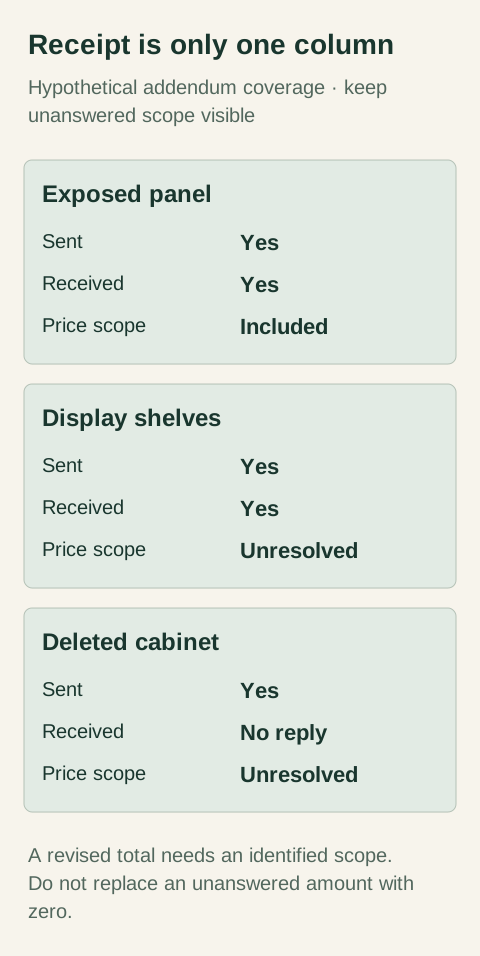
Diagram Hypothetical review record. Received, priced and unresolved are different states; this is not an actual bid comparison.
List the active bidders and the exact packet each received. Include later entrants who did not receive the original invitation. Keep the issued files available as a dated package rather than relying only on a mutable folder link. If the folder contents change again, the record should still explain what the bidder was asked to price at the time of its response.
Procore's documented bid-update workflow distinguishes updating the package from notifying existing bidders. That software example illustrates why a changed source folder is not enough by itself. Your team can maintain the same distinction with ordinary files and a spreadsheet; the guide does not require Procore or establish that a particular account has those features.
Use separate fields for sent, acknowledged and included in quote. “Received, thanks” confirms receipt. “We reviewed the panel change” indicates a response to the subject. “Our identified quote includes the specified panel at the listed locations” addresses coverage. Retain exceptions and unanswered questions beside that statement. Do not turn a general acknowledgment into a fully priced checkmark.
Ask for a row-level response
For each change, request the affected item description, the pricing treatment and any consequence for the rest of the package. The bidder may provide an added amount, a credit or a revised complete total. Record which it is. Do not add a change amount to a total that already incorporates it. When the quote is bundled, an inclusion statement can still establish scope even if the supplier declines to split its internal pricing.
Make “included without a separate adjustment,” “priced as a separate change,” “excluded” and “awaiting information” visibly different. An empty cell should not mean free or unchanged. Ask the bidder to state whether an unresolved item prevents a firm offer for the whole package or only leaves an identified line open. The comparison can show progress without pretending the remaining scope has been priced.
Test the apparent low price
In a hypothetical comparison, supplier A's baseline is $10000 and its confirmed added-panel change is $600, producing $10600 for the stated revised scope. Supplier B submits $10400 but excludes the newly required display shelves. B appears $200 lower, yet the shelf cost remains unknown. These invented amounts are an arithmetic lesson, not supplier quotes or usaKT.com pricing. No complete-scope winner can be named from this record.
Return the missing shelf question to B rather than assigning an assumed shelf allowance. If B cannot supply the shelves, record that exclusion and obtain an actual separate proposal before comparing combined scope. Check whether the separate purchase changes any connected requirement. Keep that alternative distinct from a supplier offering the complete package so the owner can weigh coordination as well as quoted amounts.
Preserve fairness without circulating another bidder's proposal
A question exposing an ambiguous common requirement should result in a shared clarification for all active bidders. A supplier's proprietary construction proposal or private pricing should remain within its own response. Rephrase the common requirement in project terms and issue it through the coordinator. The purpose is to keep the requested scope consistent, not to circulate one company's solution for competitors to copy.
If a bidder proposes a different product while answering the addendum, record it as an exception or alternate. Ask what original requirement it changes. Do not check the baseline row as included merely because a substitute occupies a similar space in the drawing. Technical acceptance of that substitute and the commercial comparison are separate decisions that need their own records.
Reconcile the final quote as a whole
After the matrix is complete, check the supplier's full revised quote against the accepted drawing and product list. A change response can be correct while the reissued quote accidentally retains a deleted cabinet or omits an unrelated item. Compare the final package, not just the visible changes. Keep the original offer and intermediate responses as history, with one unmistakable current comparison set.
State which addenda each final response includes and which exceptions remain. Preserve the offer's own validity and other commercial conditions without inventing uniform deadlines. If a late addendum arrives after selection, assess it against the selected supplier's current order state. The earlier bidding matrix remains useful history, but it does not establish that the supplier accepted a later order change.
Keep a reviewable decision record
The finished matrix should let another buyer explain why the quoted packages are comparable, which differences are deliberate and which amounts remain unknown. Name the reviewer and retain the referenced quotes. A colored cell is only a summary; the supporting response must be findable. That makes the selection defensible to the project team without claiming that the spreadsheet guarantees supplier performance.
Finish references
Pure White
Cream White
Light Warm Gray
Gray
Navy
Black
Oak Tone
Dark Walnut Tone
Design study These finish studies are design references, not a list of currently orderable colors. Screens and lighting change the appearance; compare a physical sample before choosing.See all finish options →
The sample shows the door frame, a separate center panel, the face frame and the cabinet box. Each component has its own place in this Shaker construction.
Shaker construction: door frame, center panel, face frame and cabinet box. The cutaway helps locate these parts; confirm each material in the specifications for the selected cabinet.
01 / Door frame
The Shaker door has rails and stiles around a separate center panel. The frame and center panel are different components; confirm their materials in the specifications for the selected cabinet.
02 / Face frame
The face frame surrounds the opening at the front of the cabinet box and sits behind the doors. The face frame, door frame and cabinet box are separate parts.
03 / Cabinet box
The sample exposes the cabinet sides, interior surfaces and layered edges. The image does not establish the wood species or material specification of a selected cabinet.