A useful cabinet request for quotation gives competing suppliers a shared description of the work and a clear way to disclose differences. It should identify the cabinet quantities, relevant drawings, selected finishes, required components and requested services. Ask each supplier to price that baseline and separately identify departures. Without a common starting point, a cheaper total may describe a smaller package or a different level of preparation rather than a lower price for the same work.
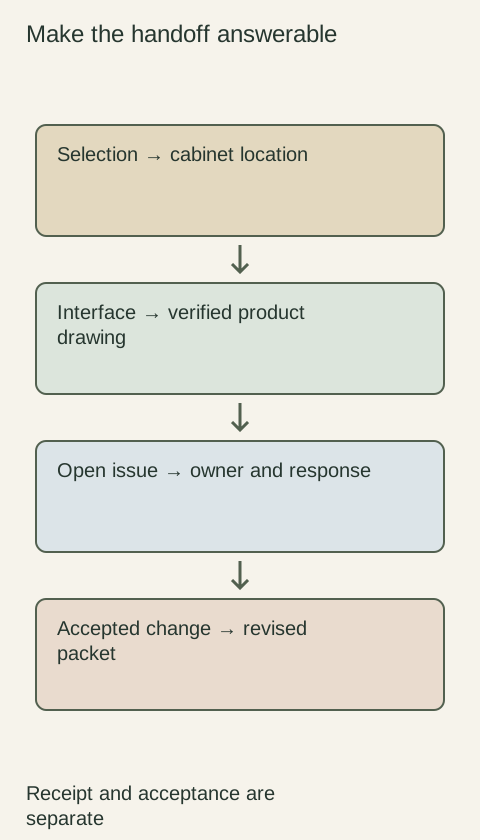
Diagram Use consistent inputs and a visible exception list. This workflow does not establish bid completeness or product approval.
Assemble a readable baseline package
Use a project identifier and an index of the files being issued. Include the cabinet schedule, relevant drawings and product requirements in formats the recipients can open. Mark which dimensions or selections are confirmed and which remain provisional. If your team has conflicting information, resolve it or identify the conflict explicitly instead of asking each bidder to choose an interpretation independently.
Designer Cabinets Online's quote request asks for a selected product line, door style and finish together with a cabinet list or legible detailed plan. That is a seller-specific example of the information needed to price a defined selection. Your package should add the particular requirements of your project; it need not imitate that seller's ordering process.
Give each requested item a stable project label and a stated quantity. Include the panels, fillers, trim and hardware that belong in the requested supply scope, rather than relying on a phrase such as complete cabinetry to explain every finishing piece. Identify whether a component is supplied loose, included in another assembly or excluded for procurement elsewhere.
If suppliers use different catalog systems, let them propose their corresponding product codes while retaining your project labels. Ask them to explain any size or construction difference rather than silently selecting the nearest item. A bid can remain useful even when an exact match is unavailable, provided the exception is clear and does not disappear into the quoted total.
Define the service endpoints being priced
State the requested assembly condition, delivery destination and scope of any separately requested work. Describe the known receiving conditions and ask suppliers to list assumptions requiring confirmation. If installation is outside the inquiry, say who is expected to review product suitability for that later work. Do not assume every supplier includes design review, assembly or receiving coordination in a product price.
Request separate identification of included, excluded and unresolved services. Imagine a supplier prices assembled cabinets delivered to the stated receiving point, while another prices unassembled products with transportation still undetermined. Both may be legitimate offers, but the buyer needs the remaining work and cost clarified before treating their totals as comparable. A shared response format exposes that difference early.
Distribute clarifications to every active bidder
Assign a contact for questions and keep a record of answers that change the common scope. When a supplier discovers an omitted panel or ambiguous finish description, resolve the issue and issue the clarification to all active recipients. Confirm which package each supplier used for its response. Individual conversations should not quietly create different versions of the same purchasing exercise.
Keep a supplier's proprietary proposal separate from a project clarification. You can tell the group that a required panel has been added without circulating another company's pricing or confidential fabrication solution. If a revised requirement materially changes the work, ask bidders to update their responses against that change instead of comparing a new-scope offer with an older one.
Evaluate response completeness before ranking totals
Build a comparison record that follows the requested items and services. For each response, mark whether the baseline is covered, an exception is offered or an answer is missing. Do not enter zero for an unpriced item; show it as unresolved until the supplier responds. Keep optional proposals separate so an attractive alternative does not replace the baseline unnoticed.
Before selecting a supplier, return a concise list of remaining differences for confirmation and retain the resulting answers with the quote. The inquiry establishes a comparison basis; it is not itself the final product approval or release to production. Its success is a purchasing decision whose scope everyone can explain, including what remains to be resolved before the order is accepted.
Pure White
Cream White
Light Warm Gray
Gray
Navy
Black
Oak Tone
Dark Walnut Tone
Design study These finish studies are design references, not a list of currently orderable colors. Screens and lighting change the appearance; compare a physical sample before choosing.See all finish options →
Translate the design into identifiable products, details and responsibilities. A useful handoff lets another professional price and build the intended arrangement without reconstructing private conversations.
The sample shows the door frame, a separate center panel, the face frame and the cabinet box. Each component has its own place in this Shaker construction.
Shaker construction: door frame, center panel, face frame and cabinet box. The cutaway helps locate these parts; confirm each material in the specifications for the selected cabinet.
01 / Door frame
The Shaker door has rails and stiles around a separate center panel. The frame and center panel are different components; confirm their materials in the specifications for the selected cabinet.
02 / Face frame
The face frame surrounds the opening at the front of the cabinet box and sits behind the doors. The face frame, door frame and cabinet box are separate parts.
03 / Cabinet box
The sample exposes the cabinet sides, interior surfaces and layered edges. The image does not establish the wood species or material specification of a selected cabinet.