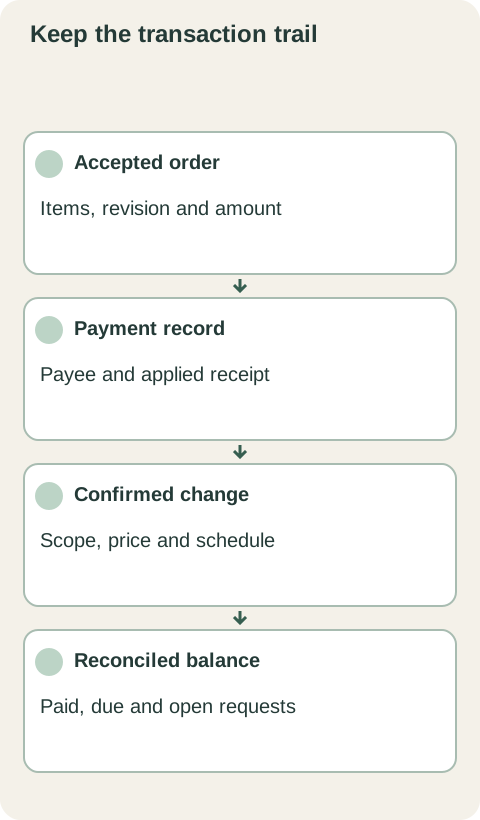
When a seller agrees to consider a cabinet return, ask for the calculation behind the expected refund. The original product price is not necessarily the amount that will come back, and the refund itself does not describe the full cost of reversing the purchase. Build the calculation from the accepted items and actual charges, then mark anything still subject to inspection or a freight quote. Do not assume a return is possible merely because you can estimate its cost.
Diagram Track the refund separately from costs paid directly and from a replacement order; the article’s dollar example is fictional arithmetic.
Establish the product amount being credited
Identify the exact items covered by the accepted arrangement and the merchandise amount the seller will use. For a partial order, do not start from the entire invoice. Ask how discounts are reflected in the credited amount and what remains undecided until the returned goods are reviewed. Keep a confirmed calculation basis separate from a hoped-for refund of the original list price.
HomeCabinets' FAQ treats restocking, return shipping and original outbound charges as distinct categories in its return process. That illustrates why they should be reviewed separately; its terms are not a universal schedule for other sellers. Use the actual response for your purchase.
Ask whether a restocking charge is fixed or calculated from a specified amount. If it is percentage-based, confirm the base rather than applying the percentage to an unrelated order total. Request the expected return freight separately and clarify whether the seller will deduct it from the credit or you will pay the carrier directly. Those payment paths change how the refund line is presented.
Check any original delivery or handling amount that will not be refunded, and any outbound-freight deduction the seller says applies. Keep already-paid costs visible without subtracting them twice. If a shipping charge is still unknown, label it pending instead of treating it as nothing. A refund estimate with an unresolved transport cost is incomplete even when its merchandise arithmetic is correct.
Work through a clearly hypothetical example
Suppose eligible merchandise cost 1000 dollars and nonrefunded original freight cost 90 dollars, for an original outlay of 1090 dollars. Assume the agreed return deducts 200 dollars for restocking and 120 dollars for return freight from the merchandise credit. The estimated refund is 680 dollars. The difference between the original outlay and that refund is 410 dollars. These are invented teaching amounts, not a seller quote or fee schedule.
In that example, return freight has already been deducted from the refund. Adding it again to the difference between the original payment and the refund would count the same cost twice. If instead you pay return freight separately, show that payment separately and calculate the seller's refund without deducting it there again. Keep the accounting path consistent with what the parties will actually do.
Separate the return from the replacement purchase
If the project still needs a different cabinet, obtain that new purchase's quote independently. It may include its own delivery, handling or installation changes. Do not assume a new order carries the old promotion, shipping arrangement or schedule. A credit proposal against another purchase also needs a clear amount and application, rather than an informal promise that the seller will take care of it.
Compare the project consequences as well as the product correction. Ask the installer about any changed visit or work scope, and identify storage or handling that must be arranged while the return is processed. Include only real, applicable estimates in the comparison. Keep these project costs outside the merchandise refund arithmetic so it remains clear which business is charging each amount.
Reconcile the estimate with the final result
Before shipping, retain the accepted item list and cost explanation, noting which figures are estimates and what could change them. After receipt and review, ask for the final credit breakdown and compare it with that record. If a deduction differs, request its basis rather than guessing from the smaller total. Match any separate carrier payment to the appropriate transport record.
Close the calculation only after the relevant amounts are known and the resulting payment or credit is confirmed. A proposed refund, a credit issued by the seller and funds received are different stages. This approach makes the return decision understandable: what product value is recognized, what costs remain and what additional purchase or work the project still requires.
Pure White
Cream White
Light Warm Gray
Gray
Navy
Black
Oak Tone
Dark Walnut Tone
Design study These finish studies are design references, not a list of currently orderable colors. Screens and lighting change the appearance; compare a physical sample before choosing.See all finish options →
The sample shows the door frame, a separate center panel, the face frame and the cabinet box. Each component has its own place in this Shaker construction.
Shaker construction: door frame, center panel, face frame and cabinet box. The cutaway helps locate these parts; confirm each material in the specifications for the selected cabinet.
01 / Door frame
The Shaker door has rails and stiles around a separate center panel. The frame and center panel are different components; confirm their materials in the specifications for the selected cabinet.
02 / Face frame
The face frame surrounds the opening at the front of the cabinet box and sits behind the doors. The face frame, door frame and cabinet box are separate parts.
03 / Cabinet box
The sample exposes the cabinet sides, interior surfaces and layered edges. The image does not establish the wood species or material specification of a selected cabinet.