Recycled content in cabinets: what is the percentage based on?
A board, its wood portion and a finished cabinet have different totals. Check what a recycled-content percentage actually counts before comparing products.
A recycled-content percentage is incomplete without the material it describes. It may refer to one board, the wood fraction within that board, or a broader product. None of those necessarily describes the finished cabinet sitting in your kitchen. Before comparing percentages, find the sentence that names the covered material and the basis of calculation. Otherwise, two impressive-looking numbers can answer different questions.
Find the total behind the percentage
Start with the wording around the number. Is it a proportion by mass? Does it include the whole panel or only certain ingredients? Does the statement cover one component or the entire product? Keep those distinctions in your notes. Removing them to make a shorter comparison can change the meaning of the claim.
For a hypothetical calculation, assume a panel weighs 10 pounds and its documented recycled portion is 40% of the entire panel by mass. That would mean 4 pounds of recycled material in that panel. Now assume a finished assembly weighs 20 pounds and contains that panel. Those 4 pounds account for 20% of the assembly by mass. This is arithmetic for these assumptions, not a cabinet specification.
That calculation still does not determine the assembly’s total recycled content. Other parts might contain recycled material, or they might not; their contribution is unknown. If the original percentage applies only to the wood fraction rather than the whole panel, even the first calculation needs another input. Do not multiply a percentage by a total that the statement never covered.
Follow the material through the cabinet
Ask which component uses the described board: sides, bottom, shelves, back or a door panel. Check whether it is standard for the quoted line, an option, or used only in particular sizes. A brochure covering a supplier’s wider panel range does not establish which board is in your cabinet selection.
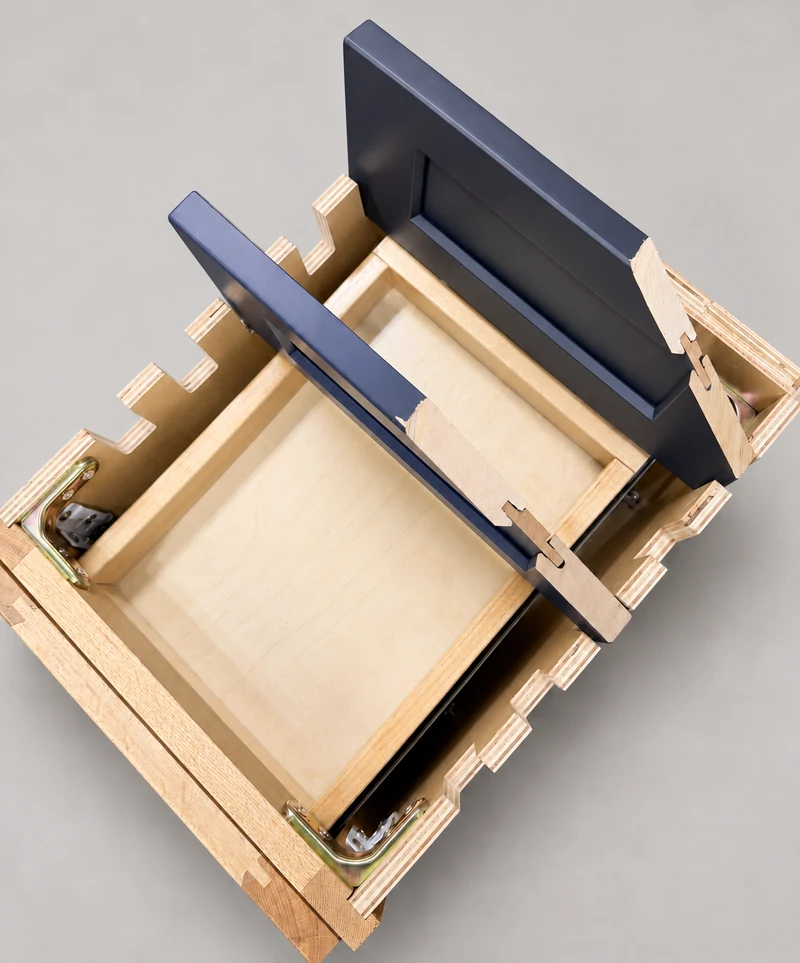
Physical sample Different components are visible in this sample. Their recycled content cannot be identified from appearance.
A useful response connects the material statement to a named cabinet configuration. If the quote changes to a different box option or door construction, ask whether the same information still applies. Keep the original document as well as the explanation connecting it to the quote. A similar finish or identical exterior shape is not enough to establish the same composition.
Compare like scopes before comparing numbers
Suppose one supplier provides a figure for its board and another supplies a figure for packaging. Both may be useful, but they describe different purchases within the delivery. Separate them. Do not declare the second cabinet better or worse because its packaging number is larger or smaller than a board number.
Also read any definitions that distinguish types of recovered material. If the documents use different categories or calculation boundaries, ask for clarification rather than combining the figures. A missing whole-cabinet value is missing information, not a zero. You can retain the documented component fact without inventing a total.
Use the information for the question it answers
Recycled content describes an aspect of material composition. By itself, it does not tell you shelf capacity, moisture performance, finish durability or repairability. Ask those questions separately through the appropriate specifications. A board can carry a meaningful material-content statement while still needing an ordinary evaluation for the part and conditions in which it will be used.
For the buying record, save the claim wording, covered material, calculation basis, document version and connection to the selected cabinet. Then write the conclusion narrowly: the identified component has the stated documented content. That is more useful than attaching a general environmental score to a kitchen whose other materials and project choices have not been evaluated.
Pure White
Cream White
Light Warm Gray
Gray
Navy
Black
Oak Tone
Dark Walnut Tone
Design study These finish studies are design references, not a list of currently orderable colors. Screens and lighting change the appearance; compare a physical sample before choosing.See all finish options →
A statement about packaging, a panel or a factory may be useful without describing the whole cabinet. Connect each claim to the product and decision it covers.
A room view shows the design. Open-door, drawer and edge views answer different questions. Ask for the missing angle that could change your cabinet selection.
The sample shows the door frame, a separate center panel, the face frame and the cabinet box. Each component has its own place in this Shaker construction.
Shaker construction: door frame, center panel, face frame and cabinet box. The cutaway helps locate these parts; confirm each material in the specifications for the selected cabinet.
01 / Door frame
The Shaker door has rails and stiles around a separate center panel. The frame and center panel are different components; confirm their materials in the specifications for the selected cabinet.
02 / Face frame
The face frame surrounds the opening at the front of the cabinet box and sits behind the doors. The face frame, door frame and cabinet box are separate parts.
03 / Cabinet box
The sample exposes the cabinet sides, interior surfaces and layered edges. The image does not establish the wood species or material specification of a selected cabinet.