A room view shows the design. Open-door, drawer and edge views answer different questions. Ask for the missing angle that could change your cabinet selection.
An attractive kitchen photo can show color relationships and the overall arrangement while leaving the actual cabinet selection unclear. Before ordering, ask for images that answer the questions still affecting the order. The goal is not a large photo folder. It is a small set of identifiable views that shows the relevant cabinet configuration and makes the remaining need for drawings or specifications clear.
Establish what is actually pictured
Ask whether the photo shows the quoted cabinet line, door style and construction option. A room image can contain custom panels, decorative trim or hardware that is not part of the standard cabinet package. A photo from another project may illustrate a design idea without documenting your order. Keep that difference visible when you save the image.
For example, if an island has an attractive paneled back, ask which parts create it. A wide room view cannot tell you whether the panels are included, applied separately or built for that particular installation. Request the corresponding panel view and order description. Otherwise, you may select the cabinet boxes correctly and still misunderstand what finishes the side facing the living room.
Request open views for interior decisions
For a door cabinet, an open view should show the opening, shelf arrangement and any interior obstruction relevant to the intended use. For a drawer, ask for a view with the drawer extended enough to see the actual box and its relationship to the front. A tall exterior drawer face does not show usable interior height, and a closed door says little about the opening behind it.
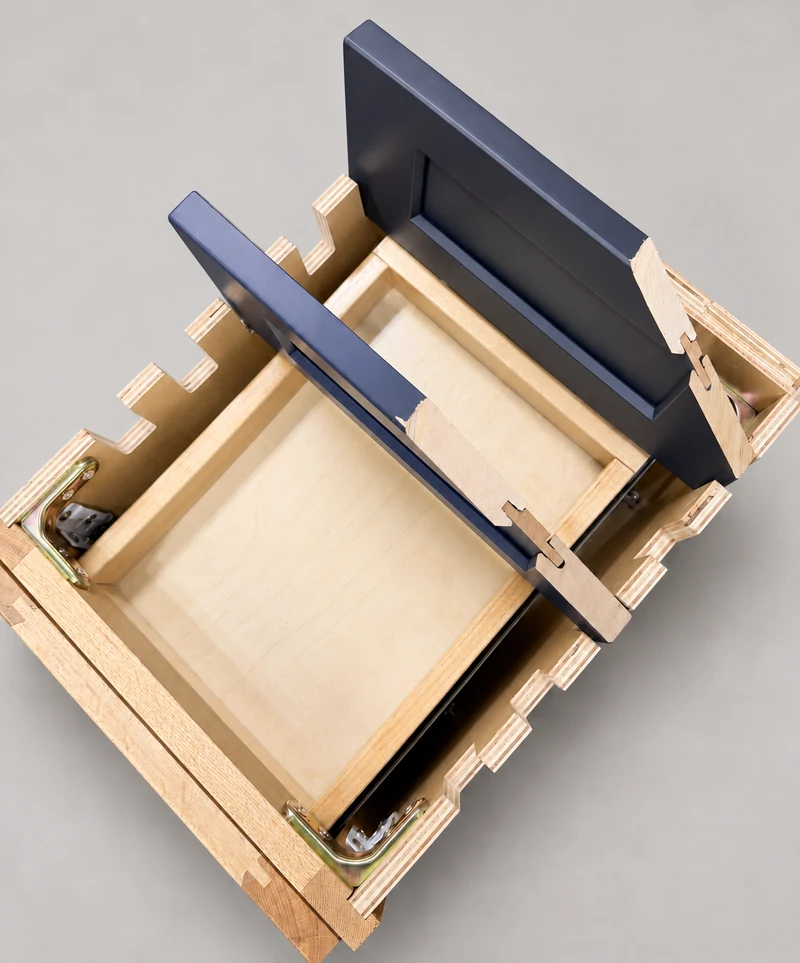
Physical sample This cutaway shows component relationships that a closed room view cannot. It is not a measured specification for every cabinet.
If you are choosing around a particular bin or appliance, photographs help locate what to measure; they do not replace the measurement. Ask for the clear opening and interior dimensions on a drawing or in a written response. A ruler at the front of an image does not reliably measure depth farther back because the perspective changes across the photo.
Check the parts visible from the room
List the ends and transitions the room exposes: an end of a cabinet run, the back of an island, a tall cabinet beside an open doorway, or the edge beside an appliance. Ask for the relevant finished-side and trim details. The showroom’s viewing angle may hide a surface that will be prominent in your home.
Use a close-up for the edge treatment and a wider view for its location. Either view alone can be misleading. A perfectly photographed trim detail might belong to a different door line; a distant room image may conceal the joint you are trying to understand. Have the supplier identify the parts in relation to the same quoted configuration.
Turn missing coverage into a specific request
Instead of asking for more pictures, name the decision: whether the selected drawer accommodates the organizer, how the exposed end is finished, or which panel covers the island back. Then request the view and specification needed to answer it. If an actual photo is unavailable, a labeled construction drawing can be more informative than an unrelated installation picture.
Keep unresolved items separate from what the images establish. Photographs cannot prove material species, load ratings, current availability or an exact color under your lighting. Save the image identification with the related drawing and quote revision. Once the open question is answered, update the selection rather than allowing a visually similar photograph to remain the only record of what you expect to receive.
Pure White
Cream White
Light Warm Gray
Gray
Navy
Black
Oak Tone
Dark Walnut Tone
Design study These finish studies are design references, not a list of currently orderable colors. Screens and lighting change the appearance; compare a physical sample before choosing.See all finish options →
A board, its wood portion and a finished cabinet have different totals. Check what a recycled-content percentage actually counts before comparing products.
Read what happens after a covered problem: which part is supplied, who handles the work and what access is required. The headline term cannot answer those questions.
The sample shows the door frame, a separate center panel, the face frame and the cabinet box. Each component has its own place in this Shaker construction.
Shaker construction: door frame, center panel, face frame and cabinet box. The cutaway helps locate these parts; confirm each material in the specifications for the selected cabinet.
01 / Door frame
The Shaker door has rails and stiles around a separate center panel. The frame and center panel are different components; confirm their materials in the specifications for the selected cabinet.
02 / Face frame
The face frame surrounds the opening at the front of the cabinet box and sits behind the doors. The face frame, door frame and cabinet box are separate parts.
03 / Cabinet box
The sample exposes the cabinet sides, interior surfaces and layered edges. The image does not establish the wood species or material specification of a selected cabinet.