What does a sustainable-cabinet claim actually describe?
A statement about packaging, a panel or a factory may be useful without describing the whole cabinet. Connect each claim to the product and decision it covers.
When a cabinet is described as sustainable, ask which part of the purchase that description addresses. It might concern material sourcing, a particular panel, packaging, manufacturing or the product’s documented environmental impacts. Those are different questions. A useful answer identifies the attribute and the item it applies to, so you can decide whether it addresses your own priority rather than treating the word as a complete product specification.
Replace the broad adjective with a specific question
If your priority is material reuse, ask for information about the relevant material content. If you want to understand environmental impacts, request the applicable product documentation. If reducing replacement is the priority, examine the available parts and practical repair scope. These questions may lead to different evidence; an attractive wood grain or natural-looking color cannot answer them.
For example, a statement about recyclable packaging can be useful when planning disposal of the delivery materials. It does not establish the cabinet’s material composition or explain what can be done with the cabinet at the end of its use. Keep the packaging statement attached to packaging, then ask a separate question about the product. This preserves useful information without extending it beyond what was said.
Identify what the document measures
UL Solutions describes an environmental product declaration, or EPD, as reporting life-cycle assessment information. It also explains the role of product-specific calculation rules. Read the declared product and scope before using such a document to compare cabinet choices.
Record the product name, represented variants, publication information and the stated boundaries. A document about a panel is not automatically a document about a finished cabinet assembled with hardware and other parts. Likewise, a company-wide report does not by itself identify the exact selection in a quote. Ask the supplier to connect the document to that selection rather than sending an unrelated library of certificates.
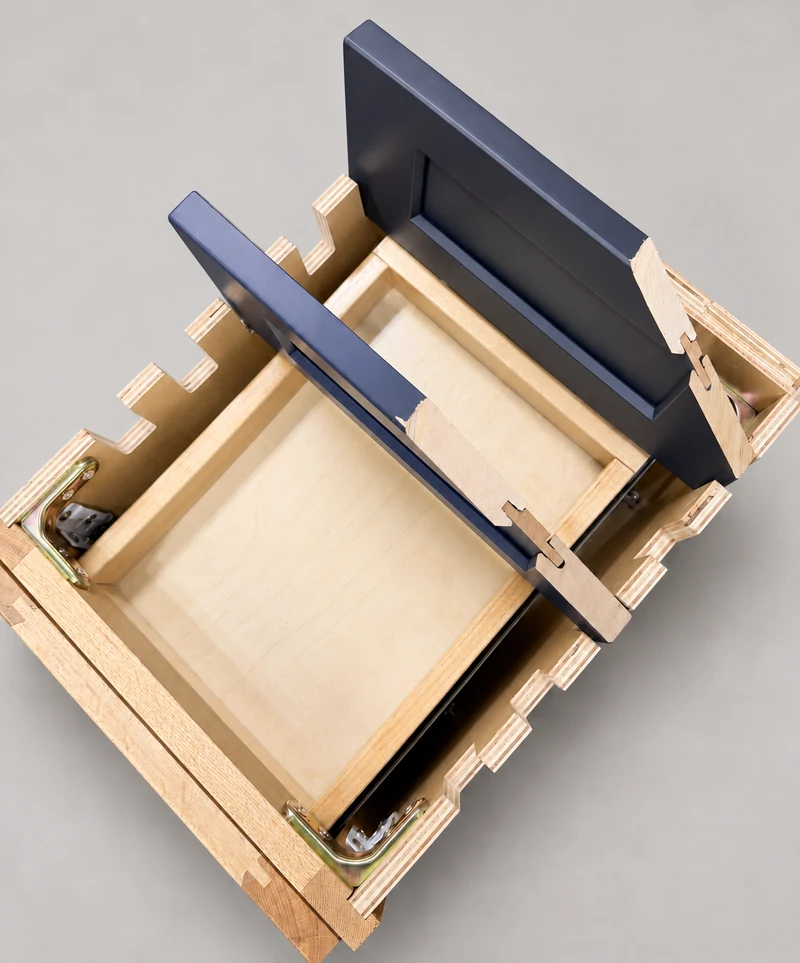
Physical sample The cutaway makes separate components visible. A photograph cannot establish environmental attributes, recycled content or certification for any of them.
Compare matching questions, not unmatched badges
Suppose one option has information about its packaging and another has a declaration for a board used in the box. Neither document directly answers the same question as the other. Do not award an overall winner by counting logos. Identify the attribute that matters to the project and ask both suppliers for evidence that addresses that attribute at a comparable scope.
If the documents use different product boundaries or assumptions, keep the comparison limited or ask a qualified specialist to interpret it. Missing information should remain missing, not become a zero score. A narrower, well-supported statement can be more useful than an expansive claim whose relationship to the selected cabinet is unclear.
Keep the evidence attached to the selected cabinet
Save the exact model, finish and construction selection alongside the document that supports the particular statement. If the product or component changes during quoting, check whether the evidence still applies. Similar appearance does not establish identical sourcing or manufacturing. A revised cabinet list may therefore require a revised answer even when the room’s color scheme stays the same.
Use the result as part of the cabinet decision alongside fit, storage, care and available service. The goal is a purchase you can describe accurately: this documented attribute applies to this identified item. Avoid turning a useful component fact into a promise about every part of the room, or asking a broad sustainability label to replace the product details you still need.
Pure White
Cream White
Light Warm Gray
Gray
Navy
Black
Oak Tone
Dark Walnut Tone
Design study These finish studies are design references, not a list of currently orderable colors. Screens and lighting change the appearance; compare a physical sample before choosing.See all finish options →
A board, its wood portion and a finished cabinet have different totals. Check what a recycled-content percentage actually counts before comparing products.
The sample shows the door frame, a separate center panel, the face frame and the cabinet box. Each component has its own place in this Shaker construction.
Shaker construction: door frame, center panel, face frame and cabinet box. The cutaway helps locate these parts; confirm each material in the specifications for the selected cabinet.
01 / Door frame
The Shaker door has rails and stiles around a separate center panel. The frame and center panel are different components; confirm their materials in the specifications for the selected cabinet.
02 / Face frame
The face frame surrounds the opening at the front of the cabinet box and sits behind the doors. The face frame, door frame and cabinet box are separate parts.
03 / Cabinet box
The sample exposes the cabinet sides, interior surfaces and layered edges. The image does not establish the wood species or material specification of a selected cabinet.