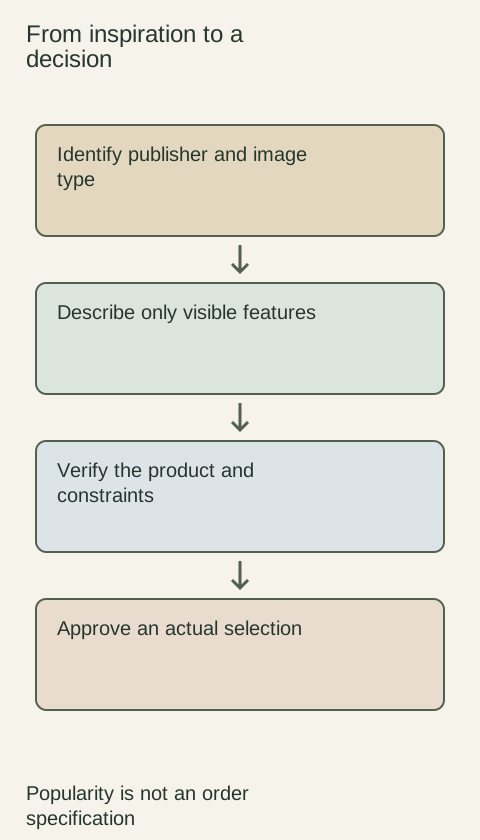
A manufacturer catalog, such as Dura Supreme's door catalog, can identify the categories and products it lists. A planning source, such as Blum's services, can lead to specifications for an identified mechanism. Neither source establishes what every cabinet seller carries. Begin a research note with the original publisher, publication or update date where supplied, and the exact product or project being described.
Separate an editorial opinion, an advertisement, a manufacturer announcement, a completed project and a computer-generated rendering. Each can be useful for a different purpose. A rendering may explain a color relationship but cannot prove completed installation quality. A launch announcement identifies a proposed offering, not local stock or a delivery commitment.
Turn the picture into observable features
Describe what you can actually see: narrow door frames, a continuous wood-grain field, open display storage or a concealed grip. Do not infer wood species, core material, fastening or load performance from appearance. Even “handleless” needs closer identification because a recessed grip and touch-open hardware produce different use patterns.
Save the original caption and credit with the image link. Record which detail interests you and which remains unknown. “I like the shadow around this raised center” is useful. “This is premium solid oak with invisible hinges” is unsupported unless the source identifies those materials and parts. If the origin is missing, retain the image as inspiration rather than quietly upgrading it into a product specification.
Diagram Illustrative diagram; not a product specification.
Read a news claim with its scope intact
Check whether the claim describes an actual released product, a preview, a survey or a designer's preference. Look for the underlying publication and its method. A survey needs its respondent group and question before its headline becomes useful. Do not convert a sample of professionals into a prediction of what every household wants.
Compare dates and product status without fabricating freshness. A current page can show an older project, and a republished photograph can make a long-standing style appear new. This guide does not report a current market ranking. When researching a specific development, return to the original manufacturer's dated announcement and present availability separately.
Test the idea in your room
Write a short brief using the feature you liked, its practical consequence and a way to evaluate it. For an illustrative example: “I like a continuous slab island face; compare a physical finish sample and show where the grip goes.” That creates a decision you can test without copying a whole photographed kitchen.
Draw the detail against your room's dimensions, appliances and storage needs. Check whether a beautiful open shelf would hold your actual dishes or simply add visible clutter. An oversized pull in a wide photographed kitchen may project into your narrower route. The purpose is to discover what the idea costs in space and daily use, not to reproduce the camera angle.
Use a shortlist with reasons to reject
For each idea, record the original link, visible feature, confirmed product information, unknowns, sample needed and effect on budget or cleaning. Keep a rejection reason too. An idea that needs unavailable access space or a finish you dislike under evening light should leave the shortlist even if the photograph is popular.
Ask the prospective supplier to respond to the feature and identified requirements rather than to promise a generic trend. A useful answer names the offered product and shows the matching documentation. If a substitute changes the profile, operating method or material, review that change as a new selection.
Carry only confirmed decisions into the order
Keep inspiration images apart from the approved product schedule. Link each accepted idea to an actual door, finish, hardware arrangement or drawing detail. Mark unresolved choices explicitly. If you plan to publish project images, obtain the necessary rights rather than treating a saved image as permission to reuse it. Your finished brief should say what the room needs and how the selected parts deliver it; a trend label is optional.
Use a source card rather than a saved image alone
A useful source card includes the original link, image credit, source type, date supplied by the publisher, visible feature and the question it creates for your project. Add a product link only when the publisher identifies that product.
Record whether the item has been checked against a current manufacturer specification and a physical sample.
This makes a research folder usable by another person and prevents an attractive but unidentified image from becoming a purchase instruction. Refresh a dated claim when it matters to the decision instead of rewriting it as timeless fact.
Finish references
Pure White
Cream White
Light Warm Gray
Gray
Navy
Black
Oak Tone
Dark Walnut Tone
Design study Design references only. The finish studies do not establish actual material, color matching or availability. Compare the selected physical sample.See all finish options →
The quarter’s current-activity and near-term readings pointed in different directions. For cabinet businesses, that distinction matters when choosing between preparing for demand and committing to additional inventory.
The new furniture program creates another way to coordinate a room. Compare a complete freestanding piece with a fitted cabinet proposal before expanding a cabinet order.
A new brand destination does not necessarily mean a new cabinet model. Read the Robern–Kallista transition through the actual selected product and the terms that apply to its purchase, rather than treating every announced change as already effective.
The sample shows the door frame, a separate center panel, the face frame and the cabinet box. Each component has its own place in this Shaker construction.
Shaker construction: door frame, center panel, face frame and cabinet box. The cutaway helps locate these parts; confirm each material in the specifications for the selected cabinet.
01 / Door frame
The Shaker door has rails and stiles around a separate center panel. The frame and center panel are different components; confirm their materials in the specifications for the selected cabinet.
02 / Face frame
The face frame surrounds the opening at the front of the cabinet box and sits behind the doors. The face frame, door frame and cabinet box are separate parts.
03 / Cabinet box
The sample exposes the cabinet sides, interior surfaces and layered edges. The image does not establish the wood species or material specification of a selected cabinet.