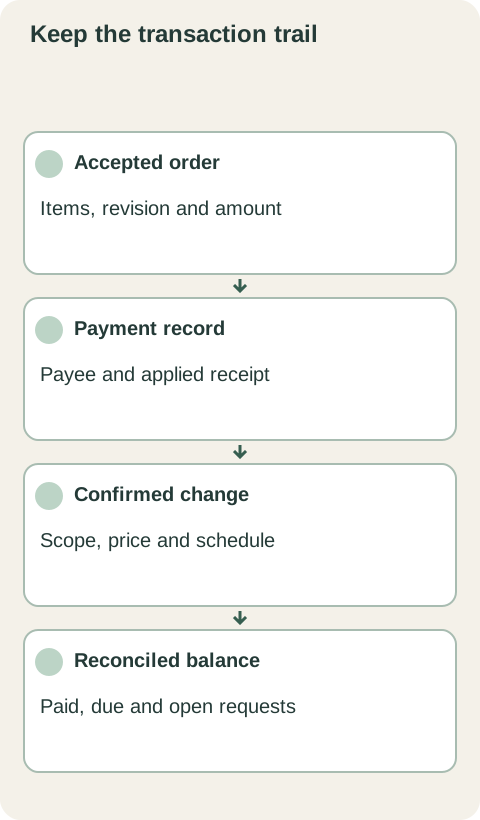
When a cabinet invoice is revised or divided into separate shipments, an earlier deposit can become hard to follow. Build a payment-application record that connects each successful payment to the seller's current invoice and remaining balance. The immediate question is not simply whether you have paid, but whether the seller has credited that payment to the bill now in front of you.
Diagram Trace each applied deposit across current invoice records; the diagram does not identify a payment provider or prove shipment.
Identify the documents that describe the same purchase
Collect the accepted order, its original invoice and every replacement or additional invoice. Ask the seller which documents are active. A revised invoice may replace an earlier bill, while a supplemental invoice may add a new charge. The presence of another invoice number does not, by itself, tell you to add both totals together or pay another deposit.
Label the relationship in your record: replacement, additional item, separately billed shipment or another arrangement the seller confirms. Preserve the old document as history rather than counting it as another active obligation. Keep quote totals out of the invoice total unless the seller identifies them as the same billing document. This establishes what is actually being reconciled before reviewing any payment.
Give each payment its own identifiable entry
For every transaction, record its reference, date, amount, recipient and status. Keep the payment receipt distinct from the invoice to which it was applied. An attempted payment, a pending transaction and a successful payment should not all appear as completed funds. If a payment appears twice in downloaded records, compare its reference before counting it as another payment.
Stripe documents partial invoice payments by updating the amount paid and amount remaining after a successful transaction. That distinction supports checking applied funds against a particular bill; it does not identify the payment provider or arrangement used by any cabinet seller. Ask your seller for the equivalent payment-application information.
If cabinets and delayed trim are billed separately, ask whether the original deposit remains against the main invoice, is divided between invoices or is handled another stated way. Obtain the seller's allocation rather than spreading it yourself. Mark which invoice receives each applied amount, while retaining the original transaction reference so the same deposit is not counted more than once.
Imagine a deposit was paid for the accepted cabinet package, then the seller issues separate cabinet and trim invoices. Both new documents display deposit due, but neither shows the earlier payment. Do not assume either a duplicate charge or a lost payment. Ask the seller to explain and correct the application record before treating those displayed requests as a reconciled amount due.
Separate a new charge from a transferred payment
An added end panel can increase the order price, whereas moving a recorded deposit between invoices only changes its application. Request separate descriptions for these events. If a new invoice repeats the full product total, ask whether it replaces the old invoice or is merely restating the package before showing the balance. Do not infer the answer from the document's title alone.
Track a proposed credit, an approved adjustment and an applied adjustment separately. A discussion about a missing item does not automatically reduce the current invoice. Likewise, a refund leaving the seller's account and a credit reducing an unpaid balance are different movements. Record the seller-confirmed treatment and its supporting reference without assuming a refund entitlement or a standard processing period.
Reconcile at each stated payment milestone
Ask the seller for a current statement that shows active charges, confirmed adjustments, applied payments and remaining balance. Compare that statement with your record across all active invoices for the order. If an amount is unapplied or appears twice, identify the exact transaction and invoice rather than sending a general complaint that the total looks wrong. Leave the discrepancy open until explained.
Then connect the next requested payment to the agreed milestone and the reconciled balance. A receipt does not prove production or shipment, and this guide sets no required deposit percentage. Keep the separate milestone confirmation with the request. At completion, retain the final statement and document relationships so a later parts purchase does not accidentally reopen a settled cabinet invoice.
Pure White
Cream White
Light Warm Gray
Gray
Navy
Black
Oak Tone
Dark Walnut Tone
Design study These finish studies are design references, not a list of currently orderable colors. Screens and lighting change the appearance; compare a physical sample before choosing.See all finish options →
The sample shows the door frame, a separate center panel, the face frame and the cabinet box. Each component has its own place in this Shaker construction.
Shaker construction: door frame, center panel, face frame and cabinet box. The cutaway helps locate these parts; confirm each material in the specifications for the selected cabinet.
01 / Door frame
The Shaker door has rails and stiles around a separate center panel. The frame and center panel are different components; confirm their materials in the specifications for the selected cabinet.
02 / Face frame
The face frame surrounds the opening at the front of the cabinet box and sits behind the doors. The face frame, door frame and cabinet box are separate parts.
03 / Cabinet box
The sample exposes the cabinet sides, interior surfaces and layered edges. The image does not establish the wood species or material specification of a selected cabinet.